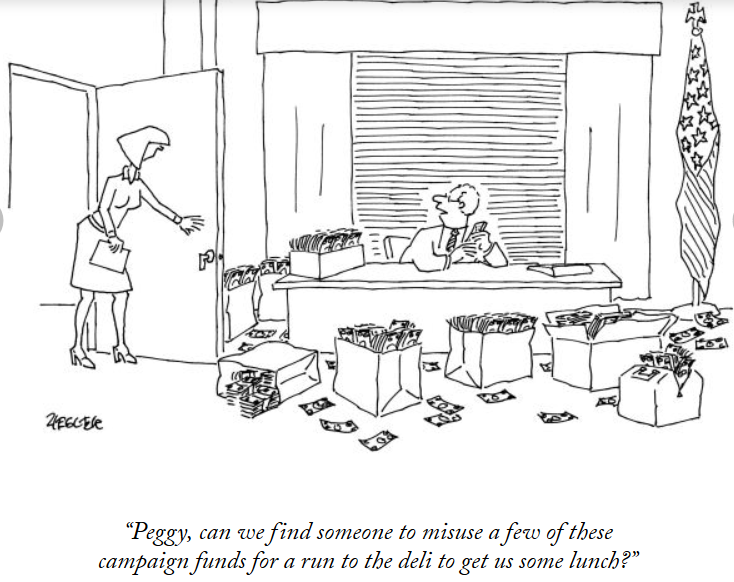
Peggy, can we find someone to misuse some of these campaign funds for a run to the deli to get us some lunch?
Vote buying, in different forms and disguises, is common all over the world. It also has a long tradition in Thailand’s elections. Banharn Silpa-Arche, Prime Minister from 1995 to 1996 and successful in the booming construction business of this era, even earned the nickname “Mr Automatic Teller Machine” with his vote buying. The following Fulcrum article by Daungyewa (Hong) Utarasintfrom the ISEAS Jusof Ishak Institute in Singapore describes the current practices in Thailand’s deep south. Ever rising “tariffs” and religious undercurrents form a strange mélange in the political culture. The interesting question is whether this historical burden might be overcome with the success of a new generation movement like the Move Forward Party, which is rejecting it. Vote buying with up to three thousand baht per vote(r) in 2023 is adding to the financial needs of the competing parties which may trigger more corruption.
Religion can be an important feature in attracting voters to a political party. Western Europe had strong Christian parties in the second half of the 20th century. In Italy, the Democrazia Christiana (DC), played a leading role in postwar Italy and the European integration until it lost its influence in the 1990 and was disbanded in 1994. In Germany, the Christian Democratic Party (CDU) is still the biggest party in the Federal Parliament today, though in opposition. The “C” (for Christian) in its name is often questioned, and it certainly does not imply a major influence of the Catholic and Protestant churches which struggle with shrinking membership already for years. For the American Republicans, the picture is different. According to a Statista survey for the years 2021 to 2023, a total of 56 per cent of the members identify themselves as Protestant and 25 per cent as Catholic. It would be difficult, though, to pinpoint the religious influence in political decisions and the legislation. Whether this can be said for the Islamic parties in Southeast Asia is a matter of perception and debate. The following article about Malaysia’s PAS party, published by the Straits Times in Singapore, gives some interesting insights.
The rise of the non-clerics in Malaysia’s Islamist PAS party
The Straits Times, Singapore
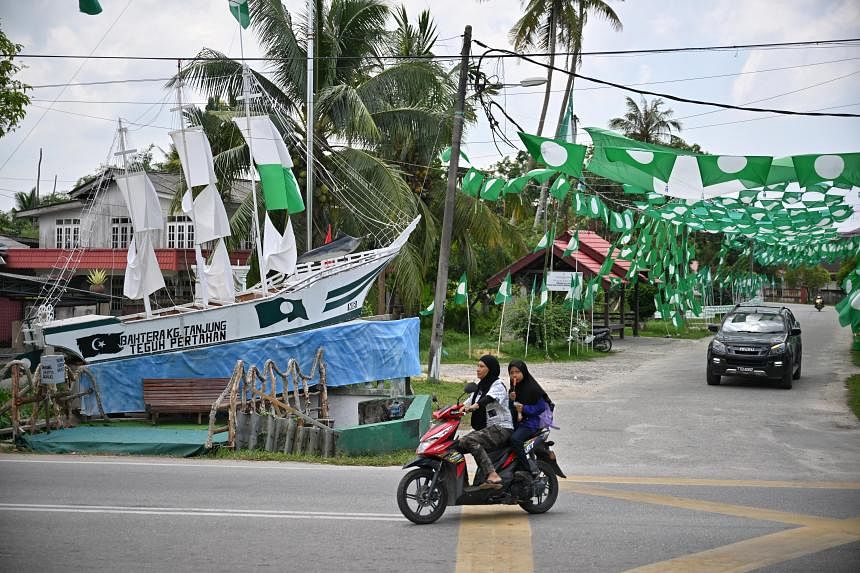
PAS flags and a ship made by party supporters were seen in Kedai Buluh, Kuala Terengganu, ahead of the state elections in August. ST PHOTO: ARIFFIN JAMAR
By Hazlin Hassan Malaysia Correspondent, 18 SEPT 2023
KUALA LUMPUR – State elections in August have put the spotlight on a pair of fast-rising non-clerics in the fundamentalist Parti Islam SeMalaysia (PAS).
Soft-spoken Datuk Seri Ahmad Samsuri Mokhtar, 52, one of the party’s three vice-presidents, wiped out the opposition in Terengganu to retain the Menteri Besar, or chief minister, post. His counterpart in Kedah, Datuk Seri Sanusi Md Nor, 49, gained prominence as a shoot-from-the-hip orator who retained the state with a commanding majority despite being hit with sedition charges for insulting the monarchy.
They are not religious scholars, who usually form the leadership ranks of Malaysia’s Islamist party.
Dr Mazlan Ali, senior lecturer at the Razak Faculty of Technology and Informatics at Universiti Teknologi Malaysia, told The Straits Times it is important for PAS, which has 43 MPs in Malaysia’s federal Parliament – the most for any single party – to have laymen instead of just religious scholars among its leaders.
He said: “In order to win votes, PAS has to be pragmatic and not just be a party based on religion alone. In politics, power is gained from votes and popularity. So PAS has to put up leaders from a variety of backgrounds, and not just clerics.
“When you form a government, you need people who are experts in administration, economy, finance and diplomatic relations. All these require professionals.”
Dr Samsuri has a PhD in aerospace engineering from Britain’s Leeds University, and uses science and data to make his points against political opponents, instead of just relying on jibes.
After PAS’ clean sweep of all 32 seats in Terengganu’s state legislative assembly, as predicted by the party, Dr Samsuri said: “I make statements based on facts and knowledge. As a scientist and an engineer, when we make a decision, we must have enough facts.
“When I said we were very confident of winning in Terengganu, it was not based on sentiment or coffee-shop talk but based on studies and surveys which we carried out.”
Mr Sanusi, meanwhile, courts controversies with his public speeches but is wildly popular with the masses.
He used to work in real estate valuation before becoming the political secretary of the previous Kedah chief minister from 2008 to 2013. Numerous gaffes throughout his tenure and a penchant for highly contentious statements have seen him compared with former US president Donald Trump.
He was charged with sedition in July for allegedly insulting the Selangor ruler when he compared him with the Sultan of Kedah, saying that the former’s choice of chief minister was substandard.
That only led to a wave of sympathy from voters, who turned up in droves to see him at political rallies and take selfies. Ruling coalition Pakatan Harapan (PH) and its ally Barisan Nasional had hoped to wrest back Kedah from PAS in August.
But, under Mr Sanusi, the opposition alliance Perikatan Nasional (PN) snatched 33 of the 36 state seats, improving on its previous 20 seats. PN is led by PAS and Malay-centric Parti Pribumi Bersatu Malaysia, with former prime minister Muhyiddin Yassin as its chief.

 Political Party Forum Southeast Asia