Partyforumseasia: International IDEA is very clear about the trend world-wide: Big money is taking over:
“…unequal access to political finance contributes to an unequal political playing field. The rapid growth of campaign expenditure in many countries has exacerbated this problem. The huge amounts of money involved in some election campaigns make it impossible for those without access to large private funds to compete on the same level as those who are well funded.” (See IDEA’s Handbook on Political Finance, freely downloadable from their website. (Link here)
The fact as such is not really new, Julius Caesar used enormous sums for his political maneuvers and was never reluctant to go into debt for their funding. But the proliferation of vested business interests in elections from local to national levels threatens to damage the rationality of policies and a balanced accommodation of the broader interests of a society.
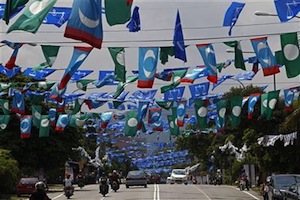 For a case study of Malaysia see the following article in Malaysia Today, 18 September 2014 (Link here): by Rita Jong, The Ant Daily
In the mid-1990s, a young politician from a Barisan Nasional component party was picked as a candidate for a state assembly seat. Being a newbie, he naively expected that all component parties in the constituency would campaign for him in the spirit of brotherhood. When that didn’t happen, he asked his party elders and found out that he had to first make “contributions” to the branch chairmen of all the parties to help “pay for expenses like petrol and food and beverages”. His rude awakening to the realities of politics came when he found out the going rate then was RM10,000 to RM20,000 per branch, depending on the number of volunteers involved. “I had to dig deep into my own pockets to pay for their help.” The politician learnt fast that there were big companies he could approach for political donations, and he made use of this channel in later campaigns that even involved throwing expensive dinners underwritten by these companies. It seems such a practice is not confined to elected representatives from the ruling coalition, especially after the watershed 2008 general election. A businessman, who declined to be named, told The Heat that in the last general election, he was instrumental in arranging several opposition candidates in Selangor to meet property development companies for donations to fund campaigns. “The sums were not large; between RM10,000 and RM20,000 each. Some donors asked for help to ease approvals for their projects, while others said they didn’t need anything at that time. This meant they would call in a favour if the need arose,” he said, adding that because Selangor is administered by Pakatan Rakyat, it was easier to seek funding. Election candidates do get funds from their parties, but the amount is usually token. Candidates, especially those in “hot” seats and those with a track record to maintain, will go all out for a win, and often have to spend the maximum that is legally allowed, although it is known that many exceed the cap. Just how much is needed? A 2008 court case gives an idea. In that high-profile case, Elegant Advisory Sdn Bhd claimed RM218 million from Umno for the supply of bottled drinking water, mineral water cartons, posters, buntings, and other election paraphernalia for the Barisan Nasional’s 2004 general election campaign. The company lost the suit on the grounds that there was no written agreement. The Election Offences Act (1954) sets the allowed campaign expenses per candidate at RM100,000 for state seats and RM200,000 for federal seats. Going by such figures alone, and the fact there were 505 state seats and 222 parliamentary seats in the 2013 general election, the BN’s maximum allowance expenses would have been about RM95 million. Using the claim by Elegant Advisory as a guide, it is safe to say the BN would have spent much more than RM95 million in GE13. Dr Wolfgang Sachsenroeder, an associate fellow at the Institute of Southeast Asian Studies in Singapore, in a new academic paper published recently, claimed that Umno spent RM1.5 billion in the 2004 election. “Knowing how close the GE13 was expected to be, the estimations of between RM2 billion and RM3 billion don’t seem to be far-fetched,” he wrote. On a request from The Heat, he said the estimations were based on a long list of items like transfers from parties to candidates, transportation, ceramah and concerts, millions of flags and posters, events sponsored by local branches, food and salaries of campaign helpers, cash handouts to the poor, T-shirts and other paraphernalia, and the pay rise for civil servants. He said a big portion of expenses came from state coffers, but there were also a lot of donations from companies. In a paper published in the International Institute’s The Journal in 2003, Linda Lim said political parties in Malaysia “solved this problem by going into business themselves – Umno, MCA and MIC all run some of the biggest business conglomerates in the country, using their political position to earn large profits, part of which are plowed back into electoral campaigns to maintain their political position”. Pakatan Rakyat’s fund-raising is also shrouded in secrecy. Sachsenröder said the component parties of PR had obviously found their own ways to attract funding for their development in the years since 2008 when they managed to challenge the BN dominance for the first time. He said the DAP was probably getting more donations from Chinese businessmen unhappy with the MCA and Umno, while PKR may have received donations from non-Umno-linked businesses and middle-class Malaysians. “PAS has cultivated its image of clean politics for decades and thrifty party management based on volunteer contributions by members.” Despite all this, and considering that all political parties stand to gain from maintaining the status quo, it is unlikely there will be any move to create laws that compel disclosure of campaign funds. It is precisely because of this that the public would not know how such funding affects them later in the form of public policies and enforcement of rules. As American political journalist Theodore H. White once said: “The flood of money that gushes into politics today is a pollution of democracy.”Sources told The Heat tycoons and industry captains are willing to make huge donations to government leaders and heads of political parties for their campaigns, with the hope that they would be favourably treated when these people were appointed to powerful positions.When these candidates get elected, it would be payback time. The projects that are carried out by the candidates’ beneficiaries may get the nod, despite protests by the people. It is, however, difficult to prove such interference without disclosure of the names of campaign fund donors.Although most contributions given to candidates come mostly in the form of cash, there are different forms of favours they can pledge. Fund-raising dinners where everything is paid for by benefactors is one of them.Former MCA member and five-term Subang Jaya assemblyman Datuk Lee Hwa Beng tells The Heat that political funds can come from individuals as well as companies, mostly developers.“This is because developers are the ones who would be most affected by the outcome of an election. Hence, developers would usually give both sides of the political divide though the amount may vary,” says Lee, who lost in the 2008 general election.The retired politician says these ‘contributions’ would sometimes be offered voluntarily, or they would be approached at times by the political parties.“Businessmen with no self-interest would also give to the political party they support. Besides that, friends of the candidates would also lend their support,” says Lee.“These contributions would normally be given in cash, so that it would not be traced back to them. The money would be given directly to the candidate alone and not through a political party’s bank account.”Lee admits that based on his experience, most candidates from both sides of the political divide could actually make money from campaigning. The problem is, he says, no one keeps a check on the amount spent and if there is any money left, no one would be the wiser.“In the 2008 general election when the then state government gave us an allocation to contest, I actually had money left over and I returned it after I lost the election.“I do feel it is time we look into regulating this like how they do it in the United States. There is nothing wrong with people donating or contributing to election campaign funds, but the money must be declared. This would then be submitted to the Election Commission to show how the money is spent,” he says.PKR’s Yusmadi Yusoff and former one-term Balik Pulau member of parliament (MP) says that during the 2008 general election, he was given RM15,000 by the central party to campaign and that was all he used to win the election.“I did not source money from any individual, except that a businessman donated two boxes of mineral water for my supporters,” Yusmadi saysHe says sourcing of funds for election campaigns actually makes democracy more expensive. “I know parties like PAS and DAP are quite active in raising their funds during ceramah. They can raise quite a lot, particularly in the urban areas,” says Yusmadi.He says since the 2013 general election, his party’s treasurer at the central level appointed a campaign director for each constituency to monitor campaign donations.“The nexus between political finance, dynamics or leadership can be interpreted based on the local development of the area. For example in Balik Pulau, some development projects are still being carried out despite complaints by locals who claimed they were victimised through forced eviction,” he says.According to the Malaysian Corruption Barometer 2014 released by Transparency-International Malaysia (TI-M) recently, Malaysians ranked political parties as the most corrupt among six key institutions. The police scored second place, followed by public officials or civil servants, the judiciary, parliament or legislature, and business or private sector.TI-M called for more transparency in political financing expenditure for campaigning to curb corruption and stop money politics. It urged the government to regulate financing for all political parties where all forms of contributions and funding must be channelled to an official party account and not into political candidates’ personal bank accounts.DAP election strategist Dr Ong Kian Ming, who is also Serdang MP, says the proposal to regulate political finances would only be viable if there is a genuinely level playing field.“My fear is that this may be used as a tool to ‘scare’ people off from contributing to opposition parties, without controlling the flow of funds to the BN parties through official and non-official channels,” he says.“For example, legislation may be introduced to make it compulsory for political parties to disclose the identity of supporters who make donations above a certain amount but does not stop companies or individuals from giving to BN parties through non-official channels.”Ong says as far as DAP is concerned, the party’s election funds are obtained from supporters who attend ceramah and those who contribute to the party’s bank account.He says candidates also get donations directly from friends, family members and their supporters. He adds that he was not aware of donations from companies.“Some funds are given to the party through its official bank accounts while other funds are channelled to the party branch account to be used for individual candidates. The decision on which account to bank the contributions into is up to the individual supporter,” says Ong.The interdependence of party politics and business sectors – once dubbed as an “incestuous relationship” by veteran opposition politician Lim Kit Siang – is prevalent in low-income and developing nations, more so in Southeast Asia.In reality, political parties and their candidates need the political funds to reach out to voters and to ensure governance. To ban such donations to parties would leave them high and dry, incapable of running an effective campaign.The acceptable compromise would be for clear rules to be created to usher in an era of transparency, so that the “dark money” may be brought into the light. Big companies should donate because they support the party they think will do a good job of governing the country, not because they would get favours from it.
This article was first published in the June 21, 2014 issue of The Heat
For further reading see also: Aboo Talib, Kartini: The Political Parties in Malaysia, in: Sachsenröder, Wolfgang (ed.): Party Politics in Southeast Asia, Singapore 2014, available at Amazon, Barnes&Noble and other internet book distributors.

 Political Party Forum Southeast Asia