
“Whenever a legislator elected on a party ticket or as an independent changes his party affiliation or joins a party, he commits a breach of faith. In most elections, party identity has more influence on the minds of the electorate than the personal prestige of the candidate. In fairness to the electorate, a defector should be made to seek a fresh mandate from the people.”
Kamath, P. M. (1985) “Politics of Defection in India in the 1980s,” Asian Survey, Vol. 25, No. 10, (October), 1039-1054.
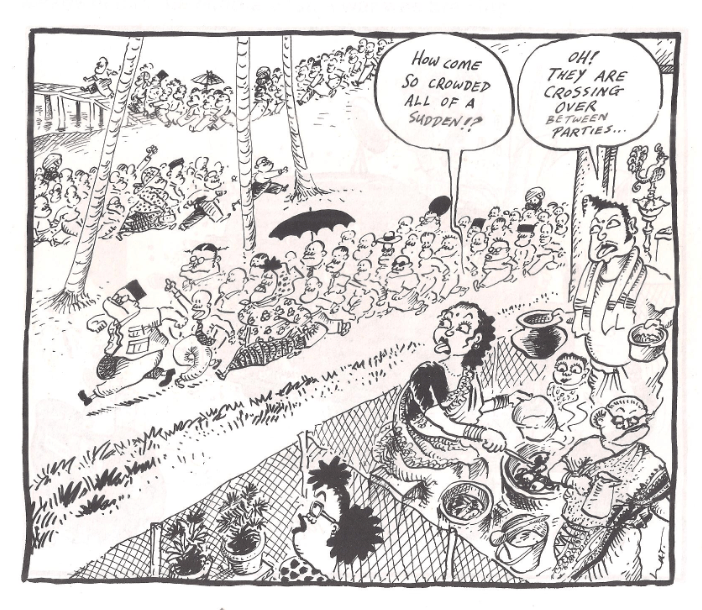
Cartoon by Lat, Malaysia, 1980s
What Prof Kamath, a political scientist at the University of Mumbai, called a breach of faith, carries many negative names on the side of the “giving” or “losing” party, something between defection and treason or more. The “receiving” party, of course, sees it in a positive light, and may call it a courageous move, a plunge of belief, a trusting jump, or a decision of conscience. The single party hopper, though, as warmly as he or she may be welcomed in the new party will never be fully trusted. Converts are often more eagerly faithful than the other group members, and that is not too welcome as well.
Since party hopping has been widespread in Southeast Asia, regulated in some countries and often being discussed for tougher regulation in others, we don’t want to discuss the pros and cons here in detail.
For a good introduction into the party hopping topic, we recommend the analysis by Kenneth Janda, Northwest University, Illinois. The paper is from 2009 and offers a good comparative overview. For Southeast Asia, a couple of updates are necessary.
Link: wp0209 (leidenuniv.nl)
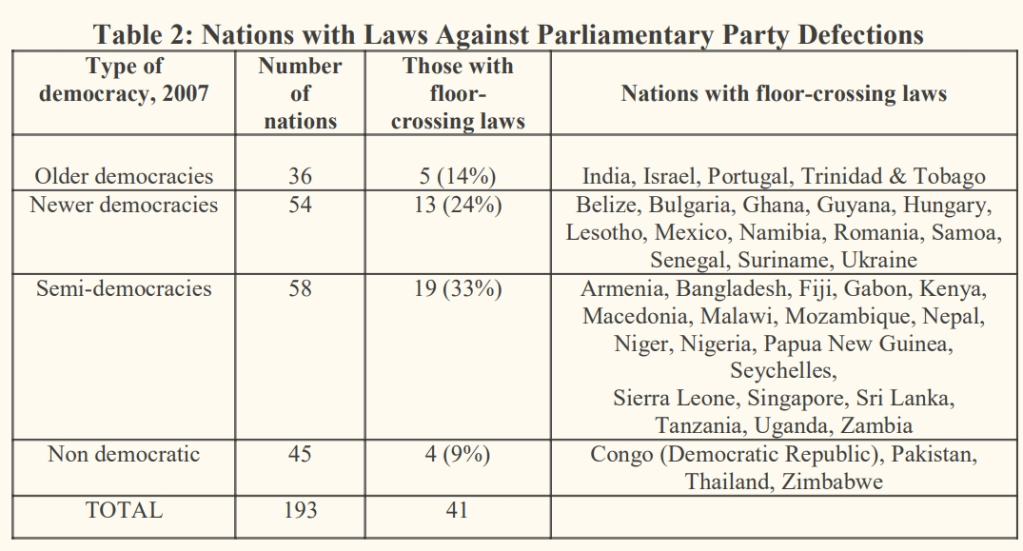
For a better understanding of politics in the region, the second sentence in the quotation above is at least similarly important, maybe even more:
“In most elections, party identity has more influence on the minds of the electorate than the personal prestige of the candidate.”
Partyforumseasia thinks that this is debatable and will continue to look into the issue. Contributions are welcome.
 Political Party Forum Southeast Asia