
How to Convince Voters in Confusing Party Landscapes


Fragmented Party Systems
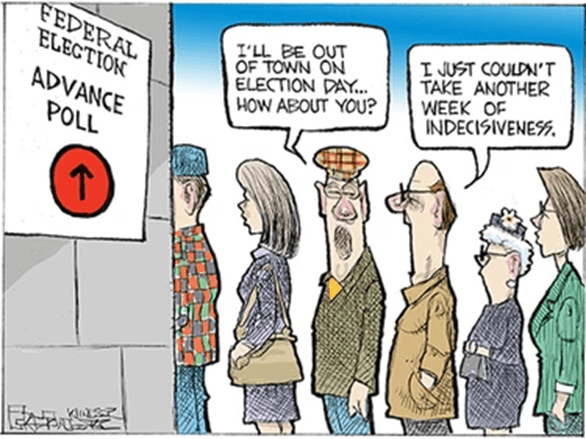
In most of the so-called mature democracies the party systems are increasingly fragmented. Britain and the U.S. are an exception, mainly due to the First-Past-The-Post election system in Britain and presumably due to the sky-high campaign costs in the U.S. which discourage the formation and rise of new parties. In Europe the traditional party landscapes, if they are still visible, are falling apart at a fast rate. After WWII, Germany wanted to build a model democracy. One of the results was the ease of establishing and registering a new party, including the right (!) to get a downpayment for campaign cost reimbursement even before an election. So far so fair, but as an unintended result, there were new parties without a realistic potential, even as small coalition partners. In the last Federal Election in 2021 there were parties like “Free Voters” (vote share 2.4%), “The Animal Welfare Party (1.5%), “Pirate Party” (.4%), “Christians for Germany” (.1%), “Vegan Party” (.1%), and many others without votes. The threshold for entering the Bundestag is 5%. Combined with the decline of the old ideological parties, namely Social and Christian Democrats and Liberals, the European party systems show a tendency to splinter and make coalition building increasingly difficult.

Splinter Parties in Southeast Asia
In many countries in Southeast Asia, the party landscapes resemble the European ones in terms of complexity and lack of ideological differentiation. Highly visible, popular, or towering leadership figures may make up for the deficits, at least for a while, sometimes even for decades. But today it is more urgent than ever to convince and win over new voters. Since the era of “safe vote banks” seems to be over, it is even more important for the parties to come up with a convincing program and attractive leaders. But most of all, they should have a strategic concept of how to define the type of voters they can hope to convince. This is why their campaign plans need to focus on who can be convinced and how!
For concepts of “selling points” and “selling techniques” there is more than enough literature available. Voter’s opinions can change and can be changed, even to the opposite conviction if done the right way. Here is a link to the first example of a toolbox:  

How Political Opinions Change | Scientific American

“In a 
recent experiment, we showed it is possible to trick people into changing their political views. In fact, we could get some people to adopt opinions that were directly opposite of their original ones. Our findings imply that we should rethink some of the ways we think about our own attitudes, and how they relate to the currently polarized political climate. When it comes to the actual political attitudes we hold, we are considerably more flexible than we think.”  And so are voters…

GENERATIVE AI FOR CAMPAIGNING


Perfecting  election campaigns with artificial Intelligence?

In the quasi two-party-system of the United Kingdom, focusing the election campaigns on possible swing voters and otherwise relying on secure vote banks, has long been practiced with good results. In some cases, it boiled down to certain streets and certain suburban clusters whenever the parties had sufficient information on the voting patterns in their constituency.
With the increasing volatility of the voting patterns, even in Britain the numbers of swing voters are increasing. Therefore, the campaign methods and instruments must be adapted. On the European continent, the volatility is much higher than in Britain, and the party systems are more and more falling apart. Political parties with faithful membership and reliable vote banks, like Social Democratic or Christian Democratic parties, are shrinking dramatically while fringe parties come and go. Certain policies, e.g. the management or mismanagement of immigration, are being seen by larger parts of the population as a threat and trigger big swings to the right, like in Denmark, Sweden, The Netherlands, France and Germany. The mainstream parties and governments, so far, have no recipe for stemming the tide and often react in panic mode by vilifying the perceived right wingers as Nazis. 
In Southeast Asia, many political parties are not offering ideologies in the traditional sense but use ethnic or religious cleavages in their societies as main attraction. The fast-growing use of artificial intelligence (AI) might provide them with new sophisticated instruments to bring the votes out and maximise their voter base.

Scientific American has published an analysis of what may be possible soon. And the advances of social media and available data harvesting methods in Southeast Asia will certainly push the competing parties to try out everything what is available. The low cost of AI generated targeted campaign messages is an additional advantage, while posters and rallies are cost intensive.

The article highlights the danger as well:

“When combined with GenAI’s ability to generate customized messages, this technique places large-scale furtive manipulation within reach of bad-faith political operators or indeed foreign adversaries. Whereas previously, manual targeting at market segments required extensive funding and knowledge, the availability of GenAI has dramatically lowered the cost. Political targeting is now cheaper and easier than ever before.”

Political Ads Tailored to Voters’ Personalities Could Transform the Electoral Landscape | Scientific American

Happy 2024


Voltaire (1694 -1778) à l’âge de 24 ans


Whether party politics can make you happy is debatable and depends a lot on which end you participate. Losing an election is no fun at all, winning one can trigger anything from euphoria to arrogance, and the same is true for helping in election campaigns. Observers and analysts like political scientists risk an impact to their mood as well.
For any role or outcome, we recommend a wise decision by the French enlightenment
writer, philosopher, and satirist Voltaire:
J’ai décidé d’être heureux, parce que c’est bon pour la santé
I have decided to be happy because that is good for my health

All the best and good health! 
Your Political Partyforum Southeast Asia