
Islamic Parties in Southeast Asia: PAS Malaysia


Religion can be an important feature in attracting voters to a political party. Western Europe had strong Christian parties in the second half of the 20th century. In Italy, the Democrazia Christiana (DC), played a leading role in postwar Italy and the European integration until it lost its influence in the 1990 and was disbanded in 1994. In Germany, the Christian Democratic Party (CDU) is still the biggest party in the Federal Parliament today, though in opposition. The “C” (for Christian) in its name is often questioned, and it certainly does not imply a major influence of the Catholic and Protestant churches which struggle with shrinking membership already for years. For the American Republicans, the picture is different. According to a Statista survey for the years 2021 to 2023, a total of 56 per cent of the members identify themselves as Protestant and 25 per cent as Catholic. It would be difficult, though, to pinpoint the religious influence in political decisions and the legislation. Whether this can be said for the Islamic parties in Southeast Asia is a matter of perception and debate. The following article about Malaysia’s PAS party, published by the Straits Times in Singapore, gives some interesting insights.

The rise of the non-clerics in Malaysia’s Islamist PAS party

The Straits Times, Singapore
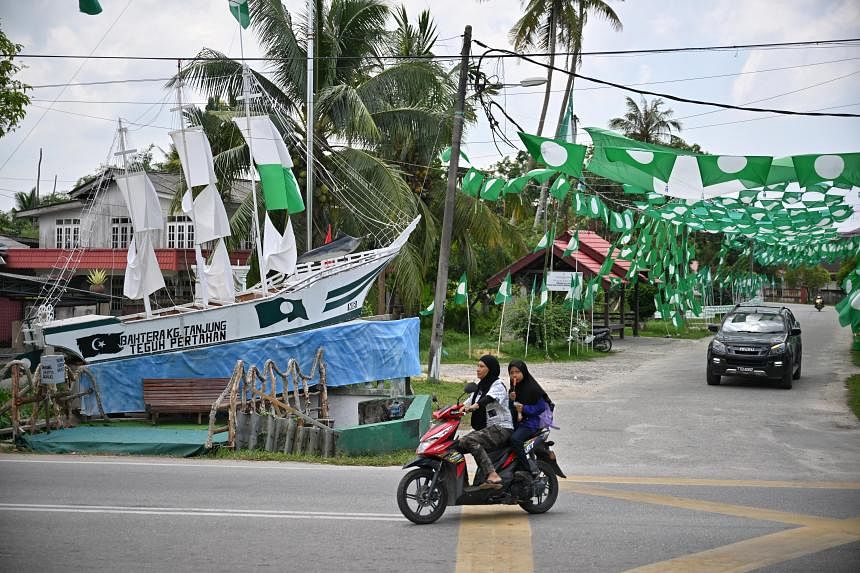
PAS flags and a ship made by party supporters were seen in Kedai Buluh, Kuala Terengganu, ahead of the state elections in August. ST PHOTO: ARIFFIN JAMAR

By Hazlin Hassan Malaysia Correspondent, 18 SEPT 2023

KUALA LUMPUR – State elections in August have put the spotlight on a pair of fast-rising non-clerics in the fundamentalist Parti Islam SeMalaysia (PAS).

Soft-spoken Datuk Seri Ahmad Samsuri Mokhtar, 52, one of the party’s three vice-presidents, wiped out the opposition in Terengganu to retain the Menteri Besar, or chief minister, post. His counterpart in Kedah, Datuk Seri Sanusi Md Nor, 49, gained prominence as a shoot-from-the-hip orator who retained the state with a commanding majority despite being hit with sedition charges for insulting the monarchy.

They are not religious scholars, who usually form the leadership ranks of Malaysia’s Islamist party.

Dr Mazlan Ali, senior lecturer at the Razak Faculty of Technology and Informatics at Universiti Teknologi Malaysia, told The Straits Times it is important for PAS, which has 43 MPs in Malaysia’s federal Parliament – the most for any single party – to have laymen instead of just religious scholars among its leaders.

He said: “In order to win votes, PAS has to be pragmatic and not just be a party based on religion alone. In politics, power is gained from votes and popularity. So PAS has to put up leaders from a variety of backgrounds, and not just clerics.

“When you form a government, you need people who are experts in administration, economy, finance and diplomatic relations. All these require professionals.”

Dr Samsuri has a PhD in aerospace engineering from Britain’s Leeds University, and uses science and data to make his points against political opponents, instead of just relying on jibes.

After PAS’ clean sweep of all 32 seats in Terengganu’s state legislative assembly, as predicted by the party, Dr Samsuri said: “I make statements based on facts and knowledge. As a scientist and an engineer, when we make a decision, we must have enough facts.

“When I said we were very confident of winning in Terengganu, it was not based on sentiment or coffee-shop talk but based on studies and surveys which we carried out.”

Then in August, after a small plane crashed on a highway near Shah Alam, Selangor, killing 10 people, Dr Samsuri offered possible theories as to what could have happened, drawing on his expertise in the field.

Mr Sanusi, meanwhile, courts controversies with his public speeches but is wildly popular with the masses.

He used to work in real estate valuation before becoming the political secretary of the previous Kedah chief minister from 2008 to 2013. Numerous gaffes throughout his tenure and a penchant for highly contentious statements have seen him compared with former US president Donald Trump.

He was charged with sedition in July for allegedly insulting the Selangor ruler when he compared him with the Sultan of Kedah, saying that the former’s choice of chief minister was substandard.

That only led to a wave of sympathy from voters, who turned up in droves to see him at political rallies and take selfies. Ruling coalition Pakatan Harapan (PH) and its ally Barisan Nasional had hoped to wrest back Kedah from PAS in August.

But, under Mr Sanusi, the opposition alliance Perikatan Nasional (PN) snatched 33 of the 36 state seats, improving on its previous 20 seats. PN is led by PAS and Malay-centric Parti Pribumi Bersatu Malaysia, with former prime minister Muhyiddin Yassin as its chief.
Malaysia: Politics for God, for the People, or for the Party?


Partyforumseasia: During the 1960s, 70s and 80s, Christian Democrats have been strong in several Western European countries. With over 40% they are still the dominant force in Germany, though the Christian element (the “C”) in its name does not play a big role in practical politics because under a secular constitution religion is considered to be private.
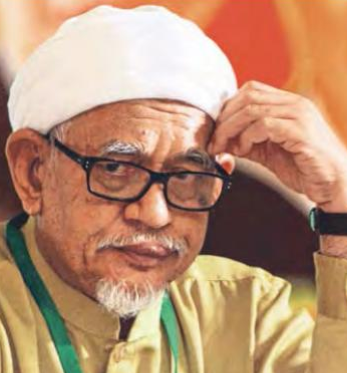
Hadi 2PAS president Hadi Awang has some reason for concern

In predominantly Muslim countries like Malaysia religion plays a bigger role, and at least for the Friday prayers mosque attendance is much more subject to peer-group control, in rural communities more than in bigger cities. Religious credentials are important factors for political careers and open support for Islam is a must for Malay candidates in election campaigns. The competition for Malay Muslim votes between two big mainstream parties, the United Malays National Organization (UMNO) and the Parti Islam SeMalaysia (PAS) has triggered even more importance on religious issues for a couple of decades. Both are targeting the same Malay constituencies, especially in the rural areas, because of the relatively small number of voters per precinct and the better chances to get elected.
With the “holier than thou”- competition the nation has changed from a more relaxed religious atmosphere only two or three decades ago to much more peer-group pressure on the Muslims with elements spilling over to the minority religions. Restaurants have to be halal, alcohol is no longer flowing so freely, and gender relations are getting more difficult. The world-wide Muslim resurgence including fundamentalist currents are finding a lot of open doors in the country.
In the last few months, but festering for much longer in the background, the introduction of Muslim criminal law elements (or hudud), especially corporal punishment, has highlighted the fault lines in Malaysia’s society, though the constitution is giving equal rights to the strong minorities and their religions, and the British-inherited legal system is basically secular.
The PAS-controlled federal state of Kelantan has passed a law on the implementation of HUDUD in the local parliament on 18 March, and UMNO had no choice but to support the motion. For its final implementation the law needs approval from the national parliament, and many politicians and lawyers think it is unconstitutional.
Though the requirements for male (!) witnesses are high, the punishments are harsh in the 21st century. For theft (2 witnesses) a hand or both have to be amputated. For extramarital sex (4 witnesses!!!??) it is 100 lashes for unmarried and stoning to death for married persons. Drinking of intoxication substances (2 witnesses) costs 40 to 80 lashes. If this sounds archaic for modern Muslims already, the reaction of non-Muslims is also strong, though hudud is supposed to apply only to Muslims. In a multi-religious society like the Malaysian there a many mixed families and many non-Muslims can be affected.

Strategy-wise:   In this complex situation there a rather different outcomes for the Malaysian political parties:

1. PAS is proud of higher religious standards than UMNO anyway. Stating it again is not providing much additional mileage. But they have a leadership problem after their spiritual leader Nik Aziz passed away. Party chairman Hadi Awang, also a Muslim scholar, is not uncontested internally. His dogmatic attitude and his alleged openness for cooperation with UMNO are criticized by the so called “Erdogan faction”. Hadi is heading the more conservative “ulama faction” and may face a grassroots revolt. More than half of the party’s committee in its Batu branch has resigned in protest a few days ago.

2. UMNO has been leading a coalition of 18 parties, maximizing its votes with the help of the Chinese, Indian and indigenous ethnic component parties. These allies are against the hudud implementation, though they know that UMNO cannot be seen to be against it in the Malay constituencies in more conservative rural areas on whose support UMNO’s survival depends. But the threat of being voted out is only there as long as the opposition coalition is united and strong. Its leader Anwar Ibrahim neutralized in prison for the next five years, dividing the opposition and maybe even splitting PAS would mean practically ending the threat. But strategies often backfire, and the hudud dilemma could add to the pressure on Prime Minister Najib by Dr. Mahathir and his friends.

3. Pakatan Rakyat, the opposition coalition composed of PAS, Chinese dominated DAP, and Anwar Ibrahim’s Parti Keadilan Rakyat, is actually close to breaking up. All non-Muslim members are against hudud and have suspected PAS of secretly dealing with UMNO for quite some time already. With Anwar in prison the “coalition of strange bedfellows”, united only by its fight against the government, is more unstable than ever.

4. The greater public: Non-Muslims anyway, but also Muslims with doubts about the more than creeping religious intolerance in the country are not fully convinced that the hudud policies are only religiously motivated. Leadership struggles in PAS and UMNO make it rather obvious that the hudud drive is not totally for God or the people but all too visibly party politics. Like in countries like Iran, where the clerics in power are detrimental to the acceptance of Islam, the turmoil created by PAS may turn out to be negative for the political development and the religion alike.

5. The social climate: A presenter at business radio station BFM 89.9 who discussed the question whether the hudud implementation would help to fill the country’s rice bowls in a video published on YouTube received death and rape threats and is under police investigation. She has apologized publicly saying that she regretted her tone and demeanor in the video and that she would never mock or insult any religion, let alone her own. The incident shows the raw nerves in the domestic debate and cast doubts on Malaysia’s  image as a moderate Muslim country.

Campaign Booster Religion


Partyforumseasia: State religions” have played important and decisive roles in European politics for centuries. Rulers have used religion as a powerful political tool. And churches have shown a great propensity to be close to the power holders, often in a cozy and successful symbiosis.
Only a few decades ago, Christian parties in Italy and Germany could rely on campaign support from their alliance with the church, especially on Sunday services before elections. Without necessarily naming the party, the priests would just say that a true believer should know where to mark the ballot paper. With urbanization and secularization the influence of churches and Christian parties has decreased. But the parties were also punished for relying too much on conservative and more religious rural constituencies and giving them more political weight than the cities.

Prayer 2In several Southeast Asian countries we witness developments in the opposite direction. In Malaysia and Indonesia where Islam is dominant anyway, religion is often used as a campaign tool. In a negative way by casting doubts on the religious credentials of candidates, in the worst case by alleging that they are covert Christians like in the case of presidential front runner Joko Widodo. But last week Muhammdiyah leader Din Syamsuddin revealed that he had “tested” Jokowi by asking him to lead a Friday prayer. Result: “It was all correct”. So the members of this Muslim mass organization can trust that Jokowi is a sufficiently pious Muslim. Muhammadiyah (30 million members) and Nahdlatul Ulama (40 million members) have declared that they won’t officially support any of the candidates, but in a country which is seeing a split between pious (santri) and possibly more lukewarm (abangan) Muslims, 70 million potential voters cannot be neglected.

In Malaysia, probably more than in Indonesia, the Islamic agenda in politics is frightening non-Muslim minorities. The introduction of Hudud laws is one of the most controversial issues in the ongoing political debates, fueled recently by their introduction in Brunei. Hindu, Christian and other minorities are concerned that amputations and stoning might be applied to them as well, though they are certainly hard to apply within a predominantly secular legal system. See details in an essay by Mohammad Alami Musa, “Hudud and Inter-Religious Relations” from the Rajaratnam School of International Sudies.( Link )
Playing the religious card in politics can be dangerous. If overdone it opens the Pandora’s box of fanaticism and intolerance. Both, unfortunately, are not unknown in Southeast Asia.