
Earlier this week, I received my ballot paper for the European Parliament Election, marked it immediately and rushed to the next post office to send it back to Berlin. Since this was my last registered residence in Germany, from where I moved to Singapore 16 years ago, the city administration in a suburb of the German capital is still responsible for my participation. And the deadline is looming, the election is on 9 June. For me the European Union is important, a dream come true during my lifetime. In my student days, my first membership after the Boy Scouts was with the “Young European Federalists”, and together with my parents, I was active in the Franco-German twin city movement. I was sad about the Brexit and sadder about the ongoing debates about other “-exits”.
In the ASEAN-debates over the last decades, the comparison with the EU was ubiquitous, often with a whiff of regret that ASEAN was not yet as far as the EU. Sure, ASEAN has no Parliament and no governmental institution like the powerful EU Commission which can make important political decisions binding the legislation of the member states. Just as an interesting example, look at the ban of combustion engines in motorcars by 2035 and the controversies it has created in the car industry.
At least for the average voter in Germany, the understanding of the role and decisions of the EU Parliament is limited. In the last election in 2019, the overall voter turnout was 50.6 %, the highest in twenty years, in Germany with 61 per cent even higher. This time, the very open party registration system in Germany does not make it more transparent or more attractive for the voters. The ballot paper is eighty centimetres long and lists 34 parties. While on the national level the ruling coalition between Social Democrats, Greens, and Liberals is increasingly unpopular, the main opposition Cristian Democratic Union joins the coalition in its fight against the more Right-wing Alternative for Germany. But probably many German voters will be surprised about the multitude of fringe parties they find on the ballot paper. If party systems all over Europa are more and more fragmented, with a trend toward the right because of the dramatic increase of immigration from Middle Eastern and African countries, 34 parties in Germany alone are somewhat strange.
Some curious fringe parties competing for a seat in the EU parliament, very probably have not much of a realistic chance. Either the five per cent threshold of all valid votes nor winning a direct mandate should be feasible for them, though some of the candidates on the list are quite prominent on the federal level in Germany. For many years, a certain type of political veterans has been “promoted” to Brussels, a parliament with limited powers of legislation. The right to initiate legislation lies with the commission and not with the EU Parliament, but the income of the MPs and the lifestyle in Brussels are attractive enough.
From the 80 cm long ballot paper below, parties 1 (The Greens), 2 (Christian Democratic Union), 3 (Social Democratic Party), 4 (The Left), 5 (Alternative for Germany), and 7 (Free Democratic Party) are established mainstream parties, the Social Democrats even with a 150-year history. The Alternative for Germany, as a right-wing party, is being attacked by all the others and the media. New on the scene is 28 (Alliance Sahra Wagenknecht) named after its leader, an outspoken younger politician who is omnipresent in talk shows and married to a Social Democratic veteran. As a registered party since only a couple of months, 28 is getting seven per cent in the polls, while The Left and the Liberal Free Democrats are struggling for survival above the five per cent threshold.
Surprisingly, socialist and communist tendencies have survived in Germany with the German Communist Party (20), Marxist-Leninist Party (23), and the Socialist Equality Party – 4th International (24).
With the environmental protection high on the government agenda via the Green Party in the ruling coalition, more groups are competing for Europe: The Ecological Democratic Party (13), Climate List Germany (30), and Last Generation (31) a grassroots group famous for street and airport blockades by gluing themselves to the streets.
The Action Party for Animal Welfare (15), Human World – Happiness for All (21), or the Party for Change, Vegetarians and Vegans (34) are the more exotic ones. But in an era where conservative world views and attitudes are uncool and being replaced by new and colourful lifestyles and social innovations, the list reflects the country’s transformations.
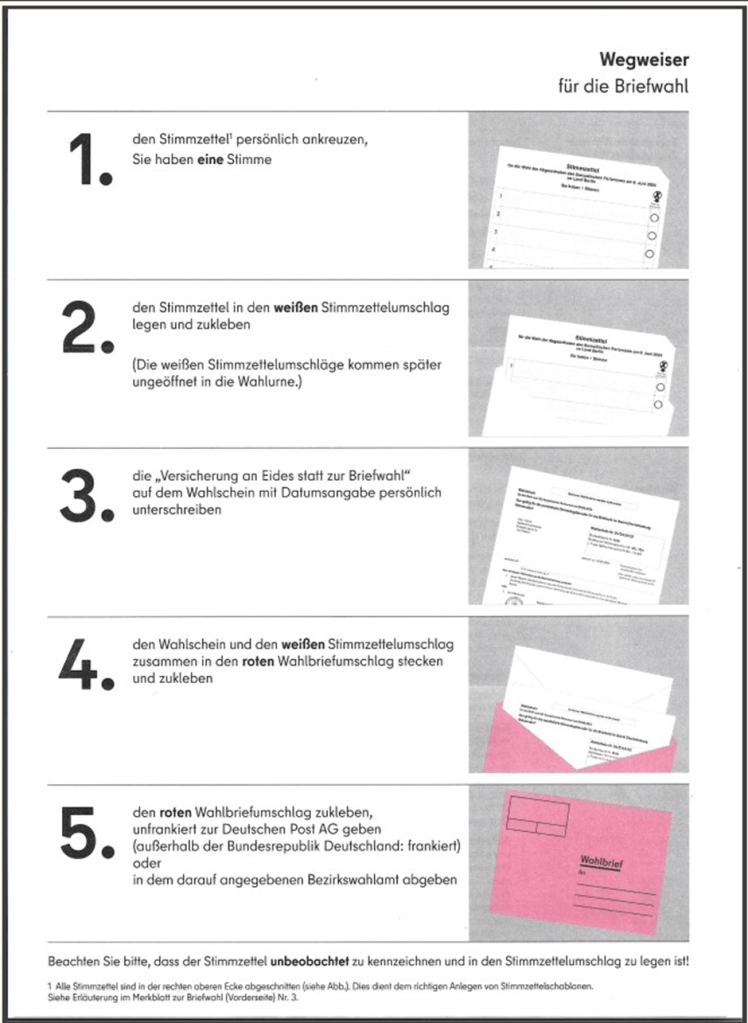
What reminds more of the old and bureaucratic Germany is the instruction leaflet for the postal vote procedure – at the end of this post after the ballot paper. The last instruction says that the voter should mark the ballot paper discreetly, without being observed by others, the secrecy of ballot principle.




 Political Party Forum Southeast Asia