The “Frogs” of Southeast Asia


Partyforumseasia:

Frogs for 32 million Ringgit Malaysia ( 7.5 m USD or 6.4 m Euros ) ?

Apart from the diminutive of frog, froggy in the English language is an ethnic slur against the French. But frog meat is not only popular in France, it is a delicacy all over Asia. And in Southeast Asia, especially in Malaysia, it is also a widespread name, not a compliment, though, for opportunistic politicians who jump from one political party to the other. Since few parties here have a distinctive program or ideology, this special political flexibility is rather widespread. But it is not that easy to explain it to the voters who suspect that there are financial considerations behind such a move.

The wafer thin parliamentary majority of the Malaysian Prime Minister Muhyiddin Yassin has been questioned from the beginning of his term which in turn encouraged the opponents of his premiership outside and even inside his coalition. The biggest faction of this coalition has been the former long-term ruling party UMNO, the United Malays National Organization, and threats to leave it and thereby force the Prime Minister to step down are going on for a while already. Party president Ahmad Zahid Hamidi thought the time was ripe when he announced the withdrawal of eleven UMNO MPs earlier this week. But the situation remains unclear because his grip on the party discipline looks as shaky as never before, and Muhyiddin managed to convince the King that a confidence vote should be postponed to September. Time enough for many Malaysian observers to allow him to buy over enough members of parliament for the maintenance of his majority.

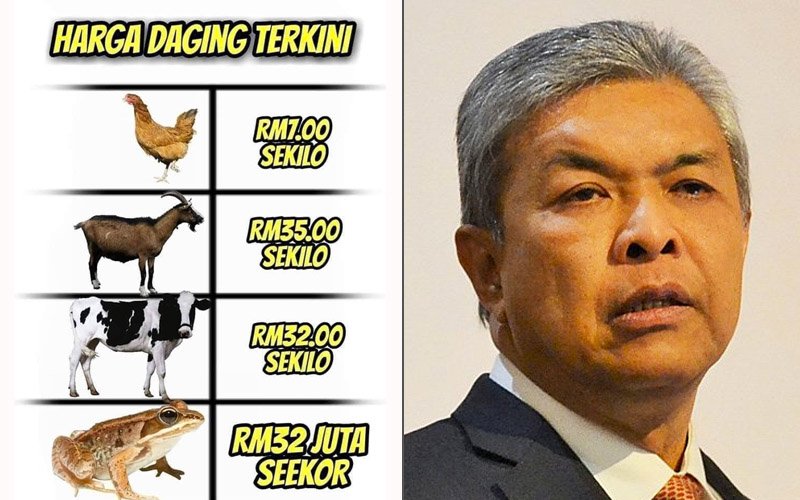
And here comes a rather interesting and intriguing contribution from a man who probably knows best how to buy over parliamentarians, Zahid Hamidi, the experienced UMNO leader. It is not that much the fact that financial transactions are part of the frogging procedure but the price tag suggested by Zahid. In a Facebook post he describes the per kg price range of different meats in the Malaysian marketplace as follows:

  • Chicken 7 RM (Ringgit Malaysia)
  • Goat 35 RM
  • Beef 32 RM
  • Frog 32 million RM

UMNO was for decades a master of money politics where even support for internal leadership positions had to be “facilitated” with cash on hand. Publishing the putative price tag for frog meat this way on Facebook can be seen as a blow to Muhyiddin, but for a man who is facing a long list of corruption charges like Zahid is is quite daring on top.

Malaysia’s Covid and Political Crisis


Partyforumseasia:

Prime Minister Muhyiddin Yassin (left) meeting Malaysia’s King, Sultan Abdullah Ahmad Shah, last November. PHOTO: ISTANA NEGARA, MALAYSIA

When Muhyiddin Yassin, a 74-year-old veteran politician from Johor, took over the prime ministership from Dr. Mahathir Mohamad on 1 March 2020, he started with a double burden and both being rather challenging. The Covid-19 pandemic had already reached Malaysia and has since increased dramatically. According to a Nikkei survey, published 7 July, the country ranks 114 out of 120 surveyed nations in terms of infection management and vaccine rollout. In the regional comparison only Thailand trails Malaysia as no. 118.

The direct political handicap for Muhyiddin is similarly challenging. He was not elected by parliament but nominated after the King conducted interviews with all MPs to gauge the candidate’s parliamentary support. As the parliament is more divided than ever, the legitimacy of Muhyiddin and his fragile Perikatan Nasional (National Alliance) coalition has constantly been questioned. As if the Prime Minister was not sure about that himself, he has avoided a formal vote so far, using the Covid crisis as a suitable justification. This break without the 222 member parliament sitting at all is ending right now. The King is urging Muhyiddin to reconvene the parliament which is now likely to happen on 26 July.

The Prime Minister’s tenure and his political survival skills may come to an end after that. On 8 July, the former long-term ruling United Malays National Organisation (UMNO) has announced that it will no longer support Muhyiddin. His shortcomings of the handling of the Covid crisis is the upfront argument. With 38 MPs, UMNO can easily topple the Prime Minister, though it is not clear so far how many of its parliamentarians will follow the leadership of party president Zahid Hamidi. Zahid, after Umno was voted out of power in May 2018, is himself under heavy pressure and no longer the power center beside former Prime Minister Najib Razak. Both are political animals of sorts, but they are both facing long lists of corruption charges. Surprisingly enough they are still out of jail.

UMNO seems to be going the way which other older political parties in the region have experienced before. After being for decades one of the richest parties in the world, behind, if not even richer than the Guomindang (KMT) of Taiwan, the 1MDB scandal has exposed the dubious financial tricks of the party and discredited its internal and external money politics. Even if the funding of political parties is predominantly dubious in Southeast Asia, UMNO under Najib Razak has exaggerated it. The well known fact that already relatively moderate leadership positions in UMNO had to be bought by the candidates with payments to the respective electors has made it necessary for the winners to recoup their expenditure within the system and finally at a loss for the taxpayers. Together with a gerrymandering scheme, biased in favor of the conservative rural areas, the grip on funds had cemented the dominance of the party for decades – until May 2018. With the fractious format since then it is not very probable that they can be expected back on top.

A Majority is a Majority or What?


Partyforumseasia:  Party switching, party hopping, candidates looking for the party which would give them the best chances to be elected, or parties shopping for the most eligible candidates, that all is common in Southeast Asia. The cartoon above by famous Malaysian cartoonist Lat from the 1980s shows the phenomenon in a light way, but Malaysia is going through a much more serious period of political turmoil at the moment. More serious because the switching persons are not just rank and file party members but parliamentarians and even ministers.

Prime Minister Muhyiddin Yassin hands over documents to the king in the 18th May session

When in February this year the Pakatan Harapan (PH) government of Prime Minister Dr. Mahathir was booted out in a surprise move by defectors who found easy support from the opposition parties UMNO and PAS, Mahathir-ally Muhyiddin Yassin turned into a challenger and was appointed as Prime Minister  by the King without a vote by parliament. The new majority was defined by the King after interviewing all members of parliament personally, and the new majority remains unclear and contested until today. The change of government was criticized as coup and backdoor move by the PH supporters and welcomed accordingly by the losers of the 2018 election, UMNO and PAS. When they found themselves in opposition after the unexpected defeat, and after having sufficiently licked their wounds, this old guard realized that they had lost all their access to state coffers and the lucrative side jobs in government linked companies. UMNO, once supposed to be one of the richest political parties in the world, was suddenly cut off from the money flows. And their former Prime Minister, Najib Razak, found himself in court with numerous charges of corruption.
On the side of the Mahathir and PH supporters, the 2018 watershed election had created high hopes for a more transparent and democratic political style and less race based competition in this multi-ethnic and multi-cultural country.

Mahathir (2)

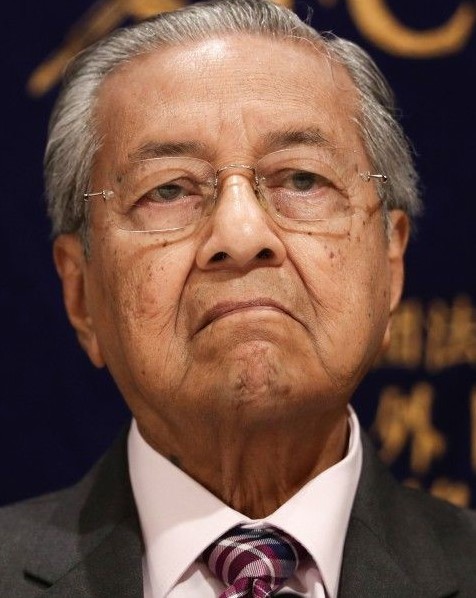
At age 94 Dr. Mahathir is as defiant as ever

On 18th May, the first sitting of parliament after the switch to Prime Minister Muhyiddin and his Perikatan Nasional (National Alliance) coalition, turned out to be remarkable in several aspects:
1. The sitting, according to the constitution, would have had to confirm the new Prime Minister and his government.
2. Mahathir had initiated a no-confidence motion against Muhyiddin for this meeting, which was accepted by the speaker.
3. But the schedule for the sitting was reduced to the introductory speech of the King. Due to the Covid-19 threat, this was the explanation, no debate was allowed after that.
4. The next sitting of the parliament was adjourned to July.

Conclusions:
1. The shortened sitting has spared Muhyiddin the no-confidence vote. That might allow doubts on his majority and legitimacy, as well as his confidence in the coalition which supports him. It is indeed wobbly because the UMNO members feel undercompensated with cabinet posts and GLC directorships.
2. Mahathir and his remaining PH supporters feel betrayed and encouraged to sabotage Muhyiddin at their best ability.
3. The top positions in the federal states are being ferociously contested as well. Mahathir’s son Mukhriz is the first victim after losing the majority in Kedah.
4. The beleaguered PKR party has tried to prevent defections after two federal state MPs left. They had made them sign a no-defection clause and threaten them with a fine of 10 million RM (more than 2 million USD). That sounds rather unrealistic to be enforced.
5. The estimated majority of the Muhyiddin government is two or three seats, or the same two or three seats short of the majority, depending on the political standpoint.
6. Wafer-thin majorities, even minority governments, are quite common nowadays all over the world. Malaysia obviously needs more time to get used to it, or make it back to big, clear, and stable majorities. 


Malaysia’s UMNO Convention: What Keeps Najib In Power?


Partyforumseasia:One important advantage of democracy  over all other systems is the possibility to exchange an unsuccessful  government against a new team and new hope for the voters. Sometimes it happens after internal power struggles like the recent transfer from Abbot to Turnbull in Australia, sometimes it is growing unhappiness among the voters and defeat in elections. With a more open and less gerrymandered electoral system PM Najib would have lost his job already in 2013. But even under

Determined to prevail

Determined to prevail

unprecedented pressure from voters, many of whom have lost trust in him, and internal opposition in his own party, Najib seems unassailable. In this week’s ongoing party convention with 2,654 delegates from 191 divisions he shrugs off all the attacks and calmly pretends to be in fighting spirit. An admirable level of self-confidence.
His long career as a politician has been a jump-start but accompanied by a series of scandals. At the age of 23 he took over the parliamentary seat of his father, a prime minister like an uncle, and moved into the cabinet as deputy minister only two years later. Prime Minister since 2009, his former mentor and predecessor Mahathir Mohamad has now turned into his most prominent critic. Mahathir’s constant call for him to step down seems unsuccessful by now, and the UMNO-internal challenge looks neutralized. As incredible as it sounds for Malaysians and outsiders, the scandalous mismanagement of 1MDB, a sovereign wealth fund with billions of debt, and the more than dubious campaign “donation” of 700 million US$ from undisclosed Middle Eastern sources into Najib’s private account (!), seem to be swallowed by most leaders of the 3.4 million strong government party. His enemies never imagined that he got get away with that.

There are four main reasons for the strong position of Najib:

1. There is no competitor who could replace him at short notice. All party comrades who speak up are being sacked, like former deputy prime minister and deputy party president Muhyiddin Yassin,  and replaced by yes-men. Najib even declares that it is a Muslim religious duty to support the leader.

2. With the  imprisonment and effective elimination of opposition leader Anwar Ibrahim and the ambivalent stand of Islamist opposition party PAS, the threat by a strong opposition coalition has more or less vanished.

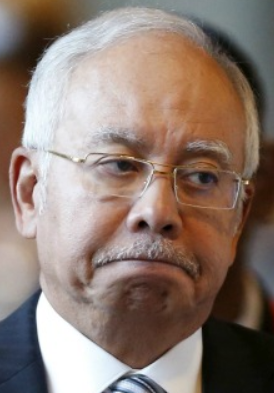
3.  Starting from Mahathir’s time, the powers of party president and prime minister have been strengthened continuously. On 3 December, Malaysia’s parliament has approved the National Security Council Bill which gives the prime minister quasi unlimited discretion to detain people and declare a state of emergency. The criticism of Mahathir sounds somewhat hollow, though, because he used the former internal security act against his challengers during his term rather extensively.Najib 1

4. The main reason, however, is the pervasiveness of money politics. Widely the norm in Southeast Asia, it has been developed and fine-tuned in Malaysia, ironically again since Mahathir’s premiership. Najib, born with the famous silver spoon in his mouth, has made full use of the UMNO patronage system. As Partyforumseasia has argued earlier, UMNO cannot afford to lose an election because the whole enormous scheme would collapse and leave hundreds of thousands of party officials and supporters in the cold. And Najib cannot afford to step down because more dirty linen suspected by critical Malaysians might surface and destroy party and patronage.
The system, described as “the patronage networks that flow downward through UMNO, and that ensure the loyalty of party cadres” (Council on Foreign Relations, Link here) is a tool for which many parties worldwide may envy UMNO. But its refinancing comes from state funds and corrupt government-business links at the expense of tax payers.
As aptly as ruthlessly playing racist and religious cards, party and prime minister seem to get away with this cancerous system among the profiteers and voters. And far from being as scandalous as it sounds for most observers, the 700 million “donation” might even strengthen Najib’s position by boosting his financial discretion even more. As the saying in the Philippines goes, the Golden Rule simply means that he who has the gold will rule…

He won't go

He won’t go

John Stewart Mill in his Considerations on Representative Government published in 1861 had warned already against money politics: “Of what avail is the most broadly popular representative system if the electors do not care to choose the best member of Parliament, but choose him who will spend most money to be elected?”