
Partyforumseasia: Nearly forty years ago, the Asian values debate confronted liberal democratic values, often perceived as “Western”, with supposedly authoritarian and restrictive Asian views on society and political participation. What Western observers and scholars often missed, especially for Southeast Asia, was the governability problem in the complex multi-ethnic, multi-cultural, and multi-religious societies. Thus, the debate was hardly a dialogue leading to better mutual understanding but was perceived in Asia much more as a sort of missionary endeavour by Americans and Western Europeans. Maybe the politically most irrelevant confrontation was on “family values”, whereby the lack of them in permissive and promiscuous Western societies was declared as undesirable in Asia, despite quite a long list of less responsible and rather debatable traditions concerning the role of women. The value debate has fizzled out in the 1990s already, though for a special variety of “values”, namely the formation of political dynasties, there should be more debate than the usual smirk in the media comments.
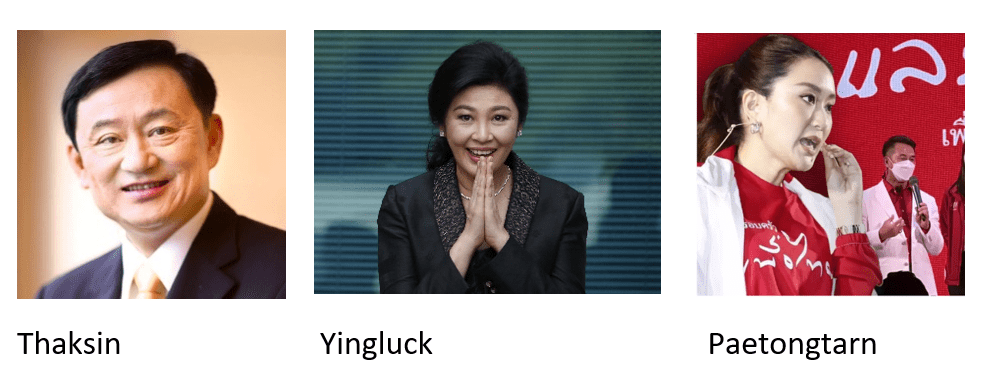
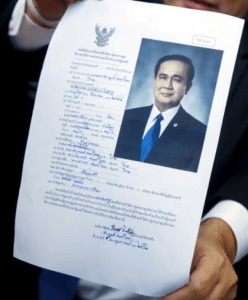
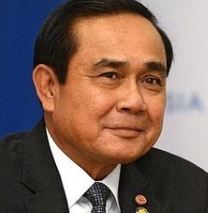
After the “rising sons” in Cambodia and the Philippines, Hun Manet and Ferdinand Marcos Jun., there seems to be a “rising daughter” in Thailand. Paetongtarn Shinawatra (35) is the youngest daughter of Thaksin Shinawatra who was Prime Minister from 2001 to 2006. His domestic policies and reforms were mainly successful, especially in poverty alleviation and infrastructure development, but controversial for the military-monarchist elite. This led to Thaksin’s ouster by a military coup in 2006, and later to the ouster of his sister Yingluck, who was Prime Minister from 2011 to 2014. The political vehicle for brother and sister Shinawatra was the Thai Rak Thai (TRT) party, which first brought Thaksin to power. In the 2006 election, Thaksin won 460 of the 500 parliamentary seats, which led to the military coup and the dissolution of the party by a Constitutional Tribunal. The People’s Power Party (PPP) became the de facto reincarnation of the TRT but was also banned in 2008. Yingluck’s vehicle to power was the next reincarnation, the Pheu Thai Party, which is today the biggest faction in Thailand’s parliament. Now the next Thaksin generation, Paetongtarn, marketing herself as “Thaksin’s little girl”, will probably be nominated as PM candidate by the Pheu Thai Party, trying to cash in on the consistently high popularity of her father. The party’s strongholds are still in rural and poor areas, especially in the Northeast, where millions of ethnically Laotian Thai citizens resent the contempt of the true Thais and the gap in development and infrastructure. As Thaksin’s little girl, Paetongtarn has a big advantage there for the 2023 elections. In an indirect attack on the increasingly unpopular and economically unsuccessful Prime Minister, General Prayut, she recently showed her ambition in an interview with AFP, saying “We can transform Thailand from a country that is riddled with debt, filled with misery, with no future in sight, into a country filled with opportunity and hope for us and future generations.” In a recent poll, she led the race for PM with 25.28% before PM Prayut Chan-ocha with 11.68 on third place. Politically, and in terms of votes, Paetongtarn and the Pheu Thai Party could win, but the formal hurdles are high. A victory in the Parliament, according to the rules established by the military coalition, would not be enough. As in the 2019 election, the handpicked military-loyal Senate could allow a coalition of losers to form the next government.

 Constitutional Court to dissolve the party with immediate effect. The surprise move of nominating Princess Ubolratana as a prime ministerial candidate turned out to be too risky a strategy. The court deemed it unconstitutional because it abused the Royalty, supposed to be above politics, for electoral advantage. To make sure that they don’t find another loophole, the 13 members of the TRC executive committee have been banned from politics for the next ten years.

 general. The problem of the party is the looming uncertainty whether the junta or the courts might dissolve it before the election, because they suspect the exiled former leader, Thaksin Shinawatra, to pull the strings from his exile in Dubai. Puea Thai and connected groups, supported by the so-called United Front for Democracy Against Dictatorship, or Red Shirts, have won the last five elections and were only stopped by the courts and the military,
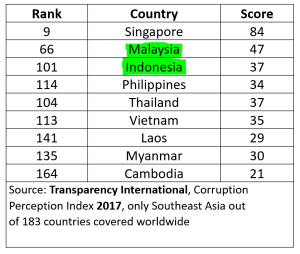


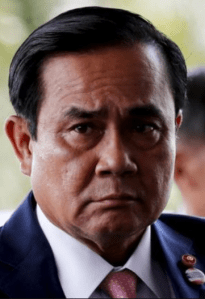
 But junta leader and Prime Minister Prayut Chan-o-cha, feeling the growing frustration of the prohibited voters, has finally announced that the election will be held “no later than February 2019”. This means that there is still a year for preparations on all sides of the broad political spectrum which includes the military and several supporters who want to prevent a return to the tumultuous contestation which triggered the military coup, and especially a return of the Shinwatra clan.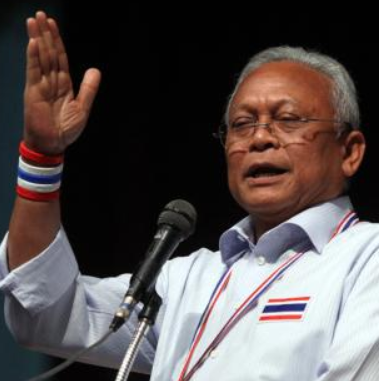







 Political Party Forum Southeast Asia