

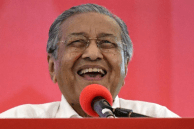
A winner’s smile
Partyforumseasia: What Malaysia’s incumbent Prime Minister Najib Razak called the “mother of all elections” has turned out to be the end of his political career, unless he follows the winner, Mahathir Mohamad, who resigned in 2003 after 22 years in power and now comes back at the age of 92! If some politicians are worn down by the burden of office and age prematurely, others seem to be rejuvenated by campaigning. Mahathir does not look like a nonogenarian at all, and the crowds he was pulling in his relentless campaign during the last two weeks were already a signal that he might lead the opposition coalition to victory. This victory is certainly a world record.
That it was possible against all the odds and against the predictions of most political pundits is more than remarkable. The incumbent Barisan Nasional (National Front, BN) had used all possible tricks and means to defend its majority. The latest were a sweeping gerrymandering exercise to make it even more difficult for the opposition, the election on a Wednesday with the expectation of a lower voter turnout, and a cornucopia of election goodies and promises for more after the election. Maybe the visible nervousness of PM Najib and the list of dirty tricks were helping the opposition to tip the scale. The victory is clear, in the national parliament as well as on the federal state level. The official results for the Federal Parliament are as follows:
Tan Sri Mohd Hashim Abdullah, chairman of the Election Commission, announced at 4.40am on May 10, that BN won only 79 seats, down from 133, and won with only 47% of the popular vote. The Islamist PAS, suspected to be wiped out by many observers, survived with 18 seats. But even if PAS should coalesce with BN, they can’t form a government. The former opposition coalition PKR has now 109 seats, the Parti Warisan Sabah eight, and with probably some more going to join, the victory is perfect. Mahathir is taking over the premiership again with a promise to hand it over to Anwar Ibrahim after he will be released from prison and pardoned by the king. July will end his prison term anyway which he is serving after a dubious conviction for alleged sodomy.
One of the main reasons for the landslide, called tsunami in the region, is the rising cost of living in a country rich in natural resources, and the all too obvious corruption in the  BN system. What most observers had underestimated, but Mahathir managed to remind the voters of, was the dubious role of Najib Razak in the 1MDB scandal and the 682 million US$ in his private accounts. Few voters could believe his explanation that the money was a donation of the Saudi royal family for a wonderful Muslim ally in Southeast Asia. The future of Najib and the BN money cascade will be a very interesting case for follow-up research and comments. If it should help against the rampant political impunity, it will be good for the democratic development in the region.


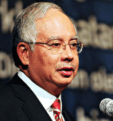 Najib, in his cold-blooded style, declared the Election Commission (EC), which happens to be under his Prime Minister’s department, as impartial and the changes as only for the benefit of the Malaysian people. The critics, on the other hand, call it gerrymandering and they do have a valid point here. While the redelineation of electoral boundaries is common everywhere when demographic changes like urbanization make it necessary, the malapportionment in Malaysia is exceptional. In the 2013 election, the number of voters per precinct ranged from 15,700 for the smallest rural to 145,000 for the biggest urban one. And, not by chance, the most reliable voters for the ruling Bairsan Nasional (BN) coalition live in the small rural districts. This is why, in 2013, and also due to the first-past-the-post majoritarian election system, a shortfall of 4% in the popular vote was changed into a 20% majority of seats. On average, BN constituencies were won with 48,000 votes, while the opposition needed 79,000.

 already triggered a heated exchange of suspicions and accusations, since CA had been hired by the ruling Barisan Nasional (BN) coalition in the 2013 election to win back the federal state of Kedah from the opposition. Obviously learning only now that the BN had hired CA, the opposition wants to know details about Prime Minister Najib‘s role in the deal. Najib, as usual, denies everything and directs all the blame on Mukhriz Mahathir, former chief minister of Kedah when he was still member of UMNO, and in charge of the 2013 campaign. Mukhriz, in turn, denies any involvement, even knowledge of Cambridge Analytica.




 Political Party Forum Southeast Asia