“Silverbacks” or Orang Utans – The Leadership Enigma in Southeast Asia


Getting to the top is as much to do with how you look as what you achieve.

Partyforumseasia: The latest Economist (September 27th, p. 67) compares leadership “qualities” in the corporate world with dominant behavior among gorillas: Gorilla“IN GORILLA society, power belongs to silverback males. These splendid creatures have numerous status markers besides their back hair: they are bigger than the rest of their band, strike space-filling postures, produce deeper sounds, thump their chests lustily and, in general, exude an air of physical fitness. Things are not that different in the corporate world. The typical chief executive is more than six feet tall, has a deep voice, a good posture, a touch of grey in his thick, lustrous hair and, for his age, a fit body.”
OK, so much for the corporate world. Is it very different on the political stage? We had taken up the issue some time ago with the good looks of Yingluck Shinawatra, which certainly helped her to get accepted as Prime Minister of Thailand but didn’t protect her against being toppled as perceived proxy of her brother Thaksin.
Political leadership is probably related to a certain degree to “silverback” features from the gorilla world, but there are many exceptions to the list. From Napoleon to Sarkozy and many others, short politicians have been successful. The touch of grey in thick, lustrous hair? Not necessarily, Putin is nearly bald. Handsome or beautiful faces? Perhaps an asset but not necessarily. Hitler, Mussolini, Mao or Nixon were far from impressing by their features but mesmerizing men and many women alike.
There are research results in political psychology looking into why some politicians seem to be more trustworthy than others at first glance. The test persons (mostly students) had just one or two seconds to watch the picture and rate it.
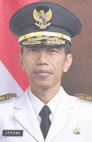
The spoken word is another powerful tool to impress voters and citizens, and, obviously much more based on the way it is expressed than dependent on the content. On that background the astounding catching-up-campaign of presidential candidate Prabowo Subianto in Indonesia and the final victory of least gorilla-style politician Joko Widodo are remarkable. Was it the aura of credibility against strongman posturing?

Partyforumseasia would very much appreciate comments and contributions to the leadership enigma in Southeast Asia. It is a region with gentle orang utans, not chest thumping gorillas.

Malaysia: End of the Selangor Menteri Besar Saga? Not Really.


Partyforumseasia: After nearly nine months of “gestation”, the drama around the replacement of Khalid Ibrahim, chief minister of Malaysia’s richest federal state of Selangor, comes to an end. In the unique set up of leaving the final appointment of his replacement to the local Sultan, the new chief minister will be Mr. Azmin Ali. Sultan 2He is the Selangor chief of Anwar Ibrahim’s Parti Keadilan Rakyat (PKR) and its vice president on the national level. Sultan Sharafuddin Idris Shah thus thwarted the strategically desastrous attempt of PKR to establish Anwar Ibrahim’s wife Dr. Wan Azizah Wan Ismail as chief minister. The series of political moves brought the opposition coalition of PKR, Democratic Action Party (DAP) and the Muslim party PAS to the abyss of breaking apart and undermined the standing and authority of de facto coalition leader Anwar Ibrahim. It really looks like the UMNO and Barisan Nasional dream of neutralizing the opposition threat is coming true (see our 30 July post), their leaders must be watching their luck in disbelief. Their initial input was preventing Anwar Ibrahim from running for the Selangor state parliament and eventually taking over as chief minister himself by simply reviving the dubious sodomy case against him. If this triggered Anwar’s decision to let his wife run instead, the Pandora box was open. One strategic mistake followed the other and created internal problems of the coalition partners, especially in PAS.
Strategy-wise there were arguably several mistakes:
1. The evidence against chief minister Khalid Ibrahim was not sufficient to sack him immediately. For his obviously unexpected refusal to step down there was no plan B.

2. Obviously the necessary early co-ordination with the coalition partners was neglected. The move looked more like a strongman decision by Anwar Ibrahim.
3. The final say-power of the Sultan seems to have been underestimated with the coalition’s focus on a narrow majority in the state parliament for Dr. Wan Azizah.
4. The internal mood in PAS and its controversial discussion about a female chief minister has not been taken seriously enough. The tensions within the party between a more religious (Ulama) and a more liberal (Erdogan) faction would have necessitated a more sensitive approach by PKR.
5. By not considering long term supporter Azmin Ali as a natural choice for Khalid’s succession Anwar himself created tensions and factional divisions in PKR.

Outlook: After the PAS party convention last weekend, which also weakened PAS president Abdul Hadi Awang, the Pakatan Rakyat opposition coalition of anyway not too compatible partners is still standing. But it looks definitely more fragile  and a lot less dangerous for the UMNO government. Anwar Ibrahim’s leadership prestige is definitely dented. It will be more difficult than ever before in the last six years of its existence to hold the coalition together.

Voter Turnout in Southeast Asia


Partyforumseasia: IFES, the International Foundation for Electoral Systems, offers a broad choice of reference material. We have selected the countries in Southeast Asia for easier reading. But the world-wide comparison is helping us to avoid prima-vista conclusions. If a higher voter turnout would mean more democratic legitimation, Vietnam and Laos were twice as democratic as the United States of America. Doubts about the USA’s political system are allowed and widespread among Americans, but there is no comparison here with the remaining Communist regimes in Southeast Asia.

As IFES points out at the end of a recent article on“Global Measures of Electoral Credibility: Voter Participation and Political Finance”By Ayesha Chugh and Hani Zainulbhai,September 17, 2014 – IFES ( Link ), “While variables like voter turnout and political finance are useful, electoral credibility is ultimately a nuanced concept that requires consideration of the full context of an election.”

Indeed, but it is certainly useful to compare the different systems in the region in light of the voter turnout in the last years. The following charts are due to IFES on www.ifes.int/vt/

The regional overview (Last parliamentary elections) Compiled by Partyforumseasia
vt WS

and world-wide:
Voter turnout

Detailed voter turnout statistics for the ten countries of Southeast Asia (Brunei has no parties) see the following page in the Partyforumseasia database:
Voter Turnout in Southeast Asia


Will Malaysia Follow the Path of Taiwan and Mexico?


Partyforumseasia: The question may sound surprising in the regional discussion in Southeast Asia, not to mention Malaysia itself. It is the headline of an analysis by Joan M. Nelson, a Malaysia expert at the American University’s School of International Service, and published in the latest Journal of Democracy, July 2014, Volume 25, Number 3, pp 105 – 119.
Roller 2Too small to create a level playing field???

By comparing Malaysia’s UMNO with Mexico’s Institutional Revolutionary Party (PRI) and Taiwan’s Kuomintang (KMT), Nelson’s list of the main similarities is as follows: “The hegemonic party controls the legislature by a majority sufficient to change the constitution at will; penetrates the bureaucracy; constrains the judiciary and the media; and controls the institutions that organize, monitor, and adjudicate elections. The party is largely sustained by the distribution of government spoils and patronage.” (p.105)

The central points of the comparison are the gradual weakening of PRI and KMT and their loss of domination, opening Mexico and Taiwan to a more open and more democratic development and a more level political playing field with chances for the opposition to take over.

Sure, the Barisan Nasional coalition has lost the important two-thirds majority in parliament and in 2013 even the popular vote. But in contrast to Mexico and Taiwan, where party elites started leveling the playing field, UMNO elites remain dedicated to maintain the status quo. The central analysis in this article is bluntly describing the attitudes of the leadership: “Politicians and cadres long accustomed to electoral advantage and pervasive reliance on patronage (to advance within the party as well as to win inter party elections) predictably resist changing the system.”

This is underlining Partyforumseasia’s pessimistic outlook for a possible sea change in Malaysia, at least in the short and medium perspective. The ruthless judicial persecution of Anwar Ibrahim and other opposition figures show that the Barisan coalition has been digging in more than their heels to stem the tide and defend their domination. Too many of them see politics as business and not as a vocation, they simply cannot afford to lose. And the “Bersih fatigue“, observed by some, as well as the somewhat suicidal handling of the chief minister saga in Selangor by the Pakatan Rakyat contribute to a pessimistic outlook.

Fifty Shades of Gray or Indonesia and the “Jokowi Effect”


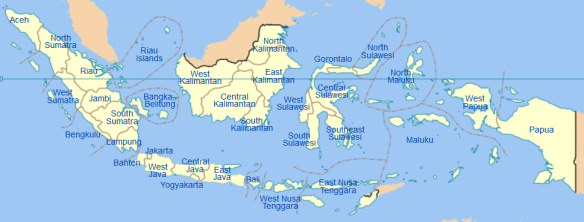
Partyforumseasia: After this year’s successful parliamentary and presidential elections Indonesia certainly deserves unrestricted praise for the consolidation of its young democracy. Organizing this campaigning and election marathon in densely populated Java and the 13.400 islands with 193.000.000 registered voters is a Herculean task.Indomap
In this administrative dimension glitches are unavoidable, but they were far from the systemic irregularities alleged by losing presidential candidate Prabowo.
So far the brighter side of Indonesia’s political development.
But there are also some all too visible shadows in the overall picture! One major dark area is being highlighted by prominent observer and commentator Julia Suryakusuma in her regular Wednesday column in the Jakarta Post http://www.thejakartapost.com/news/2014/09/03/depok-potholes-and-a-new-breed-leaders.html
With the sobering example of inefficient local government in Depok, a suburb of Jakarta with the reputation of being the second most corrupt city in the country (“Fifty shades of Gray”), Suryakusuma describes why the outspoken public intellectual Rizal, a citizen in this area, decides to run for mayor. The “Jokowi effect” could mean that Indonesians take up their responsibility as citizens and shed the long years as subjects under a political class with obvious vested interests. Like all over Southeast Asia, the country has too many politicians who see politics as business and not according to Max Weber’s famous definition of “politics as a vocation”.
Rizal could set an example and a new generation of politicians with vocation following the election of Joko Widodo would certainly be good for Indonesia.


Gerrymandering in Malaysia…and Elsewhere


Partyforumseasia: In its August 9th -15th 2014 issue, The Economist, a British weekly, is taking up the gerrymandering issue which a majority of Malaysian voters may have forgotten already after the last election in May 2013. That is the normal all over the world because manipulation of the electoral boundaries happens outside media attention and looks nearly legally correct. GerrymanderingThe ruling Barisan Nasional won 60% of the seats with only 47% of the vote, whereas the Pakatan Rakyat opposition coalition garnered 51% of the popular vote but was left with only 40% of the seats in Parliament. Malaysia, as a former British colony, adopted the British first-past-the-post electoral system which is designed to create strong majorities, irrespective of the distribution of the popular vote. To make the system even more “efficient”, the commissions in charge of delineating the constituency boundaries may carve them in a partisan way if they are close to one of the competing parties or coalitions. This is called gerrymandering and started in 1812, when the governor Elbridge Garry of Masschusetts created an electoral district which looked like a salamander on the map and was clearly favorable for his Democratic Republican Party. Until today, according to the ACE Project or Electoral Knowledge Network (aceproject.org), the USA is still at the extreme end of the spectrum between independent and partisan election commissions: “At one end of the spectrum is the United States, where the redistricting process is very political and decentralised. The responsibility for drawing districts for the United States Congress rests individually with the fifty states. There are few limitations on the states, and the boundary authorities are almost always political entities, i.e., state legislatures.
At the other end of the spectrum are many of the Commonwealth countries, where politicians have opted out of the redistricting process and granted the authority to redistrict to neutral or independent commissions.GB ConstituenciesLink here

Britain has done and is doing a lot to adjust the electoral boundaries to the demographic changes and create fair chances for the competing parties. The average number of voters per district is around 75,000 with few exceptions like East Ham (London) at 91,531 and Orkney and Shetland at 33,755 (2010).

The crux in Malaysia is that a defined maximum variation (normally 10-15%) has been taken out of the constitution and that it can reach several hundred percent. Sure, the rural constituencies in Sabah and Sarawk are difficult to administer, but Indonesia is geographically even more difficult and has managed the parliamentary and presidential elections this year much better.The Malaysian Election Commission is handpicked by the government anyway, but it does not look good that its former chairman has joined the Barisan National’s right-wing support group Perkasa.

Indonesia and Beyond: More Dirty Campaigning to Come?


Partyforumseasia: Joko Widodo’s victory in the recent presidential election in Indonesia has been praised for many reasons. Jokowi as ordinary citizen against Indo Jokowiestablishment and big money, boost of the country’s fledgling democratic culture against vested financial interests, and most important, a clean politician against the more dubious figure of contender Prabowo. As one prominent observer in the Jakarta Post wrote: A checkered shirt against a checkered past, meaning the doubts on ex-general Prabowo’s human rights record.
The Prabowo campaign nearly performed miracles in Prabowo 2catching up with the poll figures which showed Jokowi miles ahead in the beginning. The two campaigns were indeed very different. The Jokowi – PDIP campaign looked widely amateurish, whereas the deep pockets of the Prabowo camp made a professional performance possible.
After the “dirtiest campaign ever” (Marcus Mietzner), one “professional” feature to be watched more closely is negative campaigning, also known as smear campaign. We had taken up the tasteless “obituary” and the allegations that Jokowi was a Christian of Chinese descent in earlier posts. The final election results among Muslim parties suggest that this poisonous rumor played a role in pulling devout voters into the Prabowo camp.
It would be a bit easier if the dirty campaigning had been home-grown in Indonesia. But it is widely ascribed to American advisers hired into the Prabowo team, namely experts from the US Republicans. Looking into the development of opposition research (“oppo” in the short form) as a thriving new industry is not very reassuring. In an article “Digging dirt, digitally”, The Economist (July 12, 2014 p.30) provides a glimpse into the possible future of negative campaigning. Two big oppo-companies, “America Rising” and “American Bridge 21st Century” are employing so called “trackers” to collect anything which could be used against a candidate. The dilemma for the candidates is, according to The Economist, that “more or less every word a candidate says now lives online somewhere”.
Apart from the smear campaign against Jokowi, Indonesia seems to be relatively innocent so far. But after building a professional polling industry in a few years time, they certainly have the capacity to develop “oppo” mechanisms as fast. There is some hope, though, that President Jokowi will help to create more transparency and cleaner governance in the country.

Nine New Faces: Singapore’s Nominated Members of Parliament


Partyforumseasia: Singapore is not short of political parties, no less than 28 are registered, but during 49 years of independent statehood the overwhelming dominance of the People’s Action Party (PAP) has not changed much. Though its share of the popular vote has shrunk to an unprecedented 60.14 percent in the last general election in 2011, and two cabinet ministers were voted out, the ruling party won 81 out of 87 seats due to the (British heritage) first-past-the-post majoritarian election system. But for the first time in 2011, the opposition Worker’s Party managed to win a group constituency with six seats. The Group Representation Constituency (GRC) was one of the tweaks to the election system introduced since 1984 and not really seen as making it easier for the opposition.  Parliament
In order to balance the overpowering hegemony of the PAP, however, the constitution allows for a number of unelected members to join Parliament. These are Non-Constituency MPs (NCMP) or “the best opposition losers”, if they can win at least 15 percent in a single member constituency, and Nominated Members of Parliament (NMP). These are nominated by the President for two and a half years after recommendation by a parliamentary select committee under the speaker. This year’s committee included two ministers and five other MP’s including the chairman of the opposition Worker’s Party. According to the defense minister, who was part of the select committee, the NMP’s are expected to enrich the debates on issues like “ageing, economic restructuring and productivity, sporting excellence, a better living environment, retaining Singapore’s heritage and appreciation of its history, challenges of working mothers, youth aspirations, and entrepreneurism.” (Straits Times, 12 August 2011, p.1) On sensitive issues like amendments to the constitution or public finances the NMP’s can contribute to the debate but are not allowed to vote.
Among the newly appointed NMP’s are a lawyer, a social entrepreneur, an architect, a medical doctor, a unionist, a historian, an economist, and a banker. The somewhat naughty application of a social blogger who is being sued by the Prime Minister for alleging inconsistencies in how the government is handling the compulsory Central Provident Fund, has been rejected.

To put the NMP scheme into a proper perspective, it is fair to say that Singapore has only a part-time Parliament with MP’s following their professional careers as normal. Apart from the seasonal sittings of Parliament they are involved in intense grass roots work in their constituencies. So it makes a lot more sense to co-opt specialists than in classical full-time parliaments with professional politicians.

More information on Singapore’s political system can be found here:
Tan, Netina, Institutional Sources of Hegemonic Party Stability in Singapore, in: Sachsenröder, Wolfgang (ed.), Party Politics in Southeast Asia, Organization-Money-Influence, Partyforumseasia, Singapore 2014.
The new book is available at Amazon under the following link: Party Politics


Gender Inequality in Politics: More Funding = More Women MPs?


Partyforumseasia: Globally, female representation in Parliaments stands at 21.9 percent, and at 19.0 percent in Asia, according to the Inter-Parliamentary Union (www.ipu.org/wmn-e/world.htm). In a new white paper the International Foundation for Electoral Systems (IFES) is looking into the common problem “that women wanting to run for office have less access to resources than men”. The excellent research can be downloaded for free at the IFES website with the following Link: Political Finance and Gender Equality

Corruption 2The paper is very specific on electoral systems and  financial regulations and their impact on campaign funding for women in a general perspective. The two concrete country studies, Tunisia and Yemen look less relevant for Southeast Asia at first glance, but provide a lot of insight nevertheless. Especially the Tunisian example shows that societies with a big gender gap in terms of political participation can improve rather fast if the political will is there. The white paper’s comparison of the MENA (Middle East North Africa) countries is interesting and cries for a similar study on Southeast Asia:
MENA women's participation

PS: Partyforumseasia’s book “Party Politics in Southeast Asia – Organization – Money – Influence” available at Amazon (link) is paying special attention to the gender attitudes in the parties.

First Book Covering Eight ASEAN Countries Is Out


Partyforumseasia: Before the start of this blog there was a research project in the Institute of Southeast Asian Studies (ISEAS) in Singapore. It tried to add a more hands-on approach to the often theory laden political science literature on political parties in Southeast Asia, to study and describe their organizational structures, the internal hierarchies and funding mechanisms, and especially to cover as many countries as possible. We managed to bring together a team of authors from eight of the ten ASEAN countries. Since Brunei Darussalam has no parties, only Laos is missing because we could not find a local scholar willing or allowed to join. ISEAS accepted our manuscript for publication already in 2012, but due to unexpected delays did not finalize copy-editing and printing in time. This is why we decided to publish the book with the super-efficient Create Space, a subsidiary of Amazon. The book is now available at http://www.amazon.com, a very affordable e-book version should be out shortly.

Amazon Party Politics SEA

Malaysia: Is the UMNO/BN Dream Coming True?


Partyforumseasia Strategy-wise: Is the UMNO/BN dream (= seeing the PR opposition coalition committing suicide) coming true… or is it that their strategies are working? Knowing the systemic vulnerability of the UMNO/BN system by changing vote patterns and facing the extraordinary challenge by the Pakatan Rakyat opposition, held together by the charisma of Anwar Ibrahim, one might guess at least some of the defense strategies of the Barisan Nasional. The most important one in 2013 was winning the election at all cost – or, in financial terms, at a price tag of an estimated more than two billion RM. Gerrymandering as the most innocent looking tool worked as planned and the popular vote, won by the opposition, was more than neutralized. Having won the 2013 election, time would help to consolidate the shaken dominance again. And so it does, the second Malaysia Airlines (MH 17) tragedy in July even giving the Prime Minister and his government a chance to make good on perceived weaknesses after the first tragedy (MH 370). And both tragedies divert the public from domestic political issues.  Khalid Ibrahim
However, the Selangor shadow play about the replacement of chief minister (menteri besar) Abdul Khalid Ibrahim (picture with Anwar) at the hands of his own party can only be observed with glee and schadenfreude by the ruling camp. Since Khalid Ibrahim wants to stay on, a leadership drama is unfolding and develops into an operation on the open heart of the Pakatan coalition, which is anyway difficult enough to hold together . If Anwar still manages to convince most of his PKR leaders so far, the cacophony of statements by coalition partners in DAP and PAS will definitely harm the public image of the Pakatan Rakyat and spread doubts about their ability to take over the government in future. Internal squabble in any party world wide damages its public image. Even authoritarian party leadership is more acceptable for the broader public. But with the airline disasters already rallying the nation, the Selangor squabble might be close to suicidal for the opposition.

Breakthrough Compromise in Cambodia!


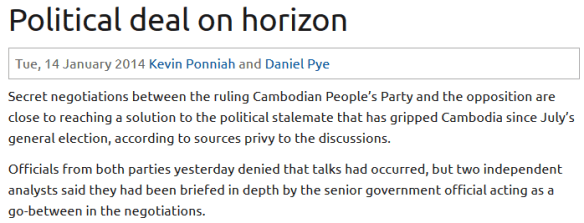
Partyforumseasia: Looking quite impossible for a whole year after the controversial election on 28 July 2013, a surprise compromise between Prime Minister Hun Sen and opposition leader Sam Rainsy ends the deadlock in the Cambodian parliament. Cambodia CompromiseThe 55 elected opposition MP’s (out of 123) will officially take up their seats, probably on Monday 28 July, thus ending their protest boycott. Ruling CambodianPeople’s Party (CPP) and Cambodia National Rescue Party (CNRP) will work together after they have reached a  compromise to overhaul the National Election Commission. It will be made a “constitutionally mandated institution” with representatives of both parties as members. With the opposition taking up its seats in Parliament and co-operating with the ruling party in the Election Commission, Cambodia makes a big step towards a more balanced and fairer political culture.  Respect is due to PM Hun Sen, who was not really known for being a compromising political leader (!) and the perseverance of opposition leader Sam Rainsy. Their compromise is a big contribution to Cambodia’s democratic development and stability.
See more details in today’s (link:) Phnom Penh Post, 23 July 2014

In a regional perspective, the Cambodian compromise must be called exceptional. A few more Southeast Asian countries are still stuck in deadlock situations with an entrenched ruling party or coalition, defending its dominance with teeth and nails and preventing a level playing field for the opposition. Internationally, the easiest way of making it difficult or impossible for the opposition to win an election is massive gerrymandering. The CNRP’s success in 2013, winning 55 mandates despite the CPP’s gerrymandering, signaled the limits of election manipulation against bigger changes in voter preferences. There are certainly a few lessons to be learned.

American Dirty Campaign Experts Helping Prabowo?


Partyforumseasia – Strategy-Wise: Indonesia’s presidential election 2014 has generated a couple of surprises. From the meteoric rise of Jokowi and the unexpectedly successful catch-up counterattack of Prabowo, all developments can be explained within the system of the country’s new democratic paradigm. The personal charisma of Jokowi and the yearning of the voters for less corruption as well as cleaner and more transparent politics explains his probable though narrow victory. Ex-general Prabowo’s coming back from hopelessly lagging behind in the polls only some months ago is seen as the result of unlimited funding and a clockwork-like campaign machinery. Unfortunately, the Prabowo success was also based on the dirtiest campaign ever in a country which is known for a highly developed culture of social harmony, at least in Java where the majority of voters live.

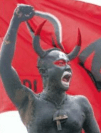
devil1The campaign devil not in the PDI-P…

Partyforumseasia had taken up the topic of dirty campaign tricks on 8th and 11th May with the wicked fake obituary for Widodo and the incredible arsenal of poisonous campaign tools in the United States of America. But at that time we did not connect the US and Indonesian dirty campaign experts. Now we learn from Indonesia observer Marcus Mietzner from the Australian National University that the Prabowo campaign was supported by American experts in smear campaigns:
Advised by American consultants who previously had taught Republican candidates on how to drown out opponents in smear campaigns, Prabowo’s electoral machine spread false rumours that Jokowi was a Singaporean Chinese and a Christian. Jokowi, pushed into the defensive by the effectiveness of these attacks among Indonesia’s devout Muslim community, could never really develop his own narrative and platform. As a result, his once seemingly unassailable lead over Prabowo in the polls (in December 2013, he was ahead by 39 percentage points) melted away rapidly.
Link: EASTASIAFORUM, 13 July 2014:
Indonesia’s presidential elections: Jokowi in, Prabowo out
This type of development co-operation can only be called highly undesirable in a country still uncertain on her path to a stable democracy, but it should also backfire on the American party development support industry. Traditional black magic looks rather harmless in contrast to this specific export item!

Thailand’s Dilemma – Coherently Explained


Partyforumseasia: Thailand’s dilemma is certainly caused by severe elite failure. But it is difficult to decide whether Thaksin and his allies or the Bangkok elite and the Democrat Party are more to blame for the frightening cleavage dividing north and south and the society at large. Under the headline The Story of Thaksin Shinawatra  British journalist Richard Lloyd Parry draws the longer lines of the political impasse which help to understand the developments during the last months.
See his conclusion here:
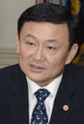
“Many people bear responsibility for Thailand‘s divisions, prominent among them Thaksin, who must dearly wish that he had rubbed his enemies‘ noses in it a bit less gleefully during his years in office. ThaksinBut the suave villainy of the Democrat Party, and of men like Abhisit and Korn, is insufficiently recognised. They understand how democratic opposition works, and how defeat, over time, strengthens losing parties, by purging them of what is unrealistic and superfluous, and forcing them into congruence with the aspirations of voters. Twice they have had the opportunity to reject military force and to insist on the primacy of elections; twice they have held the generals‘ coats for them, and watched civil rights being trampled on, in the hope of gaining some respite from their own chronic unelectability. The Democrat Party‘s leaders – young, attractive and cosmopolitan could have positioned themselves as mediators between a corrupt, complacent old elite and a corrupt, arrogant new power. Instead, they chose their natural side in the class war, and achieved the feat of losing the moral high ground to a man such as Thaksin. Their responsibility, and their disgrace, are very great.”                 London Review of Books, 6 June 2014   Link here:
http://www.lrb.co.uk/v36/n12/richard-lloydparry/the-story-of-thaksin-shinawatra

Partyforumseasia is notoriously optimistic about regional politics, but Lloyd Parry’s comment on the possibility of a North-South civil war reminds us of an earlier post on this blog which tried to wrap a warning into (hopefully!!) gross exaggeration.

WorldNewsAgency-WNA-WorldNewsAgency-WNA-WorldNewsAgency-WNA-WorldNe
15 February 2064:
The Southeast Asian Miracle: Thailand’s Re-Unification sealed!!
After the recent breakthrough in prolonged negotiations between the two sides and efficient diplomatic support from ASEAN, the heads of state of the Kingdom of Tightland (formerly known as South Thailand) and the Kingdom of Thaksimania (formerly known as North Thailand) have signed a comprehensive re-unification treaty. The signing ceremony took place in the UN Headquarters in Beijing in the presence of unification advisers from Germany and Korea.
After the former Thailand split in 2015, the founding father of Thaksimania, business-politician Thaksim Shinawatra was soon elected King of Thaksimania. The people loved him because he could fund the government out of his own pocket and reduce the tax burden to a symbolic 5%. This led to a massive migration of the business community from Bangkok and the South to Thaksimania, where they were warmly welcomed by his Majesty on the condition of participating in the funding of his government.
The impact on former South Thailand was more than difficult. The Royal Finance Ministry witnessed a rapidly dwindling inflow of taxes which could not be balanced by the most investment friendly policies worldwide. So the impoverished country succumbed to pressure from Thaksimania to drop the aggressive use of the outdated name of Thailand. To secure a sufficient flow of development aid from the rival in the North, the King agreed to change the official name of the state into Tightland. Starting around 2035 already, many countries in Asia were able to reduce or abolish taxes and military spending because the regional security was no longer threatened by the US but guaranteed by China. This ended the decades of saber rattling and aggressive symbolic politics between Tightland and Thaksimania which made the re-unification possible at the end. It remains to be seen how the population of the two nations will adapt to the changes and the big difference in affluence. 😉

Strategy-wise: First-Time Voters for Change?


Partyforumseasia strategy-wise: All over the democratic world consistent vote patterns are more and more disappearing. While the “polling industry” has become more professional, the long term prediction of election outcomes is increasingly difficult. Competing poll results and their interpretation by politicians are useful in campaigns, but the only reliable figures come from exit polls, that is when the race has been decided already. 43690-20140522
For the parties and their campaign design it is therefore most important to focus on target groups which can be reached and influenced to vote for them. Data collection of vote patterns in residential areas are so easily available nowadays that campaigning in a wrong suburb comes close to wasted time and effort.
In Southeast Asia, where political fossils like Mahathir of UMNO or Lim Kit Siang of the DAP are still influential, “safe vote banks” like Thailand’s North East or Malaysia’s Sabah and Sarawak still work but come under more pressure as well. So the campaign efforts are focusing more on one big group which is open to be influenced: the first- time voters and the young. In Malaysia first-timers and under 30 year-old voters represent 20 percent of the 13 million electorate and their preferences are more volatile than in any generation before. Especially in the urban areas they tend to prefer the opposition Pakatan Rakyat, but they are also open to switch to the ruling Barisan Nasional if any special issue comes up. The eternal Islamic Law (hudud) discussion is one of these issues which deters non-Muslim voters from PAS as the biggest component in the opposition coalition.
It is interesting how the Malaysian parties try to woo the young voters. They have started to get them engaged and work for the party instead of just harvesting their votes in one election. As one of the key tasks of a political party in democratic systems is the recruitment of political personnel and prepare “new blood” for leadership posts, the implementation of internships and volunteer movements is an important new instrument. PKR and DAP were the first to offer internships with their MP’s and that creates in many cases new activists. The two parties carefully select interested young voters for a ten-week internship, but the ruling BN coalition followed suit since 2013 with a fellowship program for 70 internships in government offices, quite attractive for further career ambitions.
The DAP, in a long term bid to break the BN strongholds in East Malaysia, sends young volunteers for development internships to Sabah and Sarawak. It is understood that all these programs are yielding dedicated party activists and future leadership material.

One difference compared to older democracies is that the political youth organizations in Europe often cultivate their critical distance to the mother parties. They feel like the vanguards of their party and are sometimes much more progressive than their elders would like them to be…

Election Casualties in Indonesia and Elsewhere


Partyforumseasia: Gratitude is not the most outstanding quality of voters. From Themistocles, the Athenian general Themistocleswho led the city-state against the Persian invasions and was later exiled by ostracism for perceived arrogance in 471 BC, to Winston Churchill who was voted out after the allied victory in 1945, many top politicians have been ousted by their electorate. Sometimes they were just around for too long and the voters were simply bored by their faces.
The tradition in Southeast Asia used to be more respectful of outstanding political leaders. Mahathir in Malaysia is still influential, Lee Kuan Yew in Singapore is still around but behind the scene, survivor Hun Sen in Cambodia fends of all attempts to topple him, and in Indonesia it took three decades to end the authoritarian rule of Suharto. But there are signs that awe and respect seem to soften or fade:
The April 2014 election in Indonesia saw quite a number of prominent and incumbent casualties, among them the law minister and the sports minister, both from the shrinking Democratic Party. The chairman of the Consultative Assembly (PDI-P) as well as the House Speaker (DP) and his deputy (Golkar) were also voted out. Practically half of the incumbent MP’s  are out, and among the “new blood” winners taking over as members of parliament now are colorful figures from sports and the arts scene like former movie star Dede Yusuf (DP) and racing car driver Moreno Suprapto (Gerindra). Whether they are the best candidates for real change, e.g. against corruption, is an open question, but media attention in the complex Indonesian environment is the most valuable asset.

Enrile & co.Another but related development in the Philippines is the indictment of until now “untouchables” on the political stage like political fossil Juan Ponce Enrile (90), former president Estrada’s son Jose “Jinggoy” Estrada, and senator Ramon “Bong” Revilla for graft and corruption. The latter is accused of diverting 224 m Pesos (approx. 5 m US$) through bogus NGO’s into huge kickbacks. Senator Revilla has been detained yesterday, 20 June, Estrada and Enrile may follow soon. President Aquino’s government is delivering on election promises to end corruption, the Philippines moved 11 levels up to 94th among 177 countries in the Corruption Perception Index of Transparency International, but, unfortunately, some of his close allies are also under investigation…


An Internet Revolt Against Singapore’s PAP?


Partyforumseasia: Singapore is one of the most successful small countries world-wide, if not the most successful anyway, and much of its success is due to the foresight of the ruling People’s Action Party (PAP). PAPNearly five decades of practically unassailable rule have allowed the political and administrative elite to plan and implement with a long term view and according to priorities of necessity. One striking example is the water supply for more than five million people plus industry on the island. From the beginning in 1965 fresh water had to be imported from Malaysia which gave the latter a dangerous blackmail capacity, fortunately always avoided. Now efforts of water catchment,  recycling and treatment have made Singapore autonomous and independent, as Malaysia is facing water shortages herself.
The younger generation, mostly grown up in affluence, may take for granted many of the advantages of living in such a well managed country. While the splintered opposition has made it into parliament in sizable numbers since 2011 (eight MP’s from the Worker’s Party – out of 87 ), the relative result for the dominant PAP has gone down to 60 percent.
Among the older generation, the heavy-handed style of founding father Lee Kuan Yew had created a lot of fear and hatred. But as long as the government provided the goods the party could cement its grip on power. Now the fear has faded under the more relaxed and accommodating political style of Prime Minister Lee Hsien Loong, but the hatred seems to resurface among the young. In April, very visible anti-PAP graffiti on housing blocks were fast removed, but the blogosphere reveals more than resentment. A 30-year-old blogger has accused the government of mishandling the billions of dollars in the compulsory retirement fund CPF. Obviously touching a nerve, he collected more than 70,000 S$ in donations for his legal cost when the Prime Minister sued him for defamation, an instrument very efficient under his father. The young man was also sacked by his employer, a hospital.
The social media attacks, called already “internet revolt” by a paper outside Singapore, go on. The newest incident happened on 12 May, when the Wikipedia site of the PAP was massively and rather viciously re-edited, changing the name into “Party Against People”. Parts of the pampered youth of Singapore, used to more freedom than any other generation in Southeast Asia, are obviously allergic against state interference in the blogosphere. But the lightning in the PAP’s logo  mPAPay not be the right answer to address the problem.

Indonesia: Vote-buying getting ever more sophisticated


Corruption 2Partyforumseasia: With 240 million inhabitants, more than 13,000 islands, 300 native ethnic groups and 742 languages and dialects, stretching 5,000 km East to West, Indonesia’s national motto sounds suitable but difficult to achieve: “Unity in diversity“. By many different standards and criteria, the country may be the world champion in complexity. No wonder that the organization of Indonesia’s democratic system and elections is extremely complex as well. Like in many Southeast Asian countries money politics and vote-buying are far from unknown, on the contrary. Since the beginning of the democratic era after the fall of authoritarian President Suharto, huge amounts of money have been spent for securing a seat in parliament or other public office. Years ago already, the necessary budget for winning the governorship in an average province has been estimated at the equivalent of ten million USD!
Beside the development of an increasingly professional polling industry, demand has created rather professional jobs for people who know their constituency and the people living in it. They can tell the candidate who they decide to work for – and who can pay them – how many voters they can mobilize for her or him. What is mostly being done in other democracies in Europe by active party members, namely canvassing from street to street and door to door, has developed into a respectable profession in Indonesia.
While being realistic about the extent of direct vote-buying, Ulla Fionna from the Institute of Southeast Asian Studies (ISEAS) in Singapore, has just published a fascinating insight into this flourishing business. Read in detail how these field coordinators (in Indonesian “koordinator lapangan” or “korlap” in the short form) have been instrumental in the 9 April elections:

Link: Vote-buying in Indonesia’s 2014 Elections: The Other Side of the Coin


Campaign Booster Religion


Partyforumseasia: State religions” have played important and decisive roles in European politics for centuries. Rulers have used religion as a powerful political tool. And churches have shown a great propensity to be close to the power holders, often in a cozy and successful symbiosis.
Only a few decades ago, Christian parties in Italy and Germany could rely on campaign support from their alliance with the church, especially on Sunday services before elections. Without necessarily naming the party, the priests would just say that a true believer should know where to mark the ballot paper. With urbanization and secularization the influence of churches and Christian parties has decreased. But the parties were also punished for relying too much on conservative and more religious rural constituencies and giving them more political weight than the cities.

Prayer 2In several Southeast Asian countries we witness developments in the opposite direction. In Malaysia and Indonesia where Islam is dominant anyway, religion is often used as a campaign tool. In a negative way by casting doubts on the religious credentials of candidates, in the worst case by alleging that they are covert Christians like in the case of presidential front runner Joko Widodo. But last week Muhammdiyah leader Din Syamsuddin revealed that he had “tested” Jokowi by asking him to lead a Friday prayer. Result: “It was all correct”. So the members of this Muslim mass organization can trust that Jokowi is a sufficiently pious Muslim. Muhammadiyah (30 million members) and Nahdlatul Ulama (40 million members) have declared that they won’t officially support any of the candidates, but in a country which is seeing a split between pious (santri) and possibly more lukewarm (abangan) Muslims, 70 million potential voters cannot be neglected.

In Malaysia, probably more than in Indonesia, the Islamic agenda in politics is frightening non-Muslim minorities. The introduction of Hudud laws is one of the most controversial issues in the ongoing political debates, fueled recently by their introduction in Brunei. Hindu, Christian and other minorities are concerned that amputations and stoning might be applied to them as well, though they are certainly hard to apply within a predominantly secular legal system. See details in an essay by Mohammad Alami Musa, “Hudud and Inter-Religious Relations” from the Rajaratnam School of International Sudies.( Link )
Playing the religious card in politics can be dangerous. If overdone it opens the Pandora’s box of fanaticism and intolerance. Both, unfortunately, are not unknown in Southeast Asia.

Indonesia: How many “Kingmakers” for one President?


Partyforumseasia strategy-wise:  The presidential race has narrowed down to the two top candidates Prabowo Subianto and Joko Widodo (or Jokowi). As Prabowo, a former general with accusations of human rights violations, underlines an image of decisive and tough leadership, the so far hugely popular Jokowi comes across as humble and approachable. Prabowo 2While he is still leading in the polls by nearly 10%, Prabowo is catching up, harping on leadership and the Sukarno legacy. Underlying traditions, especially in Java, may add to the attractiveness of this campaign strategy.
Golkar leader Aburizal Bakrie had to give up his own presidential ambitions after hopelessly trailing in the polls. Nevertheless, the business tycoon, one of the richest Indonesians, refused to simply drop out and accept defeat. In a surprise move, which seriously affects the cohesion of his party, he now supports Prabowo and tries his luck as kingmaker. According to his own information for the media Bakrie will be compensated with a new cabinet post of “Menteri Utama” or first minister, though the presidential system in Indonesia does not foresee a Prime Minister. Unable to be the “king”, he has managed to belong to the kingmakers like PDI-P leader Megawati and outgoing President Yudhoyono who cannot run again after two terms.

The question is, whether the Indonesian electorate will be impressed by this traditional horse-trading style of coalition building, which on top is burdened by a new corruption scandal concerning the leader of the United Development Party (PPP) which supports Prabowo’s campaign coalition.

Indo JokowiAccording to Indonesian analysts there is a swing development among the country’s voters away from traditional back room and horse-trading politics, “facilitated” with huge sums of money, and what Jokowi seems to represent: a new, more democratic and cleaner political style with more attention to the people. If he wins the presidency the expectations will be sky-high.


Indonesia’s Election Marathon: Who Will Win the Presidency?


Partyforumseasia:  The final results of the parliamentary election, published by the Election Commission last week, don’t come as a surprise any more. Indonesia’s polling industry has done a good job with rather accurate exit polls. For an overview of results and party descriptions go to: https://partyforumseasia.org/last-election-results-indonesia/

Indo presidentThe final decision on who will rule the country for the next five years will depend on who wins the presidency. So far, only PDI-P front runner Joko Widodo has enough support for the nomination according to the elaborate rules of the game. Runner-up Prabowo from Gerindra, a former general and projecting the image of a strong leader, will certainly find the necessary support of 25% of the national vote by May 20th, the nomination deadline.
But the strategic or tactical choice of Mr. Widodo’s vice presidential candidate is now at the centre of all guesses. Since Golkar candidate Aburizal Bakrie lags far behind the two top candidates in all polls, rumours about a PDI-P – Golkar – arrangement may not be far-fetched. If tycoon Bakrie is realistic enough to avoid a tree-cornered fight which he can only lose and swallow his pride, Widodo may make it in the first round with over 50%.
The alternatives, Prabowo the strongman and Widodo the approachable new style politician, make the decision of Indonesia’s voters psychologically interesting.


Indonesia Topping the US with Dirty Campaign Tricks?


Partyforumseasia: Only three days ago our post on dirty campaign tricks in the US, listed by http://www.oppositionnews.org, looked frightening enough. But the ongoing presidential campaign in Indonesia can obviously compete in wickedness and tastelessness.
ObituaryA fake obituary has been published on Facebook and Twitter:
” The obituary said Jokowi passed away at the age of 53 on last Sunday at 3.30 p.m. and his body was laid out at the PDI-P’s headquarters in Lenteng Agung, Jakarta, before being cremated yesterday. The obituary has vexed Jokowi’s supporters, who condemned it as a black campaign involving the sensitive SARA (ethnicity, religion, race, and inter-group relations) issues.”
Source: http://www.tempo.co/read/news/2014/05/08/055576313/Obituary-of-Jokowi-Appears-on-Facebook-Twitter

Legal action is being initiated: “Sunggul Hamonangan Sirait, the head of law and constitution division of the pro-Jokowi movement (Projo), filed a report with the police on Saturday, following a controversial online post citing Jokowi’s death entitled “RIP Jokowi”.
Sunggul said at least three items could be categorized as defamation: The false death; the statement that Jokowi was of Chinese descent’ and the use of the names Ir. Herbertus Joko Widodo and Chinese name Oey Hong Liong.”
Source: http://news.asiaone.com/news/asia/jokowi-supporters-report-obituary-ads-police
The smear campaign comes at the same time as the final results of the parliamentary election are being published by the Election Commission. With 18.9 % the PDI-P is the winner, and the National Democratic (Nasdem) Party which won 6.7 % has endorsed PDI-P and presidential candidate Joko Widodo. This provides the necessary 25 % to nominate Jokowi.
If the origin of the fake obituary should ever be found out, it may be interesting to see who is so frightened of a Widodo presidency. A candidate who looks so serious with cleaning up – programs must have a number of natural enemies.


Dirty Campaign Tricks Everywhere?


Partyforumseasia: There is no consolation in seeing that manipulation and dirty campaign tricks can be found nearly everywhere in the world. Southeast Asian countries know enough about the frustrating notoriety of unfair campaigning and manipulation of elections. But it is necessary to know and highlight the ever changing tactical tricks of politicians who cannot see why they should be fair with the competitor. As long as even dirty elections provide a semblance of legitimacy the losers will remain losers. Wahlbetrug
The sad collection of 50 dirty campaign tricks by the Opposition News in the United States shows all the frustration of opposition groups without a chance to change the status quo. But the list may help to increase awareness – not only in the USA.

Source: http://www.oppositionnews.org/articles/2014/q/50-campaign-dirty-tricks-used-establishment-candidates/

50 Campaign Dirty Tricks used by Establishment Candidates. May 5, 2014
May 5, 2014. If you’re an independent or an opposition party candidate and you’ve ever run for political office before, then you know the system is rigged against you. First, you may have to collect ten-times the number of ballot access signatures as your Democrat and Republican opponents. Then they purposely exclude you from the debates. And if you make it that far, the establishment incumbents may just use their 50 dirty tricks of election campaigning on you.

Most honest, well-intentioned citizen-candidates who try to run for elective office are either terrorized into inaction, intimidated into dropping out of the race, or so afraid of the consequences of challenging the establishment elites that they never run for office to begin with. That’s one of the reasons most incumbents are running unopposed these days. But for the reformers that know what they’re up against and aren’t caught by surprise, they can run against establishment Republicans and Democrats, and they can beat them.
The below isn’t made up. Your author has witnessed each and every example occur in real life. This list is the result of 25 years of grassroots, independent and third party election campaigns against the very same establishment incumbents you might decide to run against some day in your part of the country. Take heed, be prepared and good luck.
50 Dirty Tricks used by incumbent establishment candidates
1. Once elected, sell out your base. They will vote for you anyway. Instead, use your resources to buy off the opposition and/or quietly flip-flop to their position.
2. Lie, lie and lie some more. Out-spend your opponents 50-1. Send out mailers and run ads continuously lying about your them. (???Typo in the original website)
3. Put laxatives in the polling place coffee pot. Have your way with the ballots, polling machines and the election.
4. Break off pencil tips in your opponent’s slot in the voting booths so that the punch-pin can’t penetrate the punch card. Or enlist a party computer hacker to infiltrate the electronic voting booth’s software and vote tabulations.
5. Go through the absentee ballots before they’re counted and get rid of those voting for the opponent.
6. Pay opponent’s election workers $100 to disappear on Election Day.
7. Rewrite the law to require independent and opposition party candidates to collect ten-times the number of ballot access petition signatures that establishment candidates must.
8. Use relatives and friends in government to investigate every bit of your opponent’s background.
9. Challenge opponents’ ballot access signatures and have party Election officials and Judges rule in your favor whether warranted or not.
10. Have the government dig up the street in front of your opponent’s house. Tow away their car. Ticket every visitor and family member’s car every day.
11. Have local kids tease, torment and bully your opponent’s children at school and in the neighborhood.
12. Have media outlets and ad agencies charge your opponent five-times what they charge you for ad buys and services.
13. Put your campaign signs on people’s front lawns whether they support your candidate or not. If they take it down, tell them they support your candidate and that’s all there is to it.
14. Use supposedly independent news outlets to repeatedly smear your opponent.
15. Have local police harass, arrest, and issue unending citations to opponents and their supporters.
16. Find out what businesses are supporting your opponent and pressure them to stop their support.
17. Send a spy to join your opponent’s campaign.
18. Violently attack opponent’s campaign workers while they’re walking the precincts.
19. Steal opponent’s signs and campaign materials and have local authorities ignore it.
20. Find some mystery person from the past to come forward with damaging revelations about your opponent.
21. Run phony candidates in the other parties’ primaries.
22. Buy off opponents’ high-level advisers and staffers.
23. Distribute campaign literature hatefully attacking yourself in your opponent’s name.
24. Make sure deceased and other ineligible voters remain on the voter rolls. When challenged, ignore the challenge.
25. On Election Day, make sure the police know they work for the party; not the people, the government or the election judges.
26. Campaign right inside the polling place, pressuring voters if need be.
27. Have our Precinct Captains control each election, its equipment, the ballots and the rules. Judges come and go and have no clue what they’re doing.
28. Regardless of how many acts of election and voter fraud you perpetrate, have the local media report for the 100th year in a row, “There were no election irregularities, just one election judge sent home because he smelled like alcohol.”
29. Use government funds, jobs, grants and contracts to buy off opponent.
30. Use buddies on the state and federal level to investigate and find a reason to indict your opponent.
31. Reward all campaign contributors with 100-times the amount they donated in government grants, pork or no-bid contracts.
32. Hire gang members or local thugs to intimidate your opponent and steal campaign materials.
33. Line the government from top to bottom with friends, family and contributors.
34. Send thugs to opponent’s campaign rallies; slashing tires, breaking windows and even smashing tables and chairs over the heads of old people and little kids.
35. Print and distribute campaign literature for your opponent, making them as hateful, ugly, sexist or racist as possible.
36. Find a relative of the opponent with a criminal past. Link them to the candidate.
37. Find opponent’s past sex partners and convince them to come forward with damning accusations.
38. Run a Trojan Horse candidate against you and your opponent, mirroring his/her platform and splitting the opposition vote. If need be, have the fake reform candidate drop out before the election and endorse you.
39. Register as many voters as possible using commercial mail box stores, PO Boxes and non-residential addresses.
40. Withhold government services from opponents, their families and supporters.
41. Double-staff polling places with election workers. Use half to distract and tie-down opponents’ workers and the other half to work the polls.
42. Give presents and gifts to election judges plastered with campaign stickers. Have it displayed prominently on the election judges’ table for all voters to see.
43. Take over polling places with your precinct captains and accompany voters into the booth to help them vote.
44. Have local media black out opponents’ campaign, except for your accusations against them.
45. Insist all companies wishing to do business with the government make campaign contributions to you and/or hire specific individuals from your campaign in high-paying jobs.
46. Have party workers at the Board of Elections accidentally forget to print the opponent on the ballot, or even their entire party.
47. Send campaign workers to your opponents’ rallies and public events to heckle them.
48. Hack your opponent’s personal computer and/or internet connection. Sabotage their efforts and materials.
49. Pay your supporters to actually vote on Election Day. Warn them you’ll be watching the voter rolls.
50. Pay your opponent’s supporters not to vote. Warn them you’ll be watching the voter rolls.
While the times and technologies may change as the years go by, the tactics of the two establishment parties and their incumbent elected officials don’t. These officials are continuously re-elected because their well-intentioned and naïve opponents aren’t prepared for the ruthless, brutal and criminal experience America’s elections have become. But if honest citizen-candidates know what they’re getting themselves into, and have the support of their friends, family and coworkers, they can overcome the odds and win.
Opposition News Voice of America’s political opposition.


The Hydra of Money Politics in Indonesia


The ancient Greeks had powerful images and myths, and they were concerned about the gap between rich and poor as a threat to social cohesion and stability. When Heracles had to fight the Hydra, a serpent-like water monster, he found that for each severed head of the beast two new ones were growing instantly. HydraThe image can be applied to many real life situations, but certainly very well to money politics in Southeast Asia in general and to vote buying in Indonesia in particular.
In the aftermath of the Indonesian elections on April 9, and the official vote counting coming to an end by now, especially disappointed losers among the candidates feel cheated and go public.One was sending her assistants to take back gas stoves and other gifts from her “unreliable” voters. But it is not only the voters:
In Pasuruan, East Java, a losing Gerindra Party candidate blew the whistle on 13 election officials she had given money to, to help inflate the number of votes she got, after it turned out the money had no effect. Ms Agustina Amprawati said she gave them 117 million rupiah (S$12,800) in all for each of them to add 5,000 to 8,000 votes to her tally.
“I’m prepared for the consequences,” she told reporters at the local election commission. “I am ready to go to jail with the 13 officials who have cheated and promised a win and additional votes.” All 13 officials have been relieved of their duties.” (Straits Times, Singapore, 27 April)
The article is also quoting Ms Wahidah Suaib, a former member of the national election supervisory board (Bawaslu), as saying that “Money politics in this election is massive, vulgar and brutal compared to previous elections. People have become very permissive and this is done blatantly.” Vote buying is illegal of course but extremely difficult to control. So far, 62 candidates are being investigated for election irregularities.
Elections remaining one of the rare opportunities for the poor to be taken seriously and getting some gifts or money, fighting vote buying will remain a true Herculean task, not only in Indonesia.

Too Many Islamic Parties in Indonesia?


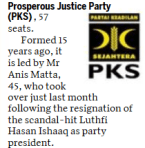
Partyforumseasia: 169 out of 560 seats in the outgoing Indonesian Parliament or 30.1% for four of the five Islamic parties  are not a bad result at first glance. Under a different angle, in relation to more than 200 million Muslims among the 237 million Indonesians, they might have done better. PKSFor the upcoming elections, though, the polls predict not more than 22 %. Why are they so (relatively) weak?
The biggest factor may be that they are competing against each other and don’t get direct support from the two huge religious mass organizations Muhammdiyah (founded in 1912) and Nahdlatul Ulama (founded in 1926). Together these Muslim movements have 70 million members but decided to stay out of party politics this time.
Other factors are corruptPANion scandals which demolished the pretended moral superiority. Politicians with religious credentials turned out to be as vulnerable to money politics as all the others and didn’t perform better when they held public office. And last but not least, the mainstream parties are promising enough bread and butter improvements which the splintered Islamic parties can’t guarantee even if some of them should make it into a government coalition as junior partners.
But religion is still playing a rather important role in the public sphere of the Republic of Indonesia. Hope bearer Joko Widodo is carefully integrating it into his campaign.
For more details see Straits Times, Singapore, 28 March 2014 (boxes)
PPP                         PKBPBB

Indonesia: The 12 Competing Parties


Partyforumseasia:        For a good overview of the twelve parties competing in the upcoming parliamentary and presidential elections we strongly recommend the following paper by Ulla Fionna and Alex Arifianto in ISEAS Perspectives, #14, 2014, 10 March 2014.

The link:

Click to access ISEAS_Perspective_2014_14-Contestants_2014_Indonesian_Parliamentary_Elections.pdf

Indo perspective

Indonesia’s Next President: Pole Position for the Hope Bearer?


Partyforumseasia: Punctually for the official campaign start for the parliamentary elections  the PDI-P has at last nominated its presidential candidate. In the polls of the last few months, Joko Widodo (“Jokowi”) is  the most successful of the possible candidates by quite a wide margin. Indo JokowiWith his successful performance as mayor of Jakarta and his clean image his popularity may not only support his presidential campaign in June, but also help PDI-P to a decisive pole position in the parliamentary elections on 9 April.

Looking into the nomination process inside the PDI-P, Partyforumseasia can confirm the strategy of the party. Keeping the public guessing whether long term party chairperson  Megawati Sukarnoputri would run herself and risk another defeat has successfully kept the media and polit-gurus busy and active. Affordable party PR can be so easy!!
And presenting the most popular candidate just at the official start into the campaign season for the parliamentary elections will certainly be good for the party as well.
Nevertheless, the nomination procedure looks a bit too leader-centric than many may see as fully democratic. But the aura of Ms Megawati as the daughter of the meanwhile legendary founder father of Indonesia, Sukarno, president 1945 – 1967, makes the nomination acceptable and valid beyond simple procedural questions:

The candidate himself is being quoted as follows: “I’ve been given the mandate by PDI-P chairwoman Megawati Soekarnoputri to become the presidential candidate representing the PDI-P,” Jokowi said during a blusukan (impromptu visit) to Rumah Pitung in Marunda, North Jakarta, on Friday. “By saying Bismillah [in the name of God], I’m ready to carry out the instruction,” Jokowi said at 2:49 p.m. as quoted by kompas.com. (Jakarta Post, 14 March 2014)
And in a letter to the editor at the end of the article we read: “
Jokowi would be the catalyst for all the honest members in the party since he gets blessing from madam chairman.”

More background information on the strategies of the competing parties can be found here on Partyforumseasia.org: LINK

Malaysia: A Lady’s Gambit against Desperate Ruling Coalition


Partyforumseasia: In 2012, opposition leader Anwar Ibrahim had been acquitted of a rather dubious sodomy indictment. Just two weeks before probably winning a Azizahby-election (scheduled for March 23) enabling him to eventually become chief minister of Selangor, last Friday, March 8, a court of appeal reverses the acquittal and sentences him to five years in jail. A more desperate move of preventing Anwar from being elected is difficult to imagine, since the shooting of political rivals, fortunately, is out of fashion in this part of Asia. Unless the court can prove that the coincidence of by-election and new conviction is based on correct legal procedures and internal court timing , the public can only see it as a desperate move of the BN-Government to politically kill Anwar off with the help of a judiciary widely seen as pliant.
The opposition coalition PKR’s strategic director Rafizi Ramli is said to be the mastermind of fielding Anwar Ibrahim in the Kajang by-election and create an even stronger power base in Selangor.  The government’s reaction is proving this by-election strategy right and dangerous for them. Obviously they are so frightened that they use the old sodomy weapon again, and against growing public disgust.
The opposition’s reaction to the appeal court intervention comes swift and smart. Instead of Anwar they will nominate tomorrow, 11 March, his wife Dr. Wan Azizah who is also president of the People’s Justice Party, PKR.
Partyforumseasia has argued already in 2013 that the ruling Barisan Nasional coalition cannot afford to lose because of the tens of thousands of party cronies and the billions at stake. Hard ball and money politics once again show their resilience in Southeast Asia.

One of Southeast Asia’s Most “Successful” Political Godfathers?!


Partyforumseasia: Transition of power is not a particularly characteristic political feature in Southeast Asia, and even less so for Malaysia. TaibThe continuing influence of former long-term Prime Minister Mahathir Mohamad, the “culling” (by a another dubious sodomy conviction) of opposition leader Anwar Ibrahim before he threatened to win the governorship of the country’s most important federal state in March are two examples. The third scandalous case in point is located in Sarawak, the huge East Malaysian federal state on the island of Kalimantan (Borneo).
After thirty-three (33!) years as Chief Minister in this resource rich state with a poor population, Tan Sri (a Malaysian title) Taib Mahmud steps down at the age of 77 on Friday 28 February, only to be sworn in as governor of the same federal state a day later, on 1 March. The succession is “very orderly” and also safe for the retiree, the new Chief Minister being a loyalist of the old one and a former brother in law. And it is nearly close to bringing in new blood, the successor is 70 years young…

It looks more than probable that Taib Mahmood had a lot of good reasons to protect his “retirement” so carefully. He has been attacked as one of the most corrupt politicians in the region, his personal assets being openly estimated at 15 billion $, that of his extended family at over 21! After his three decades at the helm and being responsible for all logging and land related issues, only 5% of Sarawak’s original rain forests are still untouched, but threatened by Taib’s blueprint for the next level of “development”.
See more details in Luke Hunt’s analysis in the (link here) The Diplomat
Godfather Taib’s role on the federal level was also important and has contributed to his long-term hold on power: He practically guaranteed Sarawak’s usefulness as a fixed deposit vote bank for the ruling Barisan Nasional (BN). Without his contribution of 25 federal parliamentary seats in 2013 the BN had lost an election which it won with a minority of the popular vote, heavy gerrymandering and … Sarawak. But increasing accusations for corruption have made Taib a growing liability as well, so an “orderly transition of power” had become necessary.

Thailand’s Politicians: Pluto- or Kleptocrats?


Partyforumseasia: In the case of Thaksin Shinawatra there has been little doubt that he made his billions with the help of political connections. And comparative research on party financing in Southeast Asia has shown that political entrepreneurship is one of the most lucrative business lines.1) The region, more or less independent of the political system, is full of “unusually rich” politicians. Corruption 4The Thai situation is being discussed in an article by Tan Hui Yee, Thailand correspondent of Singapore’s Straits Times (25.2.2014, p. A22). With a Gini coefficient of .484, higher than that of the US, Thailand is one of the most unequal societies in Asia. The regional imbalance has opened the flood gates for populist policies and the landslide victories of Thaksin’s political parties. According to Chulalongkorn University’s economy professor Pasuk Phongpaichit the minimal taxes on land are not being adjusted because most politicians are big land owners.  As protest leader Suthep Thaungsuban, himself confronted by graft allegations, tries to hurt the business empire of the Shinawatra clan, it is evident for the Thai citizens that too many politicians are millionaires in a too conspicuous way, and there seems to be no difference between the competing parties. Frustration and cynicism are growing with the number of scandals, the duration of the stand-off and the negative impact on the economy.
Money politics is all too entrenched in Thailand and Southeast Asia to be eradicated by well-intentioned reforms. Only rich enough candidates can win an election, and few will sacrifice part of their assets to get elected. That simply means that millions invested into an election campaign have to be recouped one way or the other.

1) See: Sachsenröder, Wolfgang, Party Finances and Money Politics in Southeast Asia in the reference archive.

Politics and Religion in Southeast Asia


Partyforumseasia: Groups and organizations as well as political entities like nation states need similar mechanisms to keep their members together and loyal. They have to be different from others and hostile others are especially useful to strengthen the cohesion. Religious groups cannot avoid these mechanisms either. If they don’t need enemies they have to feel at least better than others, more pious or closer to God. One of the charming internal Vatican jokes goes like this: ChurchSaint Peters shows around a newcomer and explains the different groups on the clouds sailing by. These are the Hindus, these are the Buddhists, etc. When a big cloud comes closer, the newcomer asks in a sort of excited tone: Saint Peter, so many, who are these? Peters answer with a finger over his lips: Ssh, not so loud, these are the Catholics. Don’t disturb them, they think they are the only ones in heaven…
Reli

See the full article at: http://www.rsis.edu.sg/publications/commentaries.html

If religious harmony is traditionally a delicate issue in multi-ethnic and multi-religious Southeast Asia (but becoming more and more delicate in Europe as well by massive immigration) the responsibility of the political leadership in handling latent or violent tensions is growing considerably. In this light, the Allah-privilege debate in Malaysia looks like being underestimated by its proponents. Middle Eastern Muslims don’t have too much to laugh about Malaysia, but denying Christians as people of the book the use of God’s name in Arabic makes even the Muslim Brotherhood frown in surprise.

Mega – Strategy – Pro Jokowi?


MegaThe coincidence of parliamentary and presidential elections in April makes the next months exciting for Indonesian voters and outside observers alike. Journalists and political analysts are rolling the Jokowicrystal ball back and forth, but getting reliable information about the strategic debates inside the political parties and their inner circles is more difficult than ever. With outgoing President Yudhoyono the popularity of his Democratic Party being in free fall, opposition PDI-P leader and former President Megawati Sukarnoputri (67) might be tempted to run again herself. But for many the high poll results for Joko Widodo (52, also known as Jokowi), the most popular governor of Jakarta, seem to make his candidacy a much better bet. Megawati, who still commands high respect and loyalty in the party, would probably squander the party’s chance to victory.
Merdeka.com 17.2.14
At least a growing part of the membership see it this way and try to urge an early nomination with a group called “PDI-P Pro-Jokowi”. A decision against Megawati may remain unthinkable, but intense debates within the PDI-P leadership and among the rank and file members are completely normal. There is no need to dramatize a supposed split in the party. Keeping media, voters and political competitors in the dark and guessing can be a cheap campaign tool in a country with exponentially increasing campaign costs for the parties.
Source of poll results: Merdeka.com 17.2.2104

The Southeast Asian Miracle: Thailand’s Re-Unification sealed!!


WorldNewsAgency-WNA-WorldNewsAgency-WNA-WorldNewsAgency-WNA-WorldNe
15 February 2064: The Southeast Asian Miracle: Thailand’s Re-Unification sealed!!

After the recent breakthrough in prolonged negotiations between the two sides and efficient diplomatic support from ASEAN, the heads of state of the Kingdom of Tightland (formerly known as South Thailand) and the Kingdom of Thaksimania (formerly known as North Thailand) have signed a comprehensive re-unification treaty. The signing ceremony took place in the UN Headquarters in Beijing in the presence of unification advisers from Germany and Korea.
After the former Thailand split in 2015, the founding father of Thaksimania, business-politician Thaksim Shinawatra was soon elected King of Thaksimania. The people loved him because he could fund the government out of his own pocket and reduce the tax burden to a symbolic 5%. This led to a massive migration of the business community from Bangkok and the South to Thaksimania, where they were warmly welcomed by his Majesty on the condition of participating in the funding of his government.
The impact on former South Thailand was more than difficult. The Royal Finance Ministry witnessed a rapidly dwindling inflow of taxes which could not be balanced by the most investment friendly policies worldwide. So the impoverished country succumbed to pressure from Thaksimania to drop the aggressive use of the outdated name of Thailand. To secure a sufficient flow of development aid from the rival in the North, the King agreed to change the official name of the state into Tightland. Starting around 2035 already, many countries in Asia were able to reduce or abolish taxes and military spending because the regional security was no longer threatened by the US but guaranteed by China. This ended the decades of saber rattling and aggressive symbolic politics between Tightland and Thaksimania which made the re-unification possible at the end. It remains to be seen how the population of the two nations will adapt to the changes and the big difference in affluence. 😉

Vietnam: “Tet Offensive” Towards More Democracy?


Partyforumseasia: It has not been a secret that Vietnam ‘s recent economic performance was dismal and much below her potential – largely due to red tape and mismanagement by the ruling Communist Party. Understanding that the Vietnamese people understand that very well and that resentment against the party is growing rapidly, Prime Minister Nguyen Tan Dung Dungmay be trying to change course and make himself the savior of party and country at the same time. Vietnamese researcher Huong Le Thu from the Institute of Southeast Asian Studies in Singapore sees a number of announcements in Dung’s new year address which might open up party, economy and civil society for a more dynamic development in the next few years.

Huong: “Indeed, Dung has sensed the desire of the nation well — he knows that at the current atmosphere whoever carries the ‘democracy flag’ will have the people’s support.”                                See her assessment in the EastAsiaForum here: LINK

Fast Growing Internet Risk for Politicians – PM Najib in Hot Soup


Partyforumseasia: Internet and social networks have attracted politicians all over the world as an instrument for personal propaganda and the feeling of closeness to their voters. For Prime Minister Najib Razak of Malaysia 2.1 million “Facebook likes” seem to signal popularity. The difference between these likes and the 3.4 million party members may simply reflect the focus of UMNO on rural Malay voters and their lacking internet access, not necessarily his lack of support within the party .

Najib 1Social media politics is a double-edged sword
The avalanche-like speed of communication when a post goes viral can ruin the image of a politician within hours or days. In an era where silly remarks ruin careers (an arrogant Australian wealth manager just lost his cushy job in Singapore for calling commuters on public transport “poor people”), politicians in the limelight must be extremely cautious.
PM Najib may not be fully aware of the danger. Facing a sh*t storm over his remark that food prices are not all up, since kangkung (water spinach) is getting even cheaper, many Malaysians saw it as adding insult to injury. But Najib insists and continues with more alledgedly cheaper items like sotong (squids). The public is not amused, but laughs about countless jokes ridiculing the Prime Minister.
Reports by the Malaysian Insider may be satirical, but if PM Najib is seriously asking his ministers to take a media training course, more jokes can be expected to target him in the coming weeks and months.
PS: Former PM Mahathir has already admitted last June that he might have made a mistake in giving guarantees for Internet freedom…!!

Compromise in Cambodia, Deadlock in Thailand?


Partyforumseasia:  Yesterday The Phnom Penh Post surprised with reporting on a possible compromise between PM Hun Sen and the opposition led by Sam Rainsy:
Cambodia 14.1.14

Hun SamWith the crackdown on striking garment workers two weeks ago the situation in Phnom Penh looked worse than the crisis in Bangkok. But the Thai deadlock is far from over and the intransigence of Suthep Thaugsuban (“No win-win situation, it is either they win or we win…”) signals a further increase of unrest.
Whatever the outcome in Cambodia may be, it is encouraging to hear Sam Rainsy give credit to the CPP leadership. “But they are also responsible people to some extent” he said in a press conference. The demands of PM Hun Sen to step down and snap elections being held was dropped. Instead the negotiations should focus on electoral reform, adjustments in the parliamentary set up and a TV license for the opposition.
All this may be Southeast Asian shadow play, but it could be a reminder to big neighbor Thailand that democracy is substantially compromise – for the benefit of the country.

Who is Funding Bangkok’s Street Protests?


Partyforumseasia:     According to Akanat Promphan, spokesman of the  People’s Democratic Reform Committee (PDRC), the protest activities cost between two and five million Baht (up to 160,000 US$) per day. Where’s the money coming from? That is the headline of the Singapore Straits Times’ Thailand correspondent in an article on January 9th, page A18.
THB donations

Rumours on the internet seem to suspect big companies, especially the ones sidelined by the Puea Thai government. Akanat denies that as “rarely” and holds that ordinary people support the protesters with money, food, tents, or blankets for the cooler nights. He also reports that protest leader Suthep Thaugsuban, with declared assets of more than six million US$, has even sold family land to start funding the protests.
The truth is probably a mix of the two and more possibilities, but the sophistication of the operations, including toilets, mobile kitchens, stages, big tents, sound systems and tens of thousands of people, suggest that there is quite a big logistical and planning effort behind it. And given the level of money politics in the country, the cui bono (for who’s benefit) question must be appropriate. If Suthep and the Democrat Party are right in criticizing the Shinawatra corruption (Suthep criticizsed Thaksin’s insider trading already in 1997 in Parliament), they themselves have quite a big skeleton in the cupboard. They narrowly escaped dissolution for an undeclared donation of more than 8 m US$ by a cement company (the legal donation threshold stands at 300.000) in 2005 and were acquitted in 2010 on technical grounds, because the prosecution had failed to follow proper procedures. Many Thais are not convinced that the Democrats are cleaner than Puea Thai and the Thaksin clan.
With the planned shut down of Bangkok coming Monday, 13 January, all friends of Thailand can only hope for a predominantly peaceful continuation of the standoff which is a most dangerous result of the country’s elite failure and political brinkmanship.

De-mock-racy or Demo-crazy? Political Brinkmanship in Thailand


SuthepPartyforumseasia observes with sadness the ongoing political drama in Thailand. Obviously former Deputy Prime Minister Suthep Thaugsuban from the Democrat Party tries to topple the Yingluck government at any cost for the country. By increasing the regional division between the predominantly Democrat controlled South and the overwhelmingly Puea Thai leaning North as well as between Bangkok and the rural majority he plays with fire. And by whipping up political passions hitherto unknown in the country, the future governability of a nation of 70 million people will be at risk. Many internal analysts speak already of the threat of a civil war, the spreading violence between the groups already being frightening enough.
PM Yingluck Shinawatra and Puea Thai, according to all polls, will win the February 2 election, if it materializes. This dominance over the ballot boxes can be seen as engineered by risky populist policies like cheap (30 THB) health care for the poor and rice subsidies for farmers which cost hundreds of billions and are not sustainable even medium term.
But Suthep and his supporters in the Democrat Party will be held responsible for the damage they risk to do to Thailand’s democratic and economic  development and the country’s future governability. 

Coalition Strategies in Malaysia: Barisan Component Parties No Longer Needed?


Partyforumseasia: The Malaysian Chinese Association (MCA) 150px-Flag_of_the_Malaysian_Chinese_Association.svghas been thriving for decades as appendix of UMNO, helping to secure its absolute majority by bringing in substantial numbers of Chinese votes as a regular dowry and a counterbalance to the Chinese opposition DAP. Formation and success of the Pakatan Rakyat opposition coalition and the multi-racial approach of its Parti Keadilan Rakyat (PKR) as well as the growing attractiveness of the DAP for Chinese voters have undermined MCA’s traditional role. Factional infighting has crippled the party for some time already and the extremely narrow results in the recent internal elections may herald the further decline of what was once Malaysia’s second biggest political party. In 2008 it still won 15 parliamentary and 31 state seats, in May 2013 only 7 and 11 seats respectively. But, as it was pampered by big brother UMNO with ministerial portfolios and business opportunities during its heydays, MCA is still very rich. According to a Straits Times article on 22 December the party assets are estimated at nearly 3 billion RM, which comes to over 900 million US$. These assets, land, buildings, companies (Huaren Holdings) and a 42% stake in the Star daily may keep the leadership posts embattled. 2,325 delegates elected president and deputy president, four vice-presidents and 25 central committee members, and Mr. Liow Tiong Lai has won the presidency by just 26 votes.
MCA results

Strategic Lessons: Piggy rides are dangerous coalition strategies. Junior partners have to maintain their usefulness for big brother or risk decline. Assets may keep them alive for some time but not for long.

Difficult to compare but interesting:
The German Free Democratic Party (FDP), a long term successful piggy rider in various coalitions, has lost all seats in the federal parliament in September this year. Its survival may be more difficult than for MCA because it has no assets…

Strategy or Kamikaze? Thailand’s Democrat Party…


Partyforumseasia: … between the devil and the deep blue sea, or in the more drastic German variation of the saying, choosing between plague and cholera?The problems of the Democrat Party are serious enough: It has not won an election since 1992, it narrowly escaped dissolution for irregularities with campaign donations, Chairman Abhisit Vejjajiva, just re-elected yesterday, is indicted for murder as main responsible for the army crackdown on protesters in 2010, and Prime Minister Yingluck may have outmaneuvered them by calling elections for February.
The Democrat lawmakers have resigned en masse to join Suthep Thaugsuban, a former deputy Prime Minister and prominent Democrat. Suthep is now the leader of protests against the “Thaksin system”, rallying hundreds of thousands and organizing illegal blockades around ministries and government buildings. This political “pied piper of Hamelin” is demanding that an unelected “people’s council” introduces reforms before the next Parliament may be elected in a year’s time.
SuthepIf the Democrat Party follows Suthep, they will decide on 27 December to boycott the February elections. Participating would probably mean that they lose against Puea Thai, the Thaksin Party. Boycotting would mean losing the Democrat in the party’s name. The party is probably split internally, so their strategy of resignation from Parliament may turn out to be more kamikaze than strategy.

But PM Yingluck had her own kamikaze strategy: her amnesty bill triggered the whole turmoil the country is facing now and more and more affects tourism and economy.

Partyforum Database: Party Constitutions


Partyforumseasia: Please be informed that Partyforumseasia has started to collect the constitutions of political parties in the region, starting with the constitution of the Liberal Party of the Philippines. LP PhilThe hopefully fast growing collection will be available in our database as an appendix to the basic information on the respective political party.Contributions from the parties themselves are welcome!

CONSTITUTION OF THE

LIBERAL PARTY OF THE PHILIPPINES

(as Amended on January 19, 2011)


Vision


We, the Liberal Party, envision a just, prosperous, peaceful and caring civil society anchored on social equity, a vigorous market economy, political openness, ecological balance and an honest, effective government.


            We are a responsive, accountable and broad-based political party, unleashing the potential of an empowered citizenry through the Party’s Liberal Democratic Ideals, cohesive membership and courageous, principled leadership.


Mission


            To attain that vision, we shall advance the Liberal Ideals of Society, Justice, Human Rights, a free Market Economy, Participatory Democracy, and Solidarity with all Nations.


Objectives


1.     Advance and institutionalize  the Party political ideology and philosophy;

2.     Broaden the Party’s political constituency and expand the influence of its political leaders, and;

3.     Elevate the level of political consciousness and help create a strong pluralist political system.


ARTICLE I. MEMBERSHIP


SECTION 1. MEMBERS OF THE PARTY – The members of the Liberal Party are those who are known to have affiliated themselves with it since its organization and continuously maintained their loyalty to it, and those who, after being favorably considered for admission or re-admission formally adhere to it by taking the oath of affiliation.


SECTION 2. QUALIFICATIONS – Membership in the Party shall be open to all persons, at least 15 years of age, who believe in the Party Vision, Mission and Platform of Government and subscribe to the Constitution of the Party and follow fundamental Party decisions and Party discipline.


SECTION 3. APPLICATION PROCEDURE – An application for membership in the Party shall be submitted to the Provincial, District, City or Municipal Committee of applicant’s residence, which shall have the authority to recommend its approval or disproval to the National Organizing and Membership Commission of the Party. Inaction by the National Organizing and Membership Commission for a period of thirty (30) days from receipt shall be considered as an approval of the recommendation. Applications may also be submitted to, and approved directly by, the Party President, the General Secretary, the National Political Council or the National Executive Council.


SECTION 4. OATH OF AFFLIATION – New members of the Party shall first subscribe to the following oath of affiliation:


I,________________________________,of_______________________________________________________________,_____________ _____________________________________
(City or Municipality)                                                                  (Province)

Having been accepted as a member of the LIBERAL PARTY. Do hereby solemnly swear (or affirm) that I will bear true faith and allegiance to the same; that I will support and defend its Constitution and its Vision, Mission and Program of Government; that I will work for its victory in elections and for the realization of a free, just, democratic and progressive society with a government that is clean, honest and responsive to the needs of the People; that I will comply with such rules, regulations and decision as may be promulgated by the duly-constituted  Party authorities; and that I will serve the People and the Liberal Party faithfully without any mental reservation whatsoever.

So help me God. (In the case of affiliation, this sentence will be omitted)


_____________________
(Signature)


Sponsored by:
____________________
____________________
____________________


            SUBSCRIBED AND SWORN TO before me this ____ day of ________, _____ at ___________________________.


SECTION 5. ADMINISTERING OATHS – Oaths of Affiliation may be administered by any duly authorized Party officer. This authority may be issued by the President, the National Political Council or the National Executive Council.


SECTION 6. EQUAL RIGHTS AND DUTIES AMONG MEMBERS – All members of the Party shall have equal rights and duties as follows:


  1. To be heard and to vote in Party meetings
  2. To choose or be chosen as a Party official
  3. To be informed of Party meetings, plans, activities, finances and the use of Party funds and property
  4. To be accorded due process on complaints, investigations and decisions on matters affecting membership and tenure
  5. To support and defend the Constitution
  6. To promote the Party Vision, Mission and Program of Government
  7. To be actively involved in Party meetings, activities programs and projects
  8. To pay dues and assessments


SECTION 7. GROUNDS FOR DISCIPLINARY ACTION – Any member of the Party may be disciplined, suspended or removed from the Party on any of the following grounds:


  1. Engaging in any act antagonistic to its objectives or inimical to its interest, or for violation of or deliberate failure to support any of its fundamental decisions;
  2. Failure to attend three (3) consecutive Party meetings or at least 2/3 of the meetings duly convened within a given calendar year of the appropriate committee or organ without valid reason duly communicated within a reasonable period prior to the meeting and subsequently approved by the appropriate committee;
  3. Non-participation and involvement in Party-sanctioned activities without valid reason duly communicated within a reasonable period prior to the activity and approved by the appropriate committee, and;
  4. Membership in another political party, either by act or deed.


SECTION 8. PROCEDURE – The appropriate committee or Party organ may, motu propio or acting upon a complaint executed by any Party member, investigate and decide on the case whose decision may be appealed to the National Executive Council, whose decision(s) shall be final.


SECTION 9. SUSPENSION – A Party member may be suspended for a period not exceeding one (1) year.


SECTION 10. REINSTATEMENT – A Party member duly removed may apply for reinstatement to the Party Rolls upon written application to the appropriate committee. Said member is deemed reinstated on the day the committee acts favorably on the matter by 2/3 votes of the committee members present, there being a quorum.


ARTICLE II. PARTY ADMINISTRATION


SECTION 11. GENERAL STATEMENT – The Party shall be administered by the following:


  1. The National Directorate, the National Executive Council, the National Political Council,  the National Board and the Party President
  2. The Provincial Committee and their respective Executive Committees
  3. The District Committees and their respective Executive Committees
  4. The City or Municipal Committee and their respective Executive Committees


SECTION 12. AUTONOMY AND INTERDEPENDENCE – Party administration, which is fashioned so that in the conduct of the affairs of the Party only the will of the members shall prevail, envisages autonomy in the various levels of the Party machinery, consistent with the interdependence necessary for the attainment of the objectives of the Party as provided for in this Constitution and in accordance with such decisions as from time to time may be adopted by the National Directorate, the National Executive Council, the National Political Council or the Party President.


SECTION 13. THE NATIONAL HEADQUARTERS – The Party shall establish and maintain a National Headquarters that shall be headed by a Director General aided by a functioning and effective staff complement that shall have the following functions:


  • To conduct seminars and facilitate the holding of National Party meetings and activities
  • To keep, and act as direct custodian of, Party records and papers
  • To undertake or facilitate, by itself or in coordination with research and/or political institutes, baseline and policy research for the purpose of data banking, Party legislative work and proposals
  • To assist Party members whenever appropriate and feasible, especially during elections
  • To assist the National Standing Commissions
  • To conduct such other functions as may be assigned to it by the National Executive Council, the National Political Council, the Party President and/or the General Secretary


ARTICLE III. THE LOCAL PARTY ORGANIZATIONS


SUB-ARTICLE 3.1. THE PROVINCIAL COMMITTEE


SECTION 14. COMPOSITIONThe Provincial Committee shall be composed of:


  1. The member of the National Directorate/NECO voting in the Province
  2. Incumbent members of the Provincial Board who belong to the Party and votes in the Province
  3. Incumbent City and Municipal Mayors belonging to the Party and votes in the Province
  4. One delegate, or his alternate, for each City or Municipality who shall be elected by the respective City or Municipal Committees
  5. Members of the different District Committees, should the Province consist of more than one District
  6. One delegate from each of the Allied Sectoral Groups in the Province, if so established


SECTION 15. POWERSSubject to the supervision, control and direction of the National Directorate, the National Executive Council, the National Political Council or the Party President the Provincial Committee shall be the governing body of the Party in the Province and shall represent the Party before the people and the duly constituted authorities of the province regarding Party matters therein.


SECTION 16. THE PROVINCIAL EXECUTIVE COMMITTEEUpon call of the Party President, the Provincial Committee shall elect from among its members an Executive Committee which shall be composed of a Chairman, a Vice Chairman, a Secretary, a Treasurer and such other officers as it may deem necessary, provided that each District into which a Province is divided shall have at least one representative therein. The Provincial Executive Committee shall exercise the power of the Provincial Committee when the latter is not in session.


SUB-ARTICLE 3.2. THE DISTRICT COMMITTEE


SECTION 17. COMPOSITIONThe District Committee shall be composed of:


  1. The members of the National Directorate/NECO and the Provincial Committee voting in the Congressional District
  2. Incumbent City and Municipal Mayors voting in the District who belong to the Party
  3. One regular delegate or his alternate, for each City or Municipal Committee
  4. One delegate from each of the Allied Sectoral Groups in the District, if so established


When a Province comprises one Legislative District, the Provincial Committee shall also be the District Committee, with the Provincial Chairperson acting as District Chairperson.


SECTION 18. POWERSSubject to the supervision, control and direction of the National Directorate, the National Executive Council, the National Political Council or the Party President, and in coordination with the Provincial Committee, the District Committee shall be the governing body of the Party in the Congressional District and shall represent the Party before the people and the duly-constituted authorities in the District regarding Party matters.


SECTION 19. THE DISTRICT EXECUTIVE COMMITTEEUpon the call of the Party President, the District Committee shall elect from among its members an Executive Committee composed of a Chairman, a Vice Chairman, a Secretary, a Treasurer and such other officers as it may consider necessary. It shall exercise the powers of the District Committee when the latter is not in session.


SUB-ARTICLE 3.3. THE MUNICIPAL OR CITY COMMITTEE


SECTION 20. COMPOSITION – The Municipal or City Committee shall be composed of:

  1. Members of the National Directorate/NECO voting in the Municipality or City
  2. Members of the Provincial and District Committees voting in the Municipality or City
  3. The incumbent Municipal or City Mayor who belongs to the Party
  4. The incumbent Vice Mayor and Councilors belonging to the Party
  5. The incumbent Barangay Captains belonging to the Party
  6. One delegate from each Allied Sectoral Group, if so established in the Municipality or City
  7. One regular delegate from each precinct to be named in accordance with rules to be promulgated by the National Organizing and Membership Commission


SECTION 21. POWERSSubject to the supervision, control and direction of the Provincial or District Committee, the National Directorate, the National Executive Council, the National Political Council or the Party President, the Municipal or City Committee shall be the governing body of the Party in the Municipality or City and shall represent the Party before the people and duly constituted authorities of the Municipality or City on Party matters.


SECTION 22. THE MUNICIPAL OR CITY EXECUTIVE COMMITTEEThe Municipal or City Committee shall elect from among its members an Executive Committee that shall be composed of a Chairman, Vice Chairman, a Secretary, a Treasurer and such other officers as it may deem necessary. It shall exercise the powers of the Municipal or City Committees when the latter is not in session.


Sub-Article 3.4. The Regional Party Chairpersons and

NCR Area Chairpersons


Section 23. There shall be a Regional Party Chairperson for each of the sixteen (16) administrative regions as well as four (4) Area Party Chairpersons in the National Capital Region for North, East, West, and South sectors thereof, as may be chosen by the National Board.


ARTICLE IV. THE NATIONAL DIRECTORATE


SECTION 24. COMPOSITION – The National Directorate shall be composed of delegates elected by the General Assemblies of the Party chapters from each of the four major geographical areas of the country, namely: Luzon, Visayas, Mindanao and the National Capital Region.


Each General Assembly shall be convened on the call of the Party President. The General Assemblies shall be convened at least once every six (6) years. The composition and procedures of each General Assembly shall be governed by such rules and guidelines issued by the National Executive Council (NECO) for the purpose of the Assembly, subject to the provisions of this Constitution.


The General Assemblies shall choose, in a free and open election, the delegates to the National Directorate, which shall not be more than one hundred (100) members unless otherwise established by the NECO, with equal representation to wit:


            ¼ of the delegates to come from Luzon
¼ of the delegates to come from Visayas
¼ of the delegates to come from Mindanao
¼ of the delegates to come from the National Capital Region


SECTION 25. FUNCTIONS – The National Directorate shall exercise the following functions:


  1. It shall set the general policies and guidelines for the Party, which shall be executed and administered by all Party organs under the direct supervision of the NECO.


2.     It shall be responsible for electing the following:
Party Chairperson
Two Party Vice-Chairpersons

Party President

Party Executive Vice President

Party Vice President for

1.     Policy, Platform and Advocacy

2.     External Affairs

3.     Internal Affairs

4.     Luzon

5.     Visayas

6.     Mindanao

7.     National Capital Region

8.     Youth

9.     Women

10.  Labor

11.  Farmers/Fishers

12.  Urban Poor

Party Secretary General

Party Deputy Secretary General

Party Treasurer

Party Deputy Treasurer

Party Legal Counsel

Party Spokesperson

Party Deputy Spokesperson

Party Director General


SECTION 26. SCHEDULE OF SESSIONS – The National Directorate shall meet at least once every three (3) years or as often as is necessary upon the call of the Party President. It may meet at any time upon the agreement of ¾ of all its members as certified by the Party General Secretary.


SECTION 27. POWERS – The National Directorate shall have overall administration, direction, control and supervision of the Party and its organs either directly or, when not in session, through the Party President. Upon his refusal, failure to do so, or death such powers will be exercised by the NECO, or the National Political Council when the NECO is not in session.


ARTICLE V. THE NATIONAL EXECUTIVE COUNCIL


SECTION 28. COMPOSITIONThe National Executive Council (NECO) shall be composed of the following members:


  1. The Party Chairperson
  2. The Two Party Vice-Chairpersons
  3. The Party President
  4. The Party Executive Vice President
  5. The Party Vice Presidents for Policy, Platform and Advocacy, External Affairs, Internal Affairs,  Luzon, Visayas, Mindanao, the National Capital Region, Youth, Women, Labor, Farmers/Fishers, and Urban Poor
  6. The Party Secretary General
  7. The Party Deputy Secretary General
  8. The Party Treasurer
  9. The Party Deputy Treasurer
  10. The Party Legal Counsel
  11. The Party Spokesperson
  12. The Party Deputy Spokesperson
  13. The Party Director General
  14. All former Presidents and Vice Presidents of the Republic who are members of the Party in good standing for at least six (6) months
  15. All Past Presidents of the Party
  16. All incumbent Senators and members of the House of Representatives who are members of the Party in good standing for at least six (6) months
  17. All incumbent Governors of Provinces who are members of the Party in good standing for at least six (6) months
  18. All incumbent Mayors of Cities who are members of the Party in good standing for at least six (6) months
  19. All incumbent Senior Officials of the Executive Department with rank of Ambassador, Assistant Secretary, Undersecretary, and Secretary who are members of the Party in good standing for at least six (6) months
  20. The Representatives of all Allied Sectors, which shall comprise twenty percentum (20%) of the entire NECO
  21. Such other persons of National Stature nominated by the Party President and approved by the National Board
  22. Regional Party Chairpersons from all the sixteen (16) administrative regions and four (4) Area Party Chairpersons of the National Capital Region (N,E,W,S)


Interim vacancies for these offices shall be filled by the NECO but only for the remaining portion of the term.


SECTION 29. POWERS AND FUNCTIONSThe NECO, upon formal call of the Party President, shall exercise all the powers and perform all the functions of the National Directorate when the latter is not in session. All powers exercised and functions performed by the NECO shall have the same force and effect as that of the National Directorate unless revoked or altered by the latter at the first opportunity.


SECTION 30. TENUREAll Party officers and members of the NECO shall hold office for three (3) years and until their successors shall have been duly elected and qualified or unless sooner removed for cause.


SECTION 31. SCHEDULE OF SESSIONS – The NECO shall meet at least once a year on the call of the Party President. The time, place and agenda of the session shall be specified in the call. It may meet at any time on the call of the Party President or with the agreement of 2/3 of all its members, or by a simple majority of the members of the National Political Council, as certified by the Party General Secretary.


ARTICLE VI. THE NATIONAL POLITICAL COUNCIL


SECTION 32. COMPOSITIONThere shall be a National Political Council composed of the following:


  1. The Party Chairperson
  2. The Two Party Vice-Chairpersons
  3. The Party President
  4. The Party Executive Vice President
  5. The Party Vice Presidents for Policy, Platform and Advocacy, External Affairs, Internal Affairs,  Luzon, Visayas, Mindanao, the National Capital Region, Youth, Women, Labor, Farmers/Fishers, and Urban Poor
  6. The Party Secretary General
  7. The Party Deputy Secretary General
  8. The Party Treasurer
  9. The Party Deputy Treasurer
  10. The Party Legal Counsel
  11. The Party Spokesperson
  12. The Party Deputy Spokesperson
  13. The Party Director General
  14. The Immediate Past President
  15. The Chairperson of the Parliamentary Caucus
  16. The Chairperson of the Caucus of Local Chief Executives
  17. The Chairperson of the Liberal League of Local Legislators


SECTION 33. POWERS AND FUNCTIONSThe National Political Council shall exercise all the powers and perform all the functions of the National Executive Council when the latter is not in session. It shall meet at least twice a year or as often as is necessary at such time and place as the Party President may designate.


ARTICLE VII. THE PARTY NATIONAL BOARD


SECTION 34. THE NATIONAL BOARD There shall be a National Board of the Party composed of the principal officers of the Party: the Chairperson, the two Vice-Chairpersons, President, Executive Vice President, and Vice President for Policy, Platform and Advocacy, Secretary-General and the Treasurer. It shall exercise all the powers and perform all the functions of the National Political Council and National Executive Council when these are not in session. It shall meet regularly.


ARTICLE VIII. THE ADVISORY COUNCIL


SECTION 35. COMPOSITION – There shall be established an Advisory Council composed of not less than nine (9) members, chosen by the NECO from among members of the Party of known probity, integrity and independence. They shall all have been persons of national standing who have served the Party and the Republic. It shall be chaired by the Immediate Past President of the Party and may choose such other officers as it sees fit, subject to the approval of the Party President.


SECTION 36. POWERS AND FUNCTIONS – The Advisory Council shall serve as the principal source of advice to the Party organs on matters involving the dynamics of internal Party organization as well as external political development. It shall regularly monitor development in and outside of the Party that it believes will have an impact on Party work.


It shall also undertake a regular review of the activities of the Party and its officers and the operations of the National Headquarters and it’s Staff with the view to making specific recommendations for improvement of the performance of the Party. These recommendations shall be submitted to the Party President in a written report. The Party President shall meet with the Advisory Council at least once a year.

ARTICLE IX. PARTY OFFICERS


SECTION 37.  THE PARTY CHAIRPERSONThe Party Chairperson shall be the titular head of the Liberal Party. As such, he shall preside over all the Area General Assemblies and conventions convened by the Party, as well as all the meetings of the Party National Directorate.


SECTION 38. THE PARTY VICE-CHAIRPERSONThe Party Vice-Chairperson shall exercise such powers and perform such functions as the Party Chairperson may from time to time assign. In case, for whatever reason, the Chairperson is temporarily unable to perform his duties he shall designate one of the Vice-Chairpersons to perform these functions in his temporary absence. In case of vacancy in the position of the Party Chairperson, one of the Party Vice-Chairpersons as determined by the National Board shall assume the office for the remaining period of the term. In such an instance, the National Executive Council shall elect a new Party Vice-Chairperson to serve for the remaining period of the term.


SECTION 39. THE PARTY PRESIDENT – The Party President shall be the principal leader and Chief Executive Officer of the Party. He shall also be the Party’s Spokesperson unless he designates otherwise. He shall exercise all the powers and perform all the functions of the National Board, National Executive Council and National Political Council when the urgency of the matter cannot wait for the action of the National Board, National Executive Council or the National Political Council. The exercise of such powers or the performance of such functions shall be reported to the NECO at its next session. He may delegate any of his powers to any Party officer.


He shall preside over meetings of the National Directorate, the National Executive Council and the National Political Council


SECTION 40. VACANCY IN THE PARTY PRESIDENCY In case of any vacancy of the Party Presidency or permanent disability of the incumbent, the Party Executive Vice President shall assume the office for the remaining period of the term.


Should the Executive Vice President for whatever reason fails to assume the Party Presidency, the National Political Council shall meet not later than 15 days from the occurrence of the vacancy to elect from among themselves a Party President to serve for the remaining period of the term. In the meantime, the Secretary General shall concurrently act as Party President.


SECTION 41. THE EXECUTIVE VICE PRESIDENTThe Executive Vice President shall exercise such powers and perform such functions as the Party President may from time to time assign.


In case of any vacancy in the position of Executive Vice President, the National Political Council shall elect the Executive Vice President from the incumbent Vice Presidents.


SECTION 42. THE VICE PRESIDENTthe Vice President shall assist the Party President as councilor and executives in all matters pertaining to their jurisdiction.


SECTION 43. THE SECRETARY GENERALThe Secretary General shall be the Chief Administrative and Liaison Officer of the Party, coordinating the activities of the various Party organs at all levels. He shall be the custodian of all Party records and documents and shall be the official recorder of all meetings of the National Directorate, the National Executive Council and the National Political Council. Furthermore, he shall oversee and direct the operations of the National Headquarters and other Party support organizations with the assistance of the Deputy Secretary General.


Subject to approval by the Party President, he shall appoint all subordinate officials and staff for his office. He shall fix their compensation and prescribe their duties and responsibilities.


SECTION 44. THE DEPUTY SECRETARY GENERALThe Deputy Secretary General succeeds to the powers, duties and responsibilities of the Secretary General in case of failure, disability or inability of the former to perform the same. He shall exercise such powers and perform such functions as the President and/or Secretary General may from time to time assign him.


SECTION 45. THE TREASURERThe Treasurer shall be the Chief Financial Officer of the Party and, with the assistance of the Economic, Development and Finance Commission, shall raise funds that shall be disbursed upon authority of the Party President. He shall be the custodian of Party funds and properties.


Subject to approval by the Party President, he shall appoint all subordinate officials and staff for his office. He shall fix their compensation and prescribe their duties and responsibilities.


SECTION 46. THE DEPUTY TREASURERThe Deputy Treasurer succeeds to the powers, duties and responsibilities of the Treasurer in case of failure, disability or inability to perform the same. He shall be responsible for assisting the Treasurer in implementing fund-raising programs for the Party.


SUB-ARTICLE 9.1. DISCIPLINARY ACTION REGARDING OFFICERS


SECTION 47. DISCIPLINARY ACTIONSAny officer of the Party may be removed or suspended on the following grounds:


  1. Commission of any act antagonistic to the Party objectives or inimical to its interests, or for violation of or deliberate failure to support any of its fundamental decisions
  2. Membership in another political party, either by act or deed
  3. Dishonesty, oppression or misconduct while in office, gross negligence, abuse of authority or dereliction of duty
  4. Failure to attend two (2) consecutive Party meetings or at least ½ of the meetings duly convened within a calendar year of the appropriate committee or Party organ.


Any officer of the Party may be subjected to disciplinary actions, including suspension from effective exercise of his Party rights for a period of one year or less for the same or less serious cause as may be established by the National Executive Council or the National Political Council.


SECTION 48. PROCEDUREThe National Executive Council, if so convened for the purpose, may, motu proprio or acting upon a complaint for disciplinary action against any Party member, investigate the case and decide on the matter. The decision of the National Executive Council shall be final.


Municipal, City and Provincial committees, acting upon a complaint, may impose the appropriate disciplinary action on the local Party officer concerned.


ARTICLE X. THE NATIONAL STANDING COMMISSIONS


SECTION 49. CREATION – There shall be created a number of National Standing Commissions, each to be composed of not more than five (5) members, namely:


  1. National Organizing and Membership
  2. Economic Development and Finance
  3. Political and Electoral Affairs
  4. Public Policy and Advocacy
  5. International Affairs
  6. Media and Public Relations


The National Executive Council upon recommendation by the President shall appoint the Chairperson and members of the Standing Commissions.

SECTION 50. FUNCTIONS – The functions of each National Standing Commissions shall be the following:


  1. The National Organizing and Membership Commission shall be responsible for the overall recruitment and expansion program of the Party and its local branches, and shall act on recommendations for memberships submitted by the appropriate Party committees. It shall endeavor to resolve conflicts among Party members referred to it by the National Executive Council or by the Party President.


  1. The Economic Development and Finance Commission shall formulate an overall financial and resource-generation program and facilitate and oversee national fund-raising activities. It shall also explore different approaches for Business Development, Entrepreneurship and other self-help schemes for the benefit of the Party and its members.


  1. The Political and Electoral Affairs Commission shall oversee the Party’s overall electoral organizing program and strategies. It shall likewise be responsible for developing a candidate pool and the conduct of appropriate training for candidates and their supporters. It shall regularly conduct political analysis of national and local situations and undertake alliance-building and unified-front work with other political forces promoting similar goals, subject to guidelines established by the Party President.


  1. The Public Policy and Advocacy Commission shall be responsible for the public education and policy research program of the Party.


  1. The International Affairs Commission shall be responsible for the international liaison and political work with other Liberal Parties and organizations in the world. It shall represent the Party in international meetings and conferences, whenever specifically designated by the Party President. It shall also monitor international developments that may have significance for the Party’s political work.


  1. The Media and Public Relations Commission shall have responsibility for the overall media exposure of the Party and for the maintenance of a good public image with the general population.


All policies and regulations adopted by the Standing Commissions shall be subject to the approval of the National Political Council and shall be disseminated to all Party branches and Commissions.


ARTICLE XI: CHOICE OF PARTY CANDIDATES FOR ELECTIVE

GOVERNMENT POSITIONS


SECTION 51. CHOICE OF PARTY CANDIDATES FOR ELECTIVE GOVERNMENT POSITIONS – The choice of Party candidates shall be within the exclusive jurisdiction of the appropriate Party structure, ensuring the broadest participation from the general Party membership when appropriate and feasible, as follows:


  1. Candidates for President, Vice President and Senator shall be chosen by the National Executive Council subject to the approval of the National Directorate
  1. Candidates for member of the House of Representatives shall be chosen by the appropriate District committees subject to the approval of the National Executive Council


  1. Candidates for Local Chief Executives and Vice Chief Executives and members of Local Legislative Councils of Provinces, highly urbanized Cities and Chartered Cities shall be chosen by the respective Party committees subject to the approval of the National Executive Council


  1. Candidates for Councilor shall be chosen by the Provincial, City and Municipal Committees


When the appropriate committee or organ has not been convened and constituted or has become inoperative the Party President may, upon consultation with those affected, choose and nominate candidates for the area affected.

Appeals from decisions of the committees shall be elevated to the next highest committee.


SECTION 52. CERTIFICATES OF NOMINATION – Certificates shall be issued by the Party President or the General Secretary upon authorization by the former, for candidates for President, Vice President, Senators and members of the House of Representatives.

The Party President or the General Secretary may authorize in writing other Party officers to issue Certificates of Nomination to candidates for local elective offices.


Certificates of Nomination as guest candidates may only be issued by the Party President or the General Secretary, upon the latter’s authorization.


SECTION 53. QUALIFICATIONS AND DISQUALIFICATIONS OF CANDIDATES – Aside from the qualifications of candidates as provided by law, an official candidate of the Party must:

  1. Be a member in good standing of the Party at the time of consideration of his nomination by the appropriate Party committee, AND
  1. Has been a member of the Party for at least one (1) year from the date of the Election. However, the appropriate Party committee may decide, by 2/3 vote of the members present, there being a quorum, to waive said requirement.


ARTICLE XII. MISCELLANEOUS PROVISIONS


SECTION 54. PRESIDENT OF THE PHILIPPINES – The President of the Philippines, when belonging to the Party, shall be the titular head of the Party.


SECTION 55. RULES OF LOWER PARTY ORGANS – Every organ or unit of the Party shall have power to adopt, amend or repeal such local rules for its internal government as are not inconsistent with this Constitution or with the rules, regulations, decisions or issuances of the National Directorate, National Executive Council, National Political Council or the Party President.


SECTION 56. RECORDS – Every organ or unit of the Party shall keep a roll of its members. In case of controversy, the records of its proceedings shall be considered final and binding when certified by the Party President or his duly authorized representative. It may place at its offices a signboard containing the name of the Party and the designation of the organ or unit.


SECTION 57. APPROVAL OF RESOLUTIONS OF DISTRICT, PROVINCIAL, CITY, MUNICIPAL OR BARANGAY COMMITTEES – Resolutions adopted by a Provincial, District, City, Municipal or Barangay Committees shall be registered with the Offices of the General Secretary and shall be binding as of the date of registration, subject to the limitations in Section 50.


SECTION 58. SUPPLETORY REGULATIONS – In the absence of specific provisions in this Constitution the rules, regulations, decisions or issuances of the National Directorate, the National Executive Council, the National Political Council or the Party President shall govern.


SECTION 59.  INCUMBENT LOCAL PARTY OFFICERS – All incumbent local Party officers, whether Regional, Provincial, District, City, Municipal or Barangay shall continue to serve as such until their successors shall have been duly chosen and qualified in accordance with this Constitution.


SECTION 60. NATIONAL PARTY OFFICERS – In accordance with the authority vested in the Party President [given 5 October 1985 by the National Executive Committee], all incumbent national Party officers, as duly certified by him in each case, shall continue to serve as such until their successors shall have been duly chosen and qualified in accordance with this Constitution.


SECTION 61. QUORUM – For the purpose of transacting business, the presence of ¼ of all members of any Party organ or unit shall constitute a quorum. However, the National Executive Council or National Political Council may adopt its own rules respecting quorum.


SECTION 62. VACANCIES – Vacancies in the National Political Council, the National Executive Council, Provincial, District, City or Municipal Committees shall be filled by the corresponding committee or Party organ unless otherwise provided for in this Constitution.


SECTION 63. OFFICERS OF THE PARTY – The officers and members of the National Executive Council, National Political Council and those of the Provincial, District, City or Municipal Committees are Party officers.


SECTION 64. CAUCUSES OF ELECTED OFFICIALS – Members of the Party who are elected to Congress shall constitute themselves into a caucus, with a Chairperson, for purposes of defining specific policies and approaches to be pursued in each Session of Congress. All Local Chief Executives shall likewise be convened by the Party into a caucus, which shall also elect its Chairperson, to determine common concerns for promoting local autonomy and good governance.


SECTION 65. OATH OF OFFICE OF PARTY OFFICERS – Before entering upon the performance of their duties and assumption of their responsibilities, Party officers shall subscribe to the following Oath, the original of which shall be kept on file with the Office of the General Secretary:


                I, _______________, having been elected _______________, of the Liberal Party, do hereby solemnly swear (or affirm) that I will well and faithfully discharge the duties of said office to the best of my ability; that I will uphold and defend the ideals and principles of the Liberal Party as embodied in its Vision and Program of Government; that I will maintain my unswerving loyalty to the Liberal Party, its Constitution, rules and decisions; and that I will serve the People and the Liberal Party with utmost fidelity without any mental reservation whatsoever.

                So help me God. (In case of affirmation, this sentence will be omitted)

                                                            ________________
(Signature)

SUBSCRIBED AND SWORN before me this ___ day of _____, 20___ at ____________

________________________
Administering Party Officer


SECTION 66. COMMEMORATIONS – The Party shall publicly commemorate the following occasions:


  1. 19 January, the Founding Anniversary of the Party
  2. National Heroes Day
  3. 10 December, Human Rights Day
  4. 30 November, Bonifacio Day
  5. 30 December, Rizal Day
  6. Such other days as the National Executive Council shall designate


ARTICLE XIII. PROMULGATION AND AMENDMENTS

TO THIS CONSTITUTION


SECTION 67. PROMULGATION – This Constitution shall be promulgated by the Executive Committee at a meeting called for the purpose by the President.


SECTION 68. AMENDEMENTS TO THE CONSTITUTION – this Constitution may be amended by the vote of 2/3 of all members of the National Executive Council at a meeting called for the purpose by the President, provided that the members of the National Executive Council present for said meeting are in quorum, which is defined as fifty percent plus one of the total membership of the National Executive Council.


ARTICLE XIV. TRANSITORY PROVISIONS


SECTION 69. The Executive Committee convened on 20 September 1999, for the purpose of amending the Party Constitution, shall elect the new set of Party officers provided for by these amendments.


SECTION 70. The term of office of the new set of Party officers elected by the Executive Committee shall be until 30 September 2001.


SECTION 71.  The Executive Council convened on 28 November 2003 for the purpose of amending the Party Constitution shall elect the new Party Chairperson and Vice-Chairperson who shall have the same term as all other Party Officers previously elected.


 

Malaysia: A Good Question Concerning the Pakatan Rakyat Opposition Coalition


Partyforumseasia: Prime Minister Najib Razak’s leadership of UMNO has been strenghthened and confirmed by the recent internal party polls. Najib 6.12.13For the time being there are no visible challengers around and Najib feels more than confident in promising the 3000 party leaders attending the annual meeting a continuation of the “Malays First Policy”. This is seen as race based by the roughly 40% Non-Malay Malaysians and has contributed to a surge in the popular vote for the opposition in the general election in May.
In terms of election strategy this makes sense, though, since UMNO’s main support comes from carefully gerrymandered rural constituencies with huge Malay majorities. As long as the first-past-the-post electoral system remains UMNO can focus on these vote banks while the opposition coalition might win the urban votes but fail to win a majority in parliament.

An interesting question has been raised by Murray Hunter in the New Mandala: Whether Pakatan Rakyat deserves to be in government!!!!
See (link here) New Mandala

PRakyat Whether a party or coalition really deserves to be in government is a difficult question. But there are indeed some big question marks concerning the cohesion and stability of the Pakatan Rakyat coalition. Some see the three coalition partners as somewhat strange bed fellows, united only in their struggle against the ruling Barisan Nasional.

Malaysia’s Islamic Party (PAS) Between “Ulama” and “Erdogan” Factions


Partyforumseasia: With nearly one million members Parti Islam SeMalaysia (PAS) is the biggest party in the opposition coalition Pakatan Rakyat or People’s Alliance, but many of its members seem to feel that Anwar Ibrahim’s Parti Keadilan Rakyat (PKR) and the Chinese dominated Democratic Action Party (DAP) are treating PAS as a junior partner. This has lead to the formation of factions within the party, often dubbed as Ulama (clerical) and Erdogan (“liberal”). The tensions were visible for some time already and even more so during the party convention over last weekend, 22-24 November. Party president Abdul Hadi Awang was reelected unchallenged and deputy president Mohamad Sabu‘s victory over his conservative rival from the ulama faction with 588 to 490 votes was considered a victory for the liberals, also called “Anwarinas” for supporting Anwar Ibrahim as leader of the PR coalition.
PAS leadersAmong the three vice-presidents only one from the ulama faction was elected. But some results came out only after recounting, a sign that the polling was controversial. The following calls for unity show that the strategic orientation of the party remains under debate. The “progressives” want to broaden the voter base and open it to non-Malays and non-Muslims because they are fishing in the same pond as arch rival UMNO. As seen among the religious (Christian) parties in old Europe, the rural and probably more religious constituencies lose much of their importance with the fast urbanization, even if the Malaysian first-past-the-post election system still gives them an advantage.

Indonesia: “Creative” Money Politics…


Partyforumseasia:  “Vae victis” meant in old Rome “woe to the vanquished or the conquered (ones)“. Being caught red-handed in corruption cases in Southeast Asia these days is getting more and more unpleasant as well. And the decades when politicians could easily get away with it may come to an end after new big scandals in the Philippines and Indonesia generate a bigger public outcry then ever before. caught
The picture shows former police general Djoko Susilo listening to his verdict in court. With 20 houses and other assets in the names of his second and third wives he was one of the “unusually rich” persons in power. Many politicians could follow him if the anti-corruption drive gets really serious.

But in the ever creative ranks of political entrepreneurs in Indonesia, and the chief justice of the Constitutional Court being indicted in a cash for settling an electoral fraud case, the methods of greasing helpful hands get more sophisticated as well. Instead of gangster-like cash hand-overs, credit cards backed with substantial prepaid accounts or insurance policies with substantial sums for the old age seem to be more difficult to detect.

Philippino Supreme Court: Throwing out the Baby with the Bath Water?


Partyforumseasia had taken up the pork barreling saga in the Philippines recently. babyYesterday, November 19th 2013, the Supreme Court has declared  the Priority Development Assistance Fund (PDAF) or pork barrel fund “unconstitutional”. Many concerned citizens welcome this decision with a sigh of relief, first letters to the editor thank the Lord for this decision.
See (link here) The Manila Times of November 20th.

For the political parties and politicians it will be a severe blow, cutting them off from the most important funding source for their activities and election campaigns. But their shamelessness in the practical handling of kick-backs from development funds in the billions of Pesos and millions of $ has triggered the loudest ever public outcry and the radical decision of the Supreme Court.

The question is now how the political system can find a legal and socially acceptable way of funding parties, politicians and election campaigns. As e.g. the German example shows, even generous public funding is not sufficient. In 2013 the “Campaign Cost Reimbursement” for political parties will amount to 154 million €, but the combined budgets of all eligible parties are being estimated at 450 to 500 m €. Donations are indispensable in every political system but not easy to control and protect against influence peddling and lobbyism.

Philippines: End of Pork Barrel Politics? Party Financing Endangered…


Partyforumseasia: Scandals can speed up necessary reforms. At a time when the strongest ever tropical storm hit the Philippines, one of the ugliest political corruption scandals has started to change the political porklandscape in Manila. Triggered by a whistle-blower, businesswoman and alleged “Pork Queen” Janet Lim Napoles has been exposed as central facilitator for abusing development funds for kickbacks to congressmen and senators. This method of funding politicians and political parties, partially via fake NGOs, was widely known, but never exposed like now. And the alleged dimensions are certainly outrageous in a country with the remaining poverty level of the Philippines. One of the prominent accused is veteran politician Juan Ponce Enrile (89), who only some months ago had to resign as president of the senate because of abusing senate funds. The alleged kickbacks for the multimillionaire are supposed to be 363 million Pesos (more than 8 million US$!!), half of his pork allocation. Other colleagues are liable for similar sums, that means that development funds earmarked for infrastructure projects in the respective constituencies have been used for campaign and party funding, maybe for private purposes as well.
In the face of massive demonstrations during the last few months, also against President Aquino, who won his election with an anti-corruption campaign, politicians have started to back-paddle. As of November 12th, nine senators had already declared that they are waiving their PDAF (Priority Development Assistance Fund) – allocations for 2014.
The political establishment may find other ways of refinancing, though, similar to creative new money politics in Indonesia. Cash transfers being too dangerous now, credit card payments, insurance policies, fixed assets and landed property seem to be a way out…

Appendix: 1 billion Pesos are nearly 23 million US$
PDAF

Party Formation in a Nutshell…


Partyforumseasia: The growing political science literature on political parties offers a lot of insight…but never as nicely cynical and easy to read as cartoonist Wiley Miller.

Wiley Miller Party

Political “Dynasties” in Southeast Asia


Partyforumseasia: Political families are not uncommon in party politics, take for example the 41st President of the United States, George H.W. Bush and his son, the 43d President, George W. In Europe it happens less on the top level, but often enough in regional and local politics. The corruption and enrichment scandal in Indonesia’s Banten province and the remarkable career of Mukhriz Mahathir in Malaysia have brought the issue back into the media. MukhrizIn the Mukhriz case two narrowly lost elections, his candidacy for one of UMNO’s vice-presidential posts and the recent by-election in the federal state of Kedah, where he supported the local party candidate, are interpreted as defeat and the campaign support by his father Mahathir Mohamad, 88, a liability, signalling the end of father Mahathir’s overpowering influence in Malaysia’s and UMNO’s politics.
RatuThe Banten case (already posted by Partyforumseasia) has much broader ramifications with family members of the governor Ms Ratu Atut holding seats in the national parliament, mayors, deputy regents and numerous business positions close to politics and administration. Continuing practices of money politics remind many Indonesians too much of Suharto’s family clan and the enrichment of his sons.
If the Banten-related corruption case involving the chief justice of the Constitutional Court should turn out as the tip of the iceberg, as it looks like, it will be more than difficult to fight family dynasties and money politics throughout the huge Indonesian archipelago.
By the way: Partyforumseasia has other (possible) family dynasties on its radar:
Thailand: Not only sister Yingluck, but also son Panthongtae Shinawatra
Malaysia: Mukhriz Mahathir from UMNO and Nik Abduh from PAS
Singapore: Prime Minister Lee Hsien Loong, a successful succession with a long break after his father resigned.