Partyforumseasia: Recommendation!!!!
For more details visit Greg Lopez‘ excellent blog at wordpress.com


Partyforumseasia: Recommendation!!!!
For more details visit Greg Lopez‘ excellent blog at wordpress.com
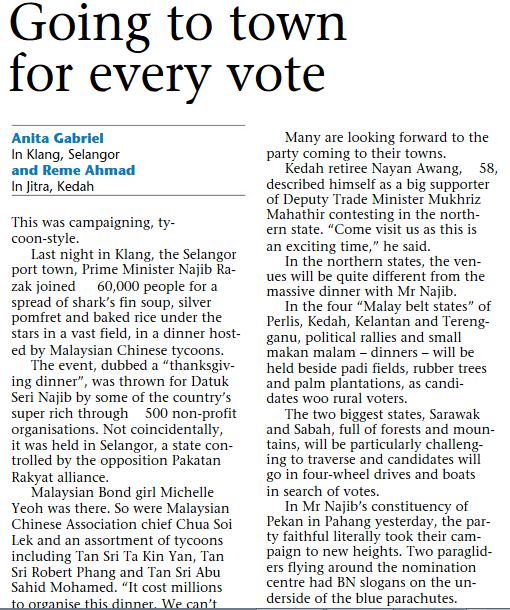
Partyforumseasia: As Partyforumseasia had already assumed, this campaign will be the most expensive ever, and money does not seem to be a problem. When Jesus fed the 5000 it was considered to be a miracle. BN can easily feed 12 times that many with shark’s fin soup and silver pomfret, payed for by rich supporters, “Chinese tycoons” who might have a stake in BN’s grip on power… Source / Link: Straits Times 21 April 2013
Partyforumsseasia: But BN and PR have a couple of problems with their dropped candidate hopefuls after nomination day. Since a certain amount of self-confidence if not narcissism is involved if people run for public office, disappointment is great for the ones who are being dropped without being tested at least by an election within the party. This is the risky side of appointments by the party leadership, and, no surprise, many of these have registered as independent candidates:
Source / Link The Malaysian Insider 21 April 2013

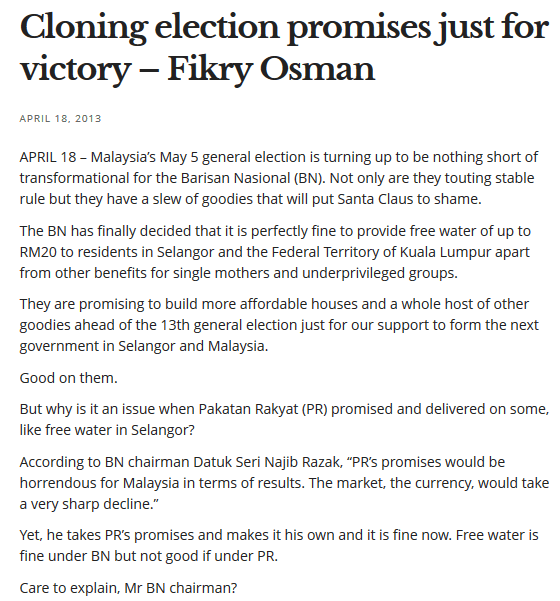
 Partyforumseasia:Christmas is less about promises than about gifts on Christmas day. GE 13 may be more about promises and less about real gifts after the election. The taxpayers will have to foot the bill anyway. But frankly: Single mothers as a vote bank for the BN? That is rather unusual in the regional and international comparison. At least it reveals a certain nervousness of PM Najib and his campaign strategists…
Source / Link: The Malaysian Insider, 18 April 2013
Partyforumseasia: Winnability is certainly the most important criterion for the selection of candidates. Whether the candidate elected by his or her branch with participation of the party members has better chances than the one appointed by the party leadership with its higher overview and wisdom is debatable. With all the appointments going on in the overheated campaign preparations in Malaysia (and the “sulking” dropped incumbents…) on both sides, in Thailand there is still the demand from the ground to hold proper elections, this time from the “Red Shirts” in Chiang Mai, obviously unhappy with the way PM Yingluck is promoting her sister…


Source / Link: The Nation 16 April 2013
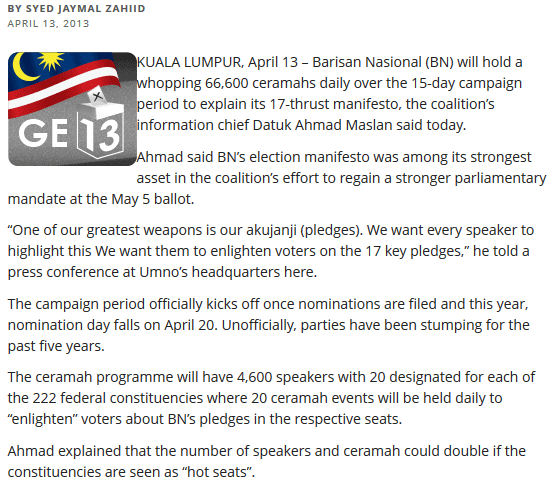
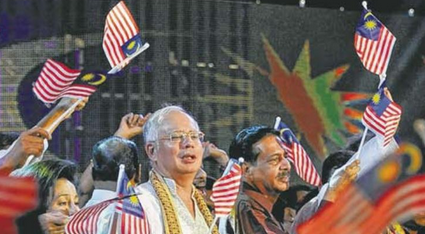 Partyforumseasia: If the Election Commission hopes for the best ever election (instead of the dirtiest), it is probably safe to say that it will be the most expensive ever in Malaysia. Everybody who has a vague idea of what is at stake for the incumbent Barisan Nasional (and its cronies) if they should lose it can understand the all out effort in this campaign. French diplomat-politician Talleyrand (1754-1838) once said that the most painful farewell in this world is the farewell from power. But losing power and at the same time being cut off from one’s financial resources must be even worse. Here are some fresh examples of BN’s campaign efforts: 66.600 rallies planned until 5 May and lots of free dinners for potential voters… The opposition is not amused.
Link: The Malaysian Insider, 13 April 2013

Link: The Malaysian Insider, 13 April 2013
Partyforumseasia: Tan Sri Abdul Aziz Mohd Yusof, chairman of the Election Commission (EC), announced 5 May as polling day and 15 days for the official campaign yesterday. Dismissing claims that it could be one of the dirtiest, he said: “We hope that this would be the best general election.” (Link: New Straits Times) Whether the 15 days are a sign of “healthy democracy”, as PM Najib says, may not be so important after nearly two years of unofficial campaigning. But the procedures organized by the EC have certainly improved, from indelible ink (colour still kept secret…) to more attention to the voter list and the possibility for voters to check it online.
Another feature, obviously less controversial in Malaysia and other countries in Southeast Asia, but at least questionable for a “healthy democracy” is the selection of candidates. As if elections inside the parties were not an option, party leaders decide among themselves on the most winnable candidates – under the risk of being sabotaged by the dropped hopefuls. For the Barisan Nasional this must be a tricky procedure given their attempt to renew the party with 40% fresh candidates. See also Straits Times, 11 April:

Partyforumseasia: Older voters have been mobilized world wide under the assumption that they are conservative and vote for the ruling party. PM Najib, concerned about retired top civil servants joining the opposition PR, tries to woo the over 700.000 retired civil servants with the promise of increasing their pensions if they support his re-election. The calculation that the oldies can bring in their spouses’ votes as well and yield up to 1.5 million votes for BN may be too optimistic, though. And according to the Election Commission, 2.3 million or 21.69 % of Malaysia’s 13.29 million registered voters are young first timers. Will it be old BN suppporters against young opposition voters?
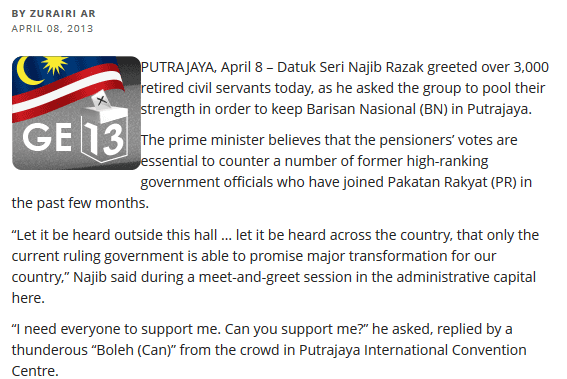

Source/Link: The Malaysian Insider, 8 April 2013
Partyforumseasia: The most interesting changes to the organization of the voting process world wide are related to overseas and postal voting. With more citizens living abroad their participation in elections has become more important in several ways. The extremely narrow victory of George W. Bush in 2000 with 537 postal votes in Florida is unforgotten. If Malaysia’s Election Commission is disappointed with the low registration rate of the 700.000 Malaysians overseas, there may be, as in many other countries, the hope that this is a conservative voter group probably supporting the ruling coalition.
The opposition does not exclude fraud and manipulation with the postal voting. See: The Malaysian Bar, 6 April 2013, reprinting an interview in the Sun of 27 March 2009 in which Anwar Ibrahim speaks about fraud with postal votes.
Find some comparative international information at the end of this post:

See the full article in The Straits Times 6 April 2013
________________________________________________
International comparison:
Italy: Nearly 3 million Italians abroad (.5 m in Germany) vote for 12 MPs in the National Parliament. Right of overseas voting since 2006.
Spain: 1.5 million Spanish citizens abroad, 870.000 in Latin America, 60% of them eligible. In the 2008 election PM Zapatero campaigned there for his Socialist Party.
Turkey: 2.5 million Turkish voters abroad, 1.5 m in Germany alone. Postal voting since 2008.
Germany: Postal voting since 1957, percentage in 2009: 21,4%. Overseas voting since 1985, 55.000 (approx. 10%) registered and voted in 2009.
World wide: E-voting in its infancy and still rather costly. With e-identification on its way for banking and business, e-voting may develop soon and result in tremendous savings for the organization of elections.
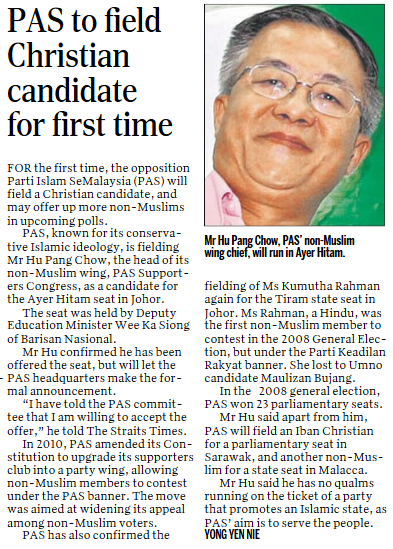
Partyforumseasia: Since UMNO is competing for the same voter pool among rural and pious Malays, opposition Parti Islam SeMalaysia (PAS) has tried for some time already to open up to non-Muslims, also showing at the same time that nobody should be frightened by its Sharia policies which would apply only to Muslims. Fielding for the first time a Christian candidate in the upcoming election is certainly a significant symbolic step. It is also in line with the Pakatan Rakyat and Parti Keadilan Rakyat line of multi-racial party development in Malaysia.
Link: Straits Times 5.4.2013
Partyforumseasia: Election fever is on the rise since Prime Minister Najib Razak was expected to dissolve the Malaysian Parliament nearly two years ago but hesitated to do so. Now that the election date is near, the temperature is rising even higher. For outsiders the wording of ABU leader Haris Ibrahim may sound exaggerated, but knowing how much is at stake for supporters and cronies if UMNO should lose this election, fears of manipulation don’t seem to be baseless. The Malaysian Insider (link) reports:
5 April 2013

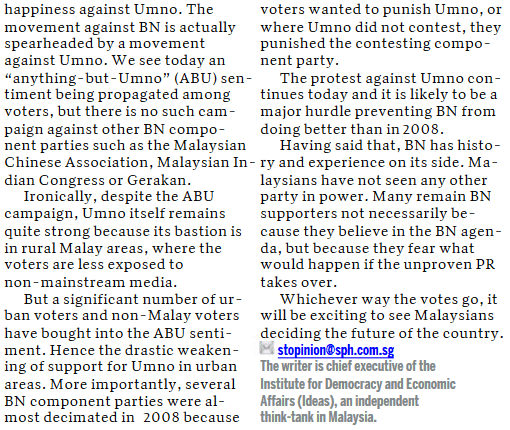
 Partyforumseasia: In many democracies the ruling parties have to face dropping popularity and voter support. That is quite normal and tends to get worse with the years in power. Malaysia, today, is deeply divided, given the general information available about arrogance of power, money politics, corruption scandals and election manipulation seen as typical for UMNO which is ruling the country since independence. In an article for the Straits Times, Singapore, Wan Saiful Wan Jan, head of the Institute for Democracy and Economic Affairs (Ideas) in Kuala Lumpur, remains cautious about an opposition victory, but points out the average voters’ frustration with UMNO: the “Anything But UMNO” or ABU sentiment. Combined with the opposition strategy of attacking long term strongholds of the ruling coalition like Johor, Pahang, Sabah and Sarawak and doubts about the cleanliness of the upcoming election, ABU may tip the scale for the Pakatan Rakyat.

Partyforumseasia: Just three weeks before the parliament would have been dissolved by law, Prime Minister Najib Razak has at last announced the dissolution – with the (expected) blessings of the King. Political Malaysia feels relieved. The elections will probably be scheduled April 20th or 27th.
Why Najib was hesitating so long will remain speculation according to the observer’s preference. For the BN-camp it will be caution and extended preparation for a victory, for the PR-camp a sign of weakness. In any case it is noteworthy that the BN government has already showered the country with several cash schemes, whereas the opposition PR could only make promises.
See today’s report of The Malaysian Insider
Links: Straits Times(30.3.2013), Straits Times (31.3.2013), Jakarta Post (31.3.)
 Partyforumseasia: The rescue operation for the somewhat “anorexic” Democratic Party by an extraordinary convention in Bali on 30 March 2013 has worked as planned.
President Susilo Bambang Yudhoyono (SBY), with acclamation ( not vote) of the delegates, has taken over the chairmanship after former chair Anas Urbaningrum had stepped down under corruption suspicion. Other candidates were being discussed, but only SBY himself was supposed to be elected without exposing the internal cleavages of the party in which Anas still enjoys major support among members and local leaders. SBY, after being elected, called for unity and cohesion, but critics say that the concentration of power is not healthy. The president who looked reluctant to take over and only under the condition that an executive chairman (to be appointed by SBY!!) does the day-to-day work, now chairs the party’s central executive committee and supreme assembly as well as the board of patrons, and his son Edhi Baskoro Yudhoyono is secretary-general.
As a sideline, the reports reveal a few details about the organizational structure of the Democratic Party: The chairpersons of the 33 provincial branches had prepared the convention by seeing the president beforehand in Jakarta “to pledge support for him”. The Bali convention assembled 754 party cadres with voting rights from provincial, district and city heads plus several other party elites. Interesting and allowing a glimpse into the internal cleavages was the exclusion from the Bali convention of former Cilacap district chairman Tri Dianto because he had no more voting rights. He happened to be one of the possible successors of Anas as new chairman…
Strategy-wise the exercise could unite the party in preparation of and until the 2014 elections, but, as it happens in medical practice, it could also turn out to be a successful emergency operation leaving the patient dying nevertheless. With SBY’s presidency definitively ending in 2014, the struggle for his succession is visibly on in the Democratic Party.
Follow-up:
Link: http://www.thejakartapost.com/news/2013/03/31/sby-names-minister-dems-executive-chairman.html
SBY names minister as Dems executive chairman
Bagus BT Saragih, The Jakarta Post, Nusa Dua | National | Sun, March 31 2013, 12:17 PM
President Susilo Bambang Yudhoyono, as the new Democratic Party chairman, has appointed Cooperatives and Small and Medium Enterprises Minister Syariefuddin Hasan as the party’s executive chairman. “The executive chairman will be more active in dealing with the party’s organizational matters and its other day-to-day business,” Yudhoyono told a press conference in Nusa Dua, Bali, on Sunday. Yudhoyono also announced that House of Representatives speaker Marzuki Alie had been appointed to serve as the deputy chairman of the supreme assembly, the party’s highest organ. Transportation Minister EE Mangindaan has been named the executive chairman of the party’s board of patrons. Yudhoyono has asked for the creation of the three positions to ease his duties in the Democratic Party after he was appointed as the party’s chairman in an extra-ordinary congress in Sanur, Bali. Yudhoyono said he accepted the proposal to name him the party chairman as long as it would not hinder him from his main duties as a state leader.Currently, Yudhoyono also serves as the party’s supreme assembly chairman, honorary council chairman and chief patron. “The formatur (formation of new appointments) has begun and these three positions are part of the initial results. We will continue to work in Jakarta and announce the results in the days ahead,” Yudhoyono said. Both Mangindaan and Marzuki said they did not know what other positions Yudhoyono would reshuffle. A rumor was circulating that the party’s secretary general, Edhie “Ibas” Baskoro Yudhoyono, the President’s youngest son, would leave his position because he would study in the US. Marzuki said Ibas should stay in his position as secretary general. “He has capability and his work in the party has been good so far,” he said, adding that he did not know about the rumor of Ibas’ plan to study in the US. (ebf)
Partyforumseasia:
More appointments than elections and rumors, the price parties pay for strong leadership.
Partyforumseasia: If this is serious it is probably too late for a decisive impact on the GE13, but it is a rather dramatic introduction for the alternative broadcasting “Radio Free Malaysia”:

Malaysia’s newest independent radio station begins broadcasting on Monday night. Radio Free Malaysia will be available on Medium Wave at 1359kHz each night between 9pm and 11pm local Malaysia time. The highlight of the first show will be a full-length exclusive interview with the PKR leader Anwar Ibrahim, who, like other opposition figures, has been largely excluded from Malaysia’s mainstream media so far. RFM represents a ground breaking venture, because it will be transmitted from outside of Malaysia and therefore is not subject to licencing by the federal government. The station therefore aims to be free of the political interferences that have caused Malaysia’s media to become recognised as one of the most restrictive in the world. “RFM will be free of political censorship by the ruling BN coalition and plans to provide a platform for alternative ideas and viewpoints”, explains founder Clare Rewcastle Brown, who is basing the programme out of the UK.
“It is well known that all press and broadcast media currently operating in Malaysia are forced to unquestioningly support and promote the ruling BN coalition and to denigrate the opposition parties, while excluding them from the chance to put their own policies and agendas before the people”.
“It is unacceptable that Malaysia poses to the world as a democracy and is about to hold a general election, and yet it is only members of the ruling coalition (in power for the entire 50 years since independence) who are allowed to have their voices heard by the people”.Radio Free Malaysia is a sister station of the existing short wave programme Radio Free Sarawak, which broadcasts on shortwave for the benefit of indigenous communities in East Malaysia. However, the new nightly programme will operate completely independently on the more accessible Medium Wave band and use only Bahasa.“A separate team has come together to run this show and their remit is to provide two hours a day of the sort of programming that people have been unable to find on any other mainstream radio or TV in Malaysia”, says Rewcastle Brown. “Just a few days ago one independent station was forced to withdraw an interview with Anwar Ibrahim from broadcast owing to political pressures [http://www.theedgemalaysia.com/political-news/232472-bfm-anwar-interview-not-aired-due-to-regulatory-concerns.html.We do not intend to be bullied in this way and now we can bring people the interview that the authorities have tried to ban”
“Anyone wanting to find out what the opposition policies and arguments actually are will now be able to tune in to our show, which can be accessed on any radio set in Malaysia and find out. At last people without access to the internet will have the opportunity to make a more informed choice at the ballot box.It is has also been of widespread concern that mainstream media outlets are being used by BN to spread politically motivated slanders and allegations about opposition figures and their policies, while at the same time refusing to allow them the space to answer the allegations or defend themselves in any way.
“Our short two hour programme provides a very limited opportunity for people who have been attacked in the media to exercise their right to reply. It is not much, but it is better than nothing and I anticipate that people from all over Malaysia will be intrigued to be able to tune in for the first time to the opposition’s response to the barrage of attacks they have been subjected to. We intend to punch above our weight, because we are providing a much needed service unavailable elsewhere”, said Rewcastle Brown.The programme will also focus on stories, which have so far been the subject of a disgraceful blackout in the regular media, because they are judged inconvenient to BN. Only the more free on-line news platforms have been allowed to give proper coverage to such matters as the Scorpene submarine contract scandal; the corruption scandals involving the Chief Ministers of Sabah and Sarawak; the murder of the model Altantuya; the so-called ‘cowgate’ scandal and numerous other cases of corruption and controversy involving those close to the BN government.These matters are waiting to find a place on Radio Free Malaysia, so that a wider public can be made aware of the issues that have been suppressed in their regular newspapers and broadcasts, which are subjected to total censorship by ‘News Controllers’ answerable to the Ministry of Information, Communications and Culture, say the producers.“We would certainly be very pleased to also do interviews with any BN figures of significance who are willing to appear on our show”, confirms Rewcastle Brown. “However, they will not be getting the deliberate soft ride they are always accustomed to from the licenced media. We will ask tough questions about tough subjects, which as the people in charge of making decisions for the country they ought to be answering”.Rewcastle Brown confirms that she will not be determining content. “There is a team of Malaysian producers and presenters who will be running Radio Free Malaysia, we are merely operating out of the UK in order to avoid censorship.”.Radio Free Malaysia will also be operating a call in line so that listeners can take part in the show the toll free number is 1-800-815-309 and callers will be able to leave messages and their number at any time of the day.The Radio Show will also be accessible on-line via podcast at its website http://www.radiofreemalaysia.org/.The station, which is operating independently of major donors, has launched a drive for donations via its website. We will not be able to maintain the project unless enough members of the public come to our help to support our costs. However, we are hopeful and confident that the millions of Malaysians, who are longing for a more free and open media will support us and keep us afloat.
Radio Free Malaysia (RFM)AM/MW 1359 kHz, 2100-2300 nightly
Also: http://www.radiofreemalaysia.org/ Toll free number: 1-800-815-309
Email: info@radiofreemalaysia.org
Date: Sun, 24 Mar 2013 11:42:24 +0000
Subject: Please circulate Widely
From: info@sarawakreport.orgTo: info@radiofreemalaysia.org
And remind people that teething challenges may make for a rough and ready start, but we will improve each day!
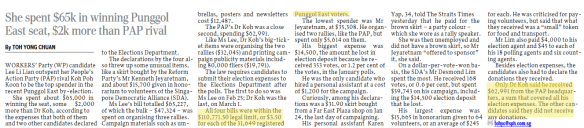
Partyforumseasia: Democracy comes at a price, campaigns are costly, and in most countries in the region, the campaign expenses of candidates are far from being disclosed to the public.The Punggol East (a suburb in the north of Singapore) by-election on 26 January 2013 made big waves because of the clear opposition win (Workers’Party’s Lee Li Lian with 54.52%) over the PAP candidate Dr. Koh Poh Koon with 43.71%.
Two months later, the Straits Times publishes today in detail the expenses of the four candidates. All of them spent much less than the regulations had allowed, i.e. S$ 3.50 per registered voter. At the end it was only a by-election, but one which has an impact on the public perception of the balance between ruling party and opposition.
Interesting: Some candidates hired helpers and assistants, and only the PAP funded its candidate’s expenses fully. The opposition candidates declared that they did not receive any donations. Link: Straits Times, 28.3.13

Partyforumseasia: Limiting the number of competing parties for the 2014 elections does not seem easy for the the General Elections Commission (KPU). It announced yesterday (25 March 2013) that Golkar splinter PKPI is eligible as no.15:
The General Elections Commission (KPU) announced on Monday that the Indonesian Justice and Unity Party (PKPI) was eligible to contest the 2014 general election. All seven members of the commission agreed to not to file an appeal with the Supreme Court over the Election Supervisory Committee’s (Bawaslu) Feb. 6 ruling that the PKPI was eligible after the KPU earlier disqualified the party. KPU chairman Husni Kamil said on Monday that the decision was unanimous as there were no voting mechanisms in KPU’s decision making, according to tempo.co. KPU’s verdict was welcomed by PKPI chairman Sutiyoso, a former Jakarta governor who attended the announcement at the KPU office in Central Jakarta. “After a long and tough journey, the PKPI has finally succeeded in being eligible to contest the general election,” said Sutiyoso.
The KPU designated the number 15 to PKPI for the elections. (asw/ebf)
Partyforumseasia: The (Islamist) Prosperous Justice Party (PKS) had won 7.34 % in the 2004 election on its anti-corruption stance and promise of good governance, and probably profited as well from its credibility among religious voters. So the arrest and indictment for corruption of former leader Luthfi Hassan Ishaaq in January has heavily dented the credibility of the party. The recent re-election of West Java governor Ahmad Heryawan and his running mate Deddy “Demiz” Mizwar ( see link: “The awesome power of sausage politics“) must be seen as an attempt to counter the loss of credibility by using a popular PR-professional as running mate. It would probably be wrong for the party to take the governor’s re-election as a sign that the voters are forgetful.

Source / link: Straits Times, 22.3.2013
 Partyforumseasia: One of the most controversial items in the “level playing field” debate is the Barisan Nasional government’s monopoly on the official media landscape in Malaysia. Will this traditional advantage for the ruling coalition continue to tip the scale in the upcoming election? In an article published by the Straits Times, Singapore, Wan Saiful Wan Jan, Chief Executive of the Institute for Democracy and Economic Affairs (IDEAS) in Kuala Lumpur, looks into the chances of the “Alternative Media” to catch up:
Media plays a crucial role
By Wan Saiful Wan Jan, also published in Singapore’s Straits Times 22 March 2013
This is the reality of the Malaysian media. The way some media outlets report news is completely predictable. Although thanks to positive steps taken by the government the Malaysian media is not as shackled as they used to be, partisanship is still in excess supply.
Of course there are exceptions and there are several media outlets that are relatively exemplary. But that is exactly the problem – serious independent journalism are exceptions rather than the rule.
As the country inches closer to general election, the media becomes even more crucial. Their extensive reach makes the media an extremely influential tool to persuade voters. And Malaysian politicians know this. Some Barisan Nasional (BN) leaders clearly have good media advisors. Their use of the media to influence public perception has been very effective lately.
The Lahad Datu incursion is a good example. In this case, BN’s strategy in handling the media is outstanding. It is so effective to the extent that almost no one is able to debate the big elephant in the room, which is the government’s incompetence that resulted in complete failure to protect Malaysia’s borders from armed invaders. This is not at all debated in the Malaysian media.
Instead, anyone who questions the authorities will immediately be labelled unpatriotic and disloyal. Discussions about the root cause of the incursion and which minister should be sacked do not get any space. It seems like a senior media advisor has decided that Lahad Datu must not be allowed to damage the government, and all media reports must focus on certain aspects on the tragedy only.
Pakatan Rakyat (PR) is severely disadvantaged because every time someone from their side tries to raise pertinent questions, the media will jump into labelling them as traitors. Admittedly it is distasteful to suggest that there may be political benefits from the Lahad Datu incursion. But it must be stated that BN’s media strategy is so good, they are monopolising such benefits if there is any. PR is completely blocked from taking even a small pinch.
Nevertheless PR is not angelic either. Their strategy is exactly the same in media outlets that they control. Pro-PR media does not report any of BN’s good deeds. So, while pro-BN media spews allegations of PR corruptions and weaknesses, pro-PR media simply take the reverse position.
This situation is far from healthy. But in a democracy, partisanship among media outlets is, in principle, not wrong. The hallmark of a free society is when people have the freedom to speak and write what they want. If a particular media outlet chooses to be partisan, then a free society would accept and defend their right to be so. Individuals exercise their freedom by deciding which media they want to read or watch.
Thus in a country facing an impending general election, if a Malaysian wants to listen to more than one side, all he has to do is simply buy more than one newspaper or watch more than one TV channel. At least that’s the theory.
The challenge faced by Malaysians today is the uneven playing field. BN has almost complete access to mainstream media, be it broadcast or print. In fact, when it comes to broadcast media, BN has almost complete domination to the extent that even a taxpayer-funded government agency could be turned into a partisan propaganda machinery.
PR’s media reach is severely limited. There may not be written rules banning opposition politicians from the media. But media practitioners and editors exercise self-censorship to reduce the risk of actions from authorities. As a result, the opposition is disadvantaged in their campaign.
The real victims are the citizens. Access to reliable information is extremely important to ensure voters vote based on knowledge. In the case of Malaysia, the print and broadcast media are the only platforms with sufficient reach for this purpose. The online media may be growing as an industry, but their reach is still limited.
True democracies would facilitate politicians’ access to media. A government that truly believes in democracy would ensure the total ecosystem is one that allows for different ideas to reach the public. This general election is a test of the Najib administration’s resolve in creating this healthy environment.
Partyforumseasia: A guest contribution to New Mandala by Partyforumseasia-editor Wolfgang Sachsenröder:
Link to the article: New Mandala, ANU, Australia

 Partyforumseasia:
With God’s Help?
In Homer’s Iliad the Olympic gods interfere directly in the battles for Troy. The crusaders were motivated by the Pope’s affirmation that they were fighting for God, and their Muslim adversaries were also convinced that they were dying for Allah. Religion as a political tool has often been successful, not least in Europe for the Christian Democratic Parties. So it does not come as a surprise that in the running- up to the elections in Malaysia both camps are trying to get religious support, if not directly from Allah, then at least by using the status and credibility of Muslim leaders. Since UMNO feels that they have their most faithful voter bank among rural and pious Malays, but face the competition of the Islamist PAS, their efforts to get support from prominent Ulama is logical. But opposition leader Anwar Ibrahim has his own religious credentials, he started his political career as head of the Muslim Youth Movement ABIM. The following article gives some details how the parties a trying to recruit religious leaders for the election campaign:
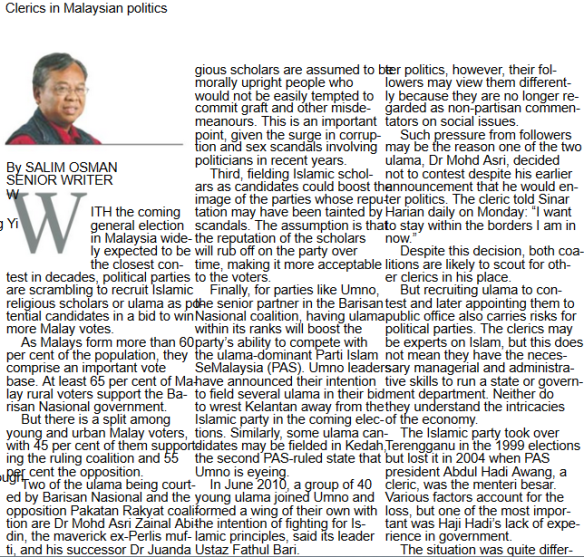
Source and link: Straits Times 21.3.2013, p. A26

Partyforumseasia: The results of the Italian elections three weeks ago were followed by rather sarcastic comments about the “clowns” (Economist et al.) who were successful against the normal odds. One of the surprise winners with a quarter of the votes was comedian Beppe Grillo, the other with a surprise comeback Silvio Berlusconi. The mature democracies in Europe with such results? Many politicians could hardly believe it, but in reality it highlights the frustration of most of the voters with the disappointing performance of the “serious” type of lawmakers.Can Southeast Asia compete? President Joseph Estrada in the Philippines is not forgotten, but we have a new example in Indonesia. Columnist Julia Suryakusuma in the (link:) Jakarta Post today comments on
“The awesome power of sausage politics” :
Julia Suryakusuma, Jakarta | Opinion | Wed, March 20 2013, 11:31 AM
Paper Edition | Page: 7
It’s hard to take a public servant seriously when you see him waving a sausage in the air and singing “It’s so nice”, with a motley crowd of backup singers sashaying behind him.
Yet that’s precisely how Deddy “Demiz” Mizwar recently became deputy governor of West Java — and his awesome sausage-waving skills helped secure winning votes for his running mate, incumbent Governor Ahmad “Aher” Heryawan as well. Yes, that’s right, Aher, worried that his own popularity would not be enough, decided to “buy” sausage-star Deddy to shore up his reelection bid.
In fact, Deddy has a solid reputation as an award-winning actor and film director, but that’s not what made him a familiar face nationally. Nope, he became a star by constant appearances in TV ads for a mobile phone network operator, bottled mineral water, motorbikes, toothpaste, heartburn medicines and others — including, naturally, the oh-so-nice sausages.
Of course, most of these products could be linked to politics in one way or another (especially mobile phones and heartburn!) but sausages are the closest connection. Think about it. Sausage-making is smelly and made up of unhealthy, disgusting and even dangerous ingredients, including preservatives and the dreaded “pink slime” (blood, fat and bits of meat trimmings disinfected with ammonia, all colored with dye — and not always food dye). Same with politics! It’s also too often made up of unsavory ingredients, including, of course, ambitions, egos, greed, corruption, manipulation and outright lies.
Ah well, perhaps Deddy’s career in advertising has prepared him well for the horrors hidden within. Just look at the sausage ad he did for Ramadhan in 2011 and 2012. Wearing Indonesian Muslim garb, Deddy exhorted viewers to gobble sausages for sahur (the early morning meal before commencing fasting), and again sausages first thing for iftar (breaking the fast). Get real? Touting this junk-filled product as healthy? In the fasting month to boot? Well, that’s advertising for you — and that’s politics too.
Besides riding on the back of Deddy’s sausage-stardom, Aher’s win was also allegedly the result of pork barrel politics (not to be confused with the recent pork-tainted meatball scare). In January 2013 — just before the elections! — Aher’s West Java provincial government allocated “grants” and “social funds” of Rp 100 million (US$10,303) per village for 5,304 villages in West Java, Rp 50 million for 2,000 agricultural extension workers, and Rp 90 million for 400 private universities. Big buck handouts and a big banger TV star! What’s not to like? No wonder he won.
Politicians like Aher, who are in “low-batt” mode (i.e. low popularity) don’t usually resort to the sausage for salvation. Instead most simply go to their political party for a “recharge”. Political parties often act as a power-bank — you know, those portable chargers you carry around so your smartphone doesn’t run out of power — for candidates. The trouble is that Aher, who hails from the Prosperous Justice Party (PKS), doesn’t seem to want to advertise the fact that he’s a PKS man too much.
You see, in recent years, his party has become pretty low-batt itself. Initially touted as clean and free of corruption and sex scandals, it has since had its fair share of both, and is in no position to help anyone anymore. The most recent uproar involves Luthfi Hasan Ishaaq, former PKS president, now embroiled in the imported beef scandal, and an alleged sex scandal involving a 19-year-old student, (“Agriculture minister faces further grilling over beef”, The Jakarta Post, March 15). At least the beef makes a change from sausages.
But let’s face it, all Indonesian political parties are in serious low-batt mode at the moment. In fact, Susilo Bambang Yudhoyono’s (SBY) Democratic Party (PD) seems to have completely short-circuited. With Anas Urbaningrum, the former chairman, finally forced to resign after being declared a suspect by the Corruption Eradication Commission (KPK), it looks like not even sausages could save the party now. The way things are going, lame-duck SBY will soon be able to hold the PD’s annual general meeting in the bathroom, all on his lonesome.
So, who’s winning from this situation? The business cronies are, because our low-batt politicians are increasingly desperate for campaign funds as elections daily creep closer. This means they are also vulnerable to cronies pressuring them for policies that will benefit their businesses. That is maybe why recently economic policy has suddenly swung protectionist, and with trade barriers soaring, imports have fallen. Slowly but surely, technocrats are being marginalized and the free-trade reforms of the last decade seem to be unraveling fast.
The Coordinating Economic Minister, Hatta Rajasa, in-law of SBY and presidential candidate from National Mandate Party (PAN), has been pushing protectionism. He claims it will strengthen domestic businesses, deliver food self-sufficiency and give added value to raw materials. But, in fact, the main results are a general increase in food prices, including basic commodities — most notably the recent spiraling price of onions and garlic — and now serious food shortages as well. Could it possibly be because his policies are motivated not by economics but political interest? In the end, the push for power is pushing policy aside.
At least the scarcity of garlic is good news for vampires. They can roam freely now. But what to do with the political vampires whose blood-sucking ways don’t depend on the absence of garlic, and who operate in broad daylight?
Perhaps we should force-feed them all smelly sausages till they burst?
The writer (www.juliasuryakusuma.com) is the author of Jihad Julia
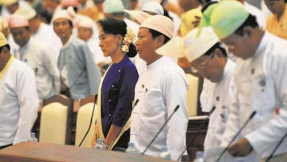 Partyforumseasia: Aung San Suu Kyi at the crossroads?
At a time when the road to Myanmar’s presidency seems to open up for the opposition leader and translate the long years of martyrdom into political success and leadership at last, the first questions about the price to pay appear as well.

Link: Straits Times 16.3.2013
Partyforumseasia: The price Aung San Suu Kyi has to pay is linked to the change of role. Suffering under the suppression of the democracy movement at the hands of the ruling military junta propelled her to international attention as “democracy icon” and martyr, culminating with the Nobel Peace Prize in 1991. Her courage and perseverance will continue to be admired.But taking over now a leadership role in the complex melee of Myanmar’s transition period will mean that she leaves her pedestal of democracy icon and cannot avoid stepping into the quagmire of practical involvement in day-to-day politics.
The first criticisms are coming up: Her re-election in the NLD party congress last week was unanimous of course, but reflected as well the party’s dependence on her. The 15 members of the executive committee were just nominated by “the lady” and then confirmed. And for the taste of the “younger blood” she had asked for, too many old loyalists, called the “NLD-uncles” were elected. Further criticism and disappointment comes up for her lack of addressing the smoldering Rohingya problem and other minority grievances, where she does not seem to have a better solution than the government. Finally, accepting donations from cronies of the former military regime for the party and her role in a controversial environmental case have started to dent her reputation.
See also: Soft on Sein (Foreign Affairs, 8.3.2013)
“The master stroke (of president Thein Sein) was the release of Suu Kyi. Over the last year, her global tour has made her a one-woman public-relations campaign for the regime and its carefully controlled reform process. She has rarely criticized the government’s treatment of minorities, even after hundreds of Rohingya Muslims, who are denied citizenship, have been killed in racist pogroms in the southwest of the country beginning last summer.”
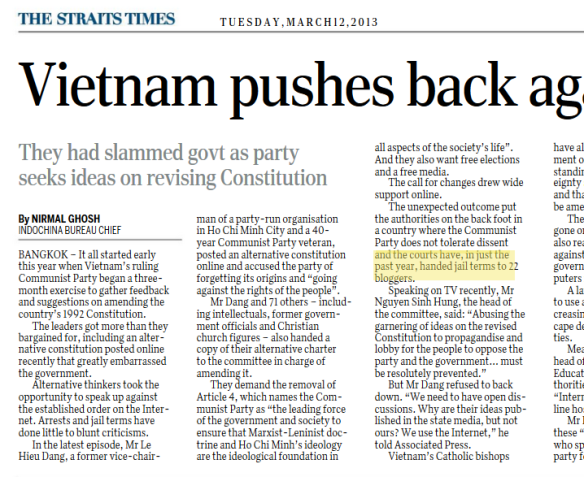
Partyforumseasia: As seen in many other countries, attempts of the governments to control the social media turn out to be something between difficult, costly, and useless. As Straits Times Indochina bureau chief Nirmal Ghosh describes in this article, 22 bloggers have been detained last year. This did not stop others from embarrassing the ruling Communist Party by inviting themselves to their debate about constitutional changes. Their proposed alternative constitution, among others, takes out the dominant role of the VCP and its Marxist-Leninist ideology and asks for free and fair elections. Obviously the balance of fear seems to shift more to party and government despite 22 jailed bloggers…
Link: Straits Times
 Partyforumseasia: The Roman Empire knew how to rule over not fully convinced people, at least for long periods. The realistic slogan “oderint dum metuant” (they may hate us as long as they fear us) expresses their approach to strong government.
In the case of Vietnam’s Communist Party fear is still an important pillar of their one-party rule… and an obstacle to change. Khanh Vu Duc, an overseas Vietnamese, describes the probability of change in an article published by Asia Times Online on 6 Mar 13:
“Because Vietnam does not elect its leaders, the government’s power rests in the people’s respect for its authority. As long as the people continue to abide by the government’s established order, nothing will change.”
See the full article at Asia Times Online
Open question are:
1. Is there less fear in the younger generation?
2. How are fear and respect related?
3. Can authoritarian governments get more respect with less fear?
Partyforumseasia:  For many Southeast Asians it may sound familiar when Prime Minister Hun Sen threatens the Cambodian voters with stopping infrastructure programs like bridge building if they should not vote for his CPP. Is he the next Prime Minister who has doubts about his re-election? At least some concern seems to haunt him if he thinks that such a threat is necessary…
See: “No CPP, no development: Hun Sen” (The Phnom Penh Post, 6 March 2013)

Partyforumseasia: According to the 2012 Edelman Trust Barometer (link here), in which an American market research company measures the trust in governments, business, media, and NGOs in 25 countries, the majority does not trust the governments. For Southeast Asia, the index has data only for Indonesia, Malaysia, and Singapore:

The figures above are for the “informed public” segment of the survey and look comparatively positive for Singapore (77% in 2011 and 73% in 2012), Indonesia (falling from 62% to 40%), and Malaysia (49% when it was included in 2012). In contrast to Western countries, the percentage of people who don’t trust government leaders at all to tell the truth looks relatively low here. The regional results are: Indonesia 36%, Malaysia 24%, Singapore 15%. But the overall distrust rates may be much higher.
Looking at all 25 countries, the deficits in credibility are shown as the difference between the expectations and the perceived reality: For the question: government “listens to needs and feedback” of the citizens the gap is 50%, for “has transparent and open practices” also 50%, and for “communicates frequently and honestly” the gap is 49%.
Partyforumseasia’s Conclusion: The survey certainly has its own limitations, not least the sometimes rather wild changes between the years surveyed since 2000. But if we extrapolate some of the disquieting results to the political parties running the respective governments, there should be enough lessons to be learned. One important development is the growing diversification of trust in the media and the number of sources of information:

Partyforumseasia: Probably Lenin’s famous formula “trust is good, control is better” comes closer to the Southeast Asian reality than Confucius’ “rectification of names” concept. But maybe modern media ownership and its possibilities of political control are a clever combination of both. The Confucian concept may be a bit too idealistic about good intentions of ancient rulers. Today’s political parties and their leaders certainly have enough good intentions, but owning and controlling the all important media seems to be considered the safer bet for electoral success.
Nota bene: Media control quasi monopolies are everywhere: Murdoch and Berlusconi, and…
Partyforumseasia suggests to collect ownership affiliations between media and political parties in the region, starting here with a number of Indonesian media.
 Most prominent is tycoon, Golkar chairman and possible presidential candidate in 2014, Aburizal Bakrie, who controls news channels TVOne and ANTV as well as online news portal Vivanews.
National Democrat (NasDem) chairman Surya Paloh owns Metro TV and daily newspaper Media Indoenesia.
Media tycoon Hary Tanoesoedibjo, controls the large media network PT Media Nusantara Citra (MNC) and seems to focus his political ambition on the Hanura party.
About 3,000 private radio stations over the country may be open to political bidders during election campaigns.
But there is also good news: Kompas, the most influential and widely circulated newspaper in Indonesia is politically independent. Its owner, Kompas-Gramedia Group, controls a large networks of local papers and the Jakarta Post.
Partyforumseasia: Some strategists from more party-politically volatile countries may have envied the “stability” of UMNO’s Malaysia and the number of “safe deposit” constituencies for so many years. The last general election in 2008 came with a brutal wake-up call for all those who have believed that power and access to assets would continue forever. Populist but not necessarily popular campaign goodies and the ferocious use of the pro-establishment media signal that BN, for the first time in decades, has doubts about winning the next election.
Dr. Ooi Kee Beng, deputy director of the Institute of Southeast Asian Studies (ISEAS) in Singapore, comments on what has changed already before the next election coming up in April:

Partyforumseasia: The elections approaching, the BN governments’ coffers are already wide open. From cash payouts for citizens to rosy future promises, the ruling coalition seemed hard to beat. But mind you, the opposition coalition Pakatan Rakyat is not shy of promises either. The just published election manifesto has good news for every Malaysian as well. And from a strategic point of view this move is logical and correct. If the competitor promises more cash you can’t preach austerity, even if the financial forecast would urge you to be cautious…
 Source: Straits Times, Singapore, 26.2.2013
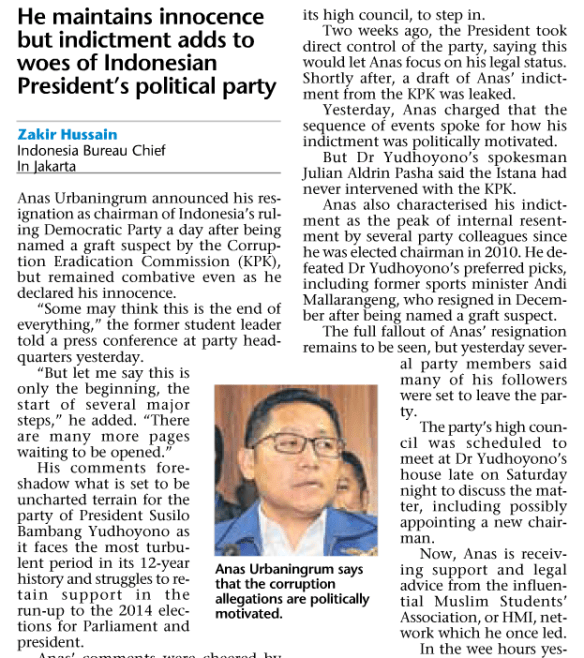
Partyforumseasia: The dramatic exit of Anas Urbaningrum as chairman of the Democratic Party under suspicion of corruption might ring in the end or at least the end of its lead in the Indonesian political landscape. The party which owed so much of its electoral success to the popularity of president Yudhoyono (SBY) and is widely seen as “the president’s party”, is down to only 8% in recent polls, far down from its 21% in 2009. Since SBY cannot run again in 2014 after ending his second term, the party suffers badly from corruption allegations and lack of clear leadership alternatives. The situation could get even worse if Anas came up with more dirty linen from inside the leadership as he vaguely threatens.
See also: http://epaper.straitstimes.com/fvx/fvxp/fvxpress.php?param=2013-02-24

Partyforumseasia:
Election manipulation and fraud are not unknown in Southeast Asia. This (Link)new book by Alberto Simpser looks already so interesting in the publisher’s advertisement that we are looking forward to have it. Here are some snippings from the introduction:
Three interesting findings:
“First, electoral manipulation is often utilized when it is patently unnecessary for victory. Second, even when electoral manipulation is needed to win, it is frequently perpetrated far beyond the victory threshold and in excess of any plausible safety margin. Third, electoral manipulation is often perpetrated blatantly, a practice that does not directly contribute to victory and goes against the intuition that, as with any cheating, the perpetrator stands only to lose if his or her activities become known. These three observations constitute what I shall call the puzzle of excessive and blatant electoral manipulation.” (p.1-2)
On the indirect effects of electoral manipulation: “…the consequences to individual citizens, politicians, bureaucrats, and organizations of their political choices and actions today depend strongly on which party ends up holding power tomorrow, and on how powerful such a party turns out to be.“ (p.6)
The book provides “a systematic, global picture of electoral manipulation”, based on “more than 800 multiparty, country-level elections around the world from 1990 through 2007” (p.8)
Among the empirical findings: “For example, of all executive elections that were substantially manipulated in roughly the past two decades, more than two in five were won by the manipulating party by a margin of victory exceeding 40 percent of the vote, suggesting that excessive electoral manipulation is quite common.” (p.8)
Partyforumseasia: Patronage politics in the Philippines, often described, but the parties have hardly been defined so bluntly or brutally as:
“convenient vehicles of patronage that can be set up, merged with others, split, reconstituted, regurgitated, resurrected, renamed, repackaged, recycled, refurbished, buffed up or flushed down the toilet.”
Nathan Quimpo, The left, elections, and the political party system in the Philippines, Critical Studies 37, 2005: 4-5 is being quoted with this verdict in: Hutchcroft and Rocamora, Patronage-based parties and the democratic deficit in the Philippines, in: Robison, Richard (ed), Routledge Handbook of Southeast Asian Politics, 2012: 97-119.
It sounds very sad, but Hutchcroft and Rocamora put the deficits into the proper historical perspective to understand how it could happen. And they sketch the necessary reforms to overcome the historical burden. Fortunately, the present administration under president Aquino seems to be set to push through the most urgent reforms.
Partyforumseasia: A must read for anybody who wants to understand the Philippino party system!
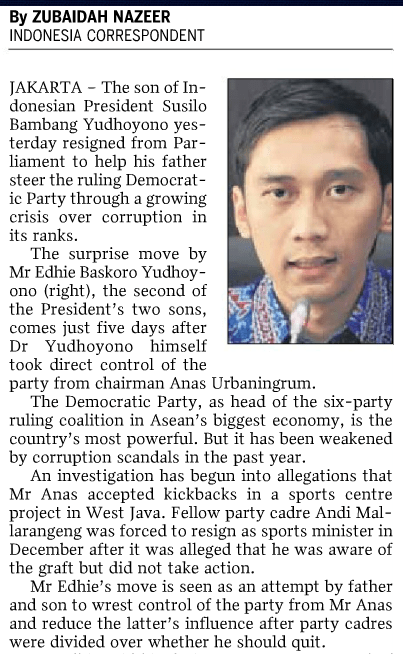
Partyforumseasia: “Political families” are a world wide feature; the Kennedys, Bushes, Ghandis etc. are well known. But the following surprise move makes it to the regional headlines, as President SBY promotes his son to better control the Democratic Party in waters troubled by a series of corruption scandals. If party stalwarts can’t be trusted any more, family bonds might be the safer bet.
Source / Link: Straits Times, Singapore
See: Vedi R. Hadiz, Democracy and Money politics – The case of Indonesia, in: Robison, Richard (ed), Routledge Handbook of Southeast Asian Politics, 2012, pp.71-82
Partyforumseasia: Hadiz’s sober assessment on page 78 underlines our thesis that the constant use of Duvergerian (and followers’) paradigms will miss the point.
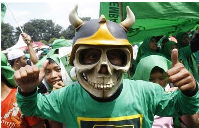
Left:
Colourful campaigning (PPP) Indonesian fun style.
“The Indonesian experience since 1998 reiterates the necessity of reassessing conventional renderings of electoral politics and of political parties. It is hardly useful to label Indonesia’s parties as ‘immature’, ‘irrational’ or ‘neo-patrimonial’ on the basis of idealized notions of party roles in Western liberal democracies. In the context of post-authoritarian societies like Indonesia, political parties as they exist currently – able to utilize money politics and even political thuggery when necessary – are quite suited for the purposes of the range of predatory interests that dominate them. It may be said that there is an internal logic to political party life and electoral competition that does not make internal transformations very likely in the foreseeable future. In fact, given the experience of democracies which have emerged in recent times, such as those in Southeast Asia, the liberal pluralist model associated with the Western experience may become increasingly exceptional.”
Partyforumseasia: The Southeast Asia Forum at Stanford University is planning a seminar on the erosion of authoritarian traditions in both countries. Will distance diagnosis be relevant for the political parties here?
Link: Stanford University

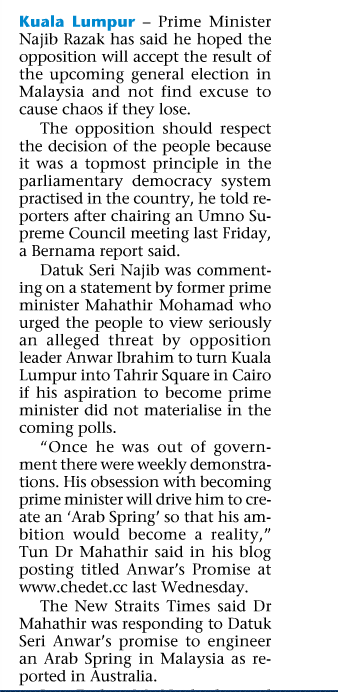
Source: Straits Times, Singapore, 10.2.2013
Partyforumseasia:
Pre-Election Campaigning already in full swing, the competing parties are not shy to frighten the voters. The threats of Christianisation or Islamisation of Malaysia may neutralise each other. PM Najib urging the opposition to accept their defeat even before the elections might backfire on election day if the loser should turn out to be the Barisan Nasional coalition…
Anyway, the large opposition rallies in the past months seem to suggest that it is more and more difficult to frighten the Malaysian voters.
And the ‘Arab Spring’ or ‘Tahrir’ comparison look a bit too far- fetched… fortunately.

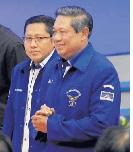
Source: Straits Times, Singapore, 10.2.2013
Partyforumseasia:
With shrinking poll results, President
SBY is pulling the emergency brake.
In a move widely seen as authoritarian,
he sidelines DP chairman Anas Urban- ingrum who is threatened by corruption investigation.
How this move will be accepted by the electorate, sensitized during the Indonesian democratization process, remains to be seen. Necessary as it is to take Anas out of the limelight, the procedure may look too authoritarian for many voters.
 Partyforumseasia: Business psychology is probably better researched than political psychology, but the parallels can be striking. Daniel A. Pink, author of “To Sell is Human” writes in the Washington Post of 28 January 2013:
Partyforumseasia: The great biologist Edward O.Wilson, (The Social Conquest of Earth, New York 2012) studied ants to better understand human group behavior. The psychological evidence is most interesting for partisanship and party membership:
“Experiments have shown that it is shockingly easy to elicit a sense of solidarity among a group of strangers. Just tell them they’ll be working together as a team, and they immediately start working together as a team, all the while attributing to each other a host of positive qualities like trustworthiness and competence—an instant five-star customer review.
Yet we are equally prepared to do battle against those who fall outside the fraternal frame. In experiments where psychologists divided people into groups of arbitrarily assigned traits—labeling one set the Blue team and another the Green, for example—the groups started sniping at each other and expressing strong prejudices toward their “opponents,” with the Greens insisting the Blues were untrustworthy and unfair. The “drive to form and take deep pleasure from in-group membership easily translates at a higher level into tribalism,” Wilson says, and can spark religious, ethnic and political conflicts of breathtaking brutality.” Source: Smithsonian Institute
Partyforumseasia: So far so bad, being member of a successful party feels good, but inside political parties tribalism among factions can be as or even more brutal than with outside enemies. A quotation attributed to Konrad Adenauer, first chancellor of post war (West) Germany, should warn us: His line was: enemy – mortal enemy – party comrade…
Slater, Dan, Strong-State Democratization in Malaysia and Singapore, in: Journal of Democracy, Vol.23, No 2, April 2012, pp.19-33
Partyforumseasia: Starting with some “political archaeology” to describe the formation of strong states with a well- functioning bureaucracy and fiscal capacity, Slater compares the two countries with the Democratisation in Korea and Taiwan. There, he argues, the authoritarian strong-state tradition has helped to maintain political stability through the democratisation and beyond.
Saying that “The iron cages of authoritarian Leviathans (…) have by no means been dismantled” may sound somewhat far-fetched when applied to Malaysia and Singapore of today. And taking the bureaucracy of the two countries as equals raises doubts as well.
Slater describes the Korean and Taiwanese developments as middle-class voters turning conservative and abandoning their support for reform and democratisation “in the face of real or perceived threats to economic and political stability.” And he predicts similar patterns in Singapore and Malaysia, “accompanied by the same sort of party-system continuity, electoral conservatism, and persistent state capacity.”
Slater is right in highlighting for both countries the huge gap between exceptionally strong states and exceptionally weak oppositions. But it seems rather questionable when he continues that UMNO and PAP could stem the tide of opposition gains by upholding their old ways of coercive tactics. Neither UMNO nor the PAP would look so concerned about recent election wins of the opposition if they were sure that coercion still works as it did in the old days.
As much as the Pakatan Rakyat opposition coalition, though unstable in itself, may win the upcoming elections to be held by June 2013 and take over the federal government in Malaysia, this remains a pipe dream in Singapore. The Workers’ Party as strongest among a number of small and splinter parties even seems to be a bit insecure with its own success and declared after a by-election win in January how loyal an opposition it will be and that it is by no means prepared to take over the national government. Preventing exaggerated expectations is fine, but Slater’s assessment at the end sounds somewhat overdone, that Singapore’s opposition “…is extreme in only one respect – its pronounced moderation.”
Comparing East Asian with Southeast Asian developments certainly has its shortcomings. But Slater’s central point is interesting, that the state structures in Malaysia and Singapore (calling them Leviathans may be exaggerated) are strong enough to allow more political liberalisation and even a smooth change of government. The latter is not on the cards in Singapore and may not be so smooth in Malaysia.
Loosening up traditional repressive controls, Slater concludes, would not only be good for democracy, but also good for UMNO and the PAP themselves. While the PAP leadership still looks relatively relaxed, though alarmed, the Malaysian ruling coalition is obviously much more nervous before the upcoming elections. According to Talleyrand the farewell from power – and its spoils – is the most painful farewell in this world.
Partyforumseasia: The democratic era in Indonesia has seen quite a number of changes to party and election laws… and quite a number of creative adaptations to them by the political parties. Advertising in newspapers to recruit more candidates may be a rather unique exercise, though, probably a first world wide.
Straits Times, Singapore, is taking that up on 29 January 2013. Here is the link:
The article is quoting Yunarto Wijaya from Charta Politika in Jakarta on the ‘cash for candidacy problem’: “This is why we have this term ‘dowry’ where candidates pass money to party officials to ensure their names are on the list.”
Growing – and 4-fold is really ambitious – with the help of self-funding candidates may be a strategy many parties did not dare to dream of so far.


Partyforumseasia:The opposition frontrunner Workers’ Party scored big in the Punggol East by-election on 26 January 2013. The results:
Workers’ Party: 54.5% (16,038 votes) + 13.5%pts compared to the 2011 GE
People’s Action Party: 43.7% (12,856 votes) – 10.8%pts compared to the 2011 GE
Reform Party: 1.2% (353 votes)
Singapore Democratic Alliance: 0.6% (168 votes)
The Punggol East single seat constituency can be classified as Singapore heartland with predominantly lower middle and middle class population, many of them young families with children. A tight neck to neck outcome had been predicted, the victory margin of nearly 11 % pts comes as a shock for the ruling PAP, after discounting the “by-election effect” which works against the PAP and its super-majority in Parliament by not threatening the stability of the government as such, just “teaching them a lesson” or “make them work harder”. The PAP had been caught on the wrong foot when speaker of Parliament Michael Palmer resigned and a candidate had to be found fast to confront the young female candidate of the WP who had scored a respectable 41% in 2011 already. And there is still a lot of anti-establishment resentment in heartland constituencies like Punggol as well, despite enormous progress in the suburb’s infrastructure.
Even more dramatic is the poor result of the two candidates from small opposition parties Reform Party and Singapore Democratic Alliance. They both lost their deposit of S$ 14,500 for some limelight to keep their small parties recognizable for the national public. And all suggestions that their participation might dilute the opposition vote and favor the PAP can be dismissed. What the Singapore Democratic Party (SDP) might have scored without their strategic blunder of asking the strong WP to support their candidate, and the following pullout after failing this call for opposition unity, is now futile to discuss anyway.
More interesting for discussion seems the question of what some suggest as an upcoming two party system. Are the very small parties doomed to follow the two losers in Punggol East????
The floor is open
Please send your suggestions to: webmaster@political-party-forum-southeast-asia.org
2. Reducing the number of parties: A danger for the diversity of Indonesia?
Partyforumseasia: Conventional political science wisdom is rather unanimous that too many competing parties are more of a nuisance than a blessing to any party system. Consequently, Indonesia has been commended for the effort to keep a lid on the mushrooming party scene in the earlier part of the democratic era (Benjamin Reilly and others). But the question is, whether what is good for “normal” countries can be applied to the huge archipelago state of Indonesia and its regional diversity.
In an article for the Link: Straits Times of Singapore (22.1.2013), John Mcbeth looks into the negative side effects of the new move by the the General Election Commission (KPU)’s screening process for the 2014 election:
“Only 10 parties passed the General Election Commission (KPU) verification, in a screening process that has seen the overall field drop from the 48 parties which took part in the first democratic elections in 1999 to 24 in 2004, and then back to 38 in 2009. (…) Among the victims of the KPU paring knife were the Crescent Star Party (PBB), which had contested all three past elections, and the United National Party, founded by the leaders of 12 minor parties who failed to win representation in 2009.
Quite apart from denying the country’s 187 million potential voters a wider choice, the onerous qualification obstacles the big parties embedded in last year’s amendment to the 2008 electoral law will also make the electorate more Java-centric than ever. The PBB, for example, failed to win a seat in 2009. But most of its 1.8 million supporters were concentrated along Sumatra’s central spine and in West Nusa Tenggara – not on populous Java.”
The criteria of the electoral law, amended in April 2008, are certainly not easy to meet by small and new parties unless they have access to very comfortable funds:
– The minimum threshold to enter parliament has been increased to 3.5% – still low in the international comparison
– A regional chapter in all 34 provinces
– Branches in 75 per cent of the 398 districts and 98 municipalities, and in 50 per cent of about 5,400 sub-districts.
See the following contribution also on page Party Theory:
Benjamin Reilly on January 25, 2013 at 9:33 am said: Edit
However, the genesis of the laws lies in Indonesian elites concerns about not just party fragmentation, but also means to deny ethno-regional parties a platform to pursue sectarian or even secessionist policies. It is in this conflict management role that the laws have been notably successful. The one exception to the law – which allows the Free Aceh Party to compete in Aceh – was a crucial bargaining chip in helping end the secessionist struggle there. More broadly the decision to disallow local political parties has meant that ethnicity cannot be a viable vehicle for party-building. As a result, Indonesia’s national political parties have proven surprisingly adept at making cross-ethnic appeals and downplaying the role of ethnicity in politics. This is a major achievement in a country as diverse as Indonesia, and not one to take lightly given the other possible avenues Indonesia’s democratic transition could have taken.
Partyforumseasia: The floor is open…
Please send your suggestions to:
webmaster@political-party-forum-southeast-asia.org

Click on the article excerpt to enlarge
Source: Straits Times, 19 Jan 2013
Partyforumseasia: It is certainly more than difficult to organize rival opposition parties to field a common candidate against a strong ruling party. The SDP’s proposal to the stronger Workers’ Party not to field their own candidate and support the SDP’s looks rather overoptimistic, especially in view of the latter’s strong self-confidence after the GRC success in 2011. A strategic mistake of the SDP??? The debate is open…

Link: Straits Times 8 Jan 2013
Partyforumseasia: A step towards cleaner and more transparent party politics? An end to an all too visible business approach in Indonesia’s party politics? This is certainly a good move, which may put pressure on the other parties if the voters show their appreciation and vote for PKS.

Link: Straits Times, 8 Jan 2013
Partyforumseasia: Many young democracies try to control the number of political parties without making the formation of new ones too prohibitive. Indonesia has been quite successful so far by changes to the electoral law (see Benjamin Reilly’s research on political engineering in our bibliography). The move of the General Elections Commission (KPU) is the next step, which, of course, is being criticized by the small parties which lose their chance to get at least a few seats, and maybe some business opportunities… It remains to be seen whether they find a creative way out.
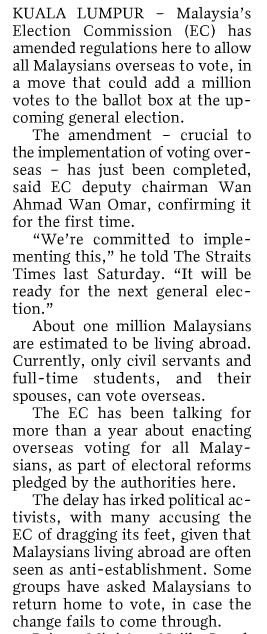
Link: Straits Times, 7 Jan 2013
Partyforumseasia:
Expectations on both sides seem to be high and the question is whether Malaysians living abroad are more pro or more anti establishment. If they are really a million voters the effect could be crucial.
For comparative purposes and not predicting anything: When Germany introduced overseas voting in the late 1970s, most expectations were disappointed by a very low turnout.
Link: Straits Times, 7 Jan 2013

Partyforumseasia:
Coalitions between more or less comparably strong partners can be more than difficult. In the best case they are marriages of convenience, hardly or never a love affair, but more often than not a marriage dispute and not a honeymoon, in the case of Pakatan Rakyat hardly a harmonious ménage a trois. With the overbearing dominance of UMNO in the Barisan Nasional coalition, where smaller parties look more like piggy riding, the semblance of harmony seems to be easier to project. And the discord within Pakatan certainly gives hope to the Barisan for the upcoming elections.
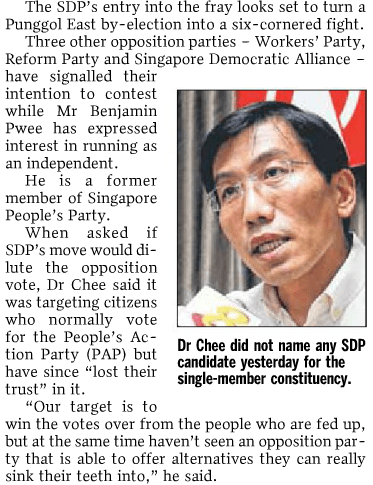
Partyforumseasia: Can a six-cornered fight be a winning strategy for any opposition party?
http://epaper.straitstimes.com/fvx/fvxp/fvxpress.php?param=2012-12-28
Partyforumseasia:
Many – maybe too many – scholars have been searching for a suitable typology of political parties in Southeast Asia. Many see at least a semblance of “Duvergerian” types of parties, others don’t.
Historian Wang Gungwu‘s assessment is very clear:
“None resembles the classic parties of the West.”
See also in: Party Theory
Partyforumseasia: The floor is open…
Please send your suggestions to:
webmaster@political-party-forum-southeast-asia.org
 Political Party Forum Southeast Asia