Golkar caught red-handed again


Partyforumseasia: Jon S.T.Quah has chosen a very telling title for his new book, published by ISEAS, Singapore, this year: Curbing Corruption in Asian Countries. An Impossible Dream?The latest political corruption scandal in Indonesia seems to underline the impossibility of the dream. Too much money is at stake, too costly are the election campaigns, too greedy the political players, and too toothless the anti-corruption programs of the government.Banten 3
The Golkar Party seems to be especially vulnerable after rolling in money for decades as the main political instrument of president Suharto who was more than well known for the corrupt practices of his extended family. Indonesia expert Marcus Mietzner* from Sidney University reports that Suharto withheld 100 million US$ from Golkar party funds after his fall in 1998. This gives an idea of the financial dimensions the party was used to.
But Suharto also urged his cronies not to show their wealth with too flashy villas. This advice has obviously been forgotten by Banten governor Ms Ratu Atut and her billionaire family empire. If being known for their collection of Maseratis and Lamborghinis alone was incautious, a direct involvement of the clan in the bribery scandal around the chief justice of the Constitutional Court is a graver political mistake. Madam governor’s youngest brother is accused of offering 1 b Rupiah (about 92,000 US$) to the judge for a favorable decision in an election dispute. A number of Ms Ratu Atut’s close relatives are mayors or district chiefs in Banten province close to Jakarta…And Golkar chairman Aburizal Bakrie, himself one of the richest businessmen in Indonesia, is being quoted as saying that the problem is not the political dynasty!

*Mietzner, Marcus (2007), Party Financing in Post-Soeharto Indonesia: Between State Subsidies and Political Corruption, in: Contemporary Southeast Asia, Vol. 29, No. 2:241


Malaysia: UMNO Polls Without Surprise


Partyforumseasia:The internal party polls are over, UMNO president Najib and his deputy were confirmed uncontested. As The Star Online (click for the link) summarises today, 20 October 2013, “Umno president Datuk Seri Najib Tun Razak’s call for status quo resounded within the party.”

All incumbents for the top party posts have been re-elected, and the probably most anticipated possible win of “rising son” Mukhriz Mahathir was narrowly avoided with 91 votes for Mukhriz and 100 for the incumbent. Mukhriz 1
Speculations that Prime Minister Najib Razak’s position as party president had been weakened after the May general election were obviously exaggerated, if even the women wing’s leader Sharizat, tainted

by her “cowgate”- corruption scandal, made it easily with a 90% majority.

The real balance of power between the different factions in the party remains mostly behind the wayang kulit screen, though. But according to analyst Bridget Welsh from Singapore’s Management University, the Mahathir Mohamad camp is angry and expected to hit back (Malaysiakini, 20.10.)

What is interesting beyond the incumbents is how the new internal polling system worked and whether it changed the dynamics within the party. It is difficult to believe vice president Muhyddin’s statement that the new system is “not only a mission to eliminate money politics but more importantly, to strengthen the party by empowering the grassroots” (The Star Online, 20.10.) For the first time, not the traditional 2,500, but 230,000 delegates could vote, but only within one of the 191 branches. This gives the rural branches which are easier to control much more weight than the urban ones with more members. According to Bridget Welsh (Malaysiakini) there is also evidence of vote-buying and the usual top-down pattern in the new system.

Cambodia: Prime Minister Hun Sen Ignores Opposition


Partyforumseasia: Never underestimate the determination of Prime Minister Hun Sen to defend his grip on power and ignore the opposition which may have been tempted to overestimate its leverage after its success in the 28 July elections. Especially calling support from the international community gives Hun Sen the easy counter-argument that he will never allow such interference.
Opposition leader Sam Rainsy might share the bitter experience of Anwar Ibrahim in Malaysia. They both have their nemesis in prime ministers clinging to power and defending a privileged access to the resources of their country.

Cambodia 1

The Voice of America Cambodia article (http://www.voacambodia.com/content/hun-sen-decries-foreign-interference-in-cambodian-politics/1757797.html) also quotes the PM:
“Hun Sen said in a six-hour address on Wednesday that he opposed “foreign interference” in Cambodia’s political affairs.
“We do not need the recognition of any president or ambassador,” Hun Sen said. “It’s not necessary to ask for the recognition of the UN secretary-general, or signature countries of the Paris Accords. I won’t allow any foreigners to dictate Cambodian politics.”
Partyforumseasia:
See also the insightful analysis by Phoak Kung in The Diplomat (http://thediplomat.com/2013/10/14/reforming-the-cambodian-peoples-party/) also available in Bomborra  (Click on the blue names to access the article)

Philippines: Is Re-election Without Pork Barrelling Possible?


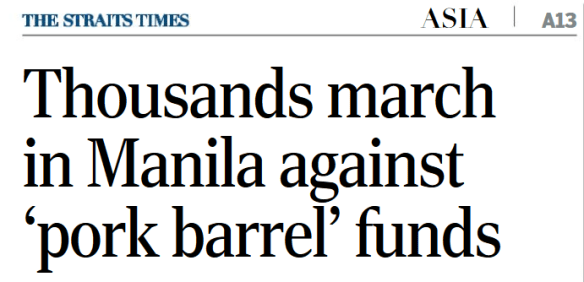
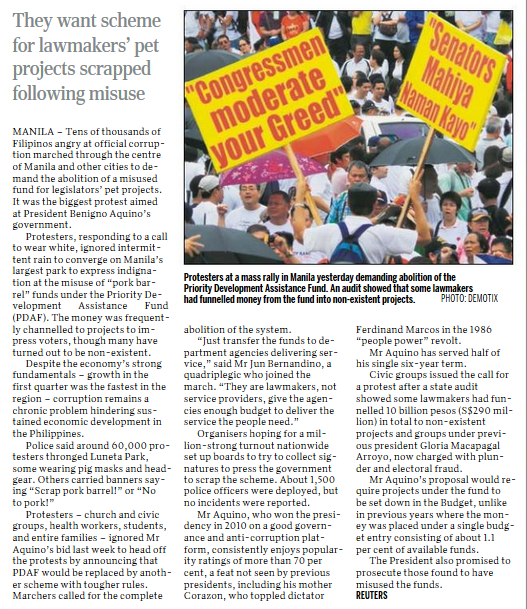
PorkPartyforumseasia: A recent scandal involving 23 suspects including members of parliament and senators as well as former president Gloria Macapagal Arroyo may give new momentum to the fight against political corruption and the endemic pork barrelling in the Philippines, which President Aquino has declared a priority for his term of office. Businesswoman Janet Lim-Napoles is under investigation for setting up bogus NGOs and embezzling nearly $ 290 million from disaster relief and development funds. Up to half of the funds paid out to the NGOs seem to have gone to the accused legislators.
Pork Barrelling is a common political tool in the country and based, like in other countries in the region, on traditional patron-client relations between voters and their MP or senator. According to the political science analysis legislators get kickbacks from development projects (e.g. the Countryside Development Fund – CDF) at a rate of 30%. One full term in office was supposed to yield about $ 200,000 for a House member and $ 600,000 for a senator (estimated 2009 figures). This has been called “Standard Operation Procedures (SOP)” but growing public protest and President Aquino’s determination to fight corruption might end the SOP – probably later than sooner. Lawmakers so far need this additional income to pay for their party and campaign expenses.

Malaysia: Another Rising Son – Nik Abduh in PAS


Nik Abduh.docxPartyforumseasia: Nik Abduh (full name: Nik Mohamad Abduh Nik Abdul Aziz) combines religious credentials and family ties for a promising political career in Malaysia’s Islamic party PAS. Son of the spiritual leader and long term chief minister of PAS stronghold Kelantan Nik Abdul Aziz Nik Mat, the 43 year old Nik Abduh has studied in Nadwatul Ulama (Lucknow) and Darul Uloom (Deoband) in India as well as at the Al Azhar University in Cairo. Whereas these institutions do not necessarily prepare their students for political practice, they may encourage them to go into politics with a religious motivation. And since religion plays an important role in PAS and Malaysia in general, Nik Abduh seems to be cut out for a top leadership role and possible succession of his father as spiritual leader of the party.
Nik Abduh’s political credentials are also impressive. He is deputy chairman of the PAS Youth Wing and defeated a formidable competitor in the May 2013 election, Ibrahim Ali, leader of the Malay rights and supremacy group Perkasa.
In the run-up to party elections in November, the coalition issue with Pakatan Rakyat seems to be controversially discussed among members and candidates. Some say that Nik Abduh and other leaders in his age group are against Anwar’s supporters, called Anwarinas. But Nik is also being quoted with a clear preference for PAS remaining in the opposition coalition.
Less reassuring for the Malaysian Non-Muslims may be Nik’s activities in the religious field like a sticker campaign “Love Rasulullah” (the messenger of God) when the reputation of the Prophet Muhammad seemed to be under attack. Or his clear stance against Shiites and Liberals. But his second name Abduh is possibly referring to the Egyptian Muhammad Abduh, a liberal reformer and key founder of Islamic Modernism.

PAS (Malaysia): Dirty Campaign Tactics Ahead of Party Polls?


Mat SabuPartyforumseasia: While complaining about dirty and “worst-ever” campaigning tactics ahead of the party polls in November, PAS vice-president Mohamad (Mat) Sabu notes that open campaigning was not permitted in the party but has become the trend among members now. For Partyforumseasia the “new trend” (?) is less surprising than the alleged ban on open campaigning. Competition is or should be normal in a political party and is rather common. If you have ambitions on party posts you must be known by the members and this is hardly possible without some sort of internal campaigning.
Civility, courtesy, calumny, comeradery, friendship, blackmailing, bribery, brutality, even violence and all the shades between them are common in political parties since ancient times. Former German chancellor Konrad Adenauer was quoted as saying about the relations between competing party members: enemy – mortal enemy – party comrade…
It would be close to a miracle if PAS had managed to avoid it. But they may have a moral chip on their shoulder by claiming that they are better Malays than the UMNO members.
See: Straits Times, Singapore, 27.9.2013, page 17A
PAS 1

UMNO’s Party Elections- Another Rising Son?


Mukhriz 2Partyforumseasia: Fierce competition inside a political party is the best time for observers and researchers to get a better picture of what is going on inside. The preparations for the internal elections which should have taken place already in 2012 but were postponed because of the May 2013 general election reveal a few things about UMNO after the extremely narrow victory which keeps it in power.
One interesting detail is that six candidates compete for three vice-presidential posts whereas PM Najib Razak und his deputy Muhyiddin Yassin remain unchallenged.
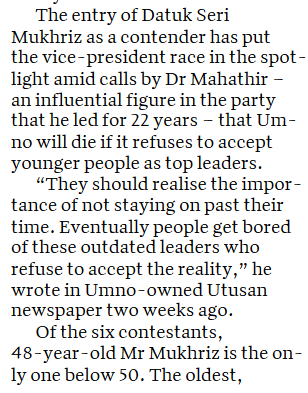
Among the six vice-presidential hopefuls one is more interesting than most of the others because he happens to be the son of former party president and long serving prime minister Mahathir Mohamad. This son, Mukhriz Mahathir, newly appointed chief minister of the federal state of Kedah immediately after the May election, is on the way up and would be a possible successor of PM Najib if elected as vice-president.

His father, Dr. Mahathir Mohamad, like many other elder statesmen, continues to comment on everything political in the country, but still wields more real influence than most of his peers. His direct support for his rising son and his vice-presidential ambitions may help a lot in this special area of political culture. (In most European countries this open support would be counterproductive).
Mukhriz 1

Source: Straits Times (Singapore) today, 26-9-2013.

But there is a nice irony involved which seems to go unnoticed by father Mahathir when he says:
“Eventually people get bored of these outdated leaders who refuse to accept the reality.”
A European proverb is saying that you should not throw stones if you sit in a glass house…

Another interesting detail is the contest for chairing the women’s wing. Incumbent Shahrizat, who was involved in a massive corruption scandal under the headline “Cowgate” seems to enjoy endorsement for another term by PM Najib. But her challenger, senator Mazlah Maznan has good chances to replace Shahrizat exactly because of Cowgate.
UMNO is the biggest Malaysian party with 3.4 million members and the results of next month’s convention promise to be interesting!

Can UMNO Survive without Reform?


NajibPartyforumseasia: UMNO’s narrow victory of the May election (if it was a true one anyway as the opposition still doubts) seemed to suggest that the party cannot continue business (!!!!) and politics as usual. Reform should be the order of the post election period if the steady increase of support for the opposition coalition was to be stopped. The party leadership, instead, seems to see the way out in playing the Malay card again and forget about reform.
Asia Sentinel, 16 September 2013 (=link), sums it up in the formula:
                Malaysia’s PM Capitulates to the Hardliners________________
“The Sept.14 announcement of an array of new economic benefits for ethnic Malays by Malaysian Prime Minister Najib Tun Razak represents the premier’s final post-election capitulation to radical Malay nationalists in the United Malays National Organization.

The new plan signifies a U-turn back to the New Economic Policy of affirmative action for ethnic Malays that was put in place in 1971 following disastrous 1969 race riots. Economists are largely in agreement that the policy has saddled the economy for three decades. Najib, an economist himself, has been attempting to undo the policy for three years through his 1Malaysia economic liberalization program. The new plan will play a major role in UMNO’s deliberations at its Oct. 5 annual general assembly and is key to Najib’s keeping his job, UMNO insiders say. If nothing else, it is recognition that reform inside the party is dead.”
Partyforumseasia is not surprised. PM Najib keeps his job but does not really look like a winner.

New Overview Paper: Party Financing in Southeast Asia


GlasbergenPartyforumseasia’s editor, Wolfgang Sachsenröder, has presented a comparative paper on party finances at the ICIRD Conference (22-23 August 2013) at Chulalongkorn University Bangkok.

Below you find an abstract.
If you are interested in the topic see the whole paper here:
Political Party Finances in Southeast Asia 1

Party Funding and Party Finances in Southeast Asia(Abstract)
by Wolfgang Sachsenröder, visiting fellow at the Institute of Southeast Asian Studies, Singapore, and editor of www.partyforumseasia.org

Southeast Asia, riding on a wave of economic and asset growth in the last few decades, has developed an exaggerated level of money politics and enrichment opportunities for all sorts of political entrepreneurs. The part of political parties in this game and the different methods of securing enough funding for the management of the party machineries and the increasingly costly election campaigns vary from country to country. But the basic pattern can be described as a skilful move to blur the distinction between big business, state funds, and political parties in order to control and manipulate cash flows as the main instrument for coming to power and secure it.

Based on traditional patron-client relationships and the remaining big income gap between mostly rural poor and limited mostly urban middle classes, “pluto-populism” and “pork-barrelling” have become prominent features of party politics everywhere. The overrepresentation of businessmen and bankers in parliaments and governments reflects the interdependence of party politics and business sectors, once dubbed as “incestuous relationship” by veteran opposition politician Lim Kit Siang in Malaysia. And the rising cost of being selected as a candidate or branch leader as well as the goodies to be showered on potential voter groups and party supporters are only a logical consequence of these developments which have hardly been affected by progress in democratic and institutional development. Frustration with the level of corruption is high in Southeast Asia, but the vicious cycle of political cash flows and party politics remains below the necessary domestic debate threshold to lead to radical reforms.
As the Malaysian election campaign for the 5 May 2013 “GE13” has shown, anti-corruption rhetoric strikes a strong chord with large sectors of the electorate, but the well-oiled machinery of the incumbent government coalition could not be defeated. In Indonesia, and certainly similarly in other parts of the region, the anti-corruption sentiments seem to be superseded by resignation. Since all parties are more or less involved, and people are so used to the daily petty corruption, the argument is losing appeal in campaigns, also because even the most corrupt parties use it strategically.

State funding for political parties, not to speak of the generous levels in many European countries (e.g. 154 million Euros in Germany in 2013) is widely unknown in Southeast Asia. An exception is Thailand, which has introduced – after long debates since the mid-1990s – a quite generous party funding system.
Membership fees are more or less symbolic in the region (e.g.Democrat Party, Thailand 20,- THB, PAP, Singapore S$ 18 / year) if collected at all. These contributions to the party funding are practically negligible and certainly no serious part of the parties’ income.

The elections in Malaysia (May 2013) and Cambodia (July 2013) suggest that the electorates are increasingly aware and sick of political corruption and vote for the opposition which they expect to be cleaner.

Will Political Corruption in Southeast Asia Come to an End?


Pork1Partyforumseasia: The funding of party activities and election campaigns is closely related to corruption in many countries in the region. This is why many businessmen are in politics or close to politicians and vice versa. But the enormous cash flows in the political arena are more and more tarnishing their image and creating a public outcry and demonstrations. Demonstrations alone would not bother the beneficiaries of this “incestuous relationship” too much, if there were not a backlash against corrupt parties in elections. Malaysia’s GE 13 in May and Cambodia’s July election ended as a very close shave for the ruling parties perceived as very corrupt.
These days it is in the Philippines that citizens demand an end to the infamous pork projects and President Aquino will have to show some results in the second half of his term.
Partiforumseasia will soon publish a comparative assessment of party financing and corruption in Southeastasia which was first presented in the ICIRD Conference in Bangkok last week.
Pork2

Source: Straits Times, Singapore, 27 August 2013

Where is the Ethical High Ground in Malaysia?


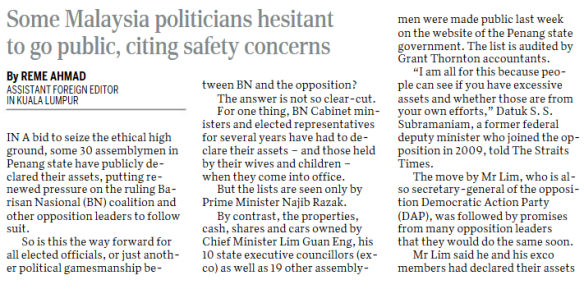
Partyforumseasia: There are probably few lawmakers world-wide who live on their official income alone and certainly even fewer who seriously bare their financial situation to the voters. The common tricks are sufficiently known. If you have to declare the financial status of spouse and children as well, proxies are easily found.
As laudable as the newest move towards transparent pockets by 30 Penang state assemblymen may be, doubts are allowed that this move can really put pressure on the financial networks of the Barisan Nasional elite. Though a lot of evidence of corrupt practices has been published so far and the image is sufficiently tarnished, full transparency will be too nice to be true.
Malaysia assets 2

Penang assets

Source: Straits Times, Singapore, August 13, 2013

Unity Government in Malaysia: Extended Wayang Kulit?


Najib denies
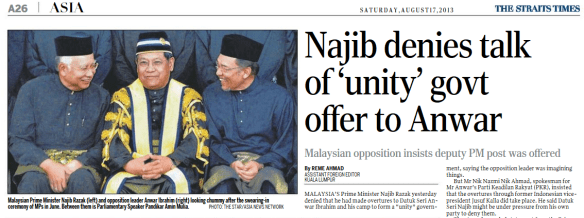
najib 2Partyforumseasia: Compromising after the bitterness of the GE 13 election last May cannot be easy for opposition leader Anwar nor for PM Najib, the latter even stabbed in the back by UMNO godfather Mahathir. And before a solution has been found it would not be clever to leak details one by one. A power-sharing solution won’t be easy to swallow for party members on both sides but would probably be conducive for the social cohesion of Malaysia. UMNO would be well advised to swallow its pride since it has to change dramatically if it wants to survive. A majority of the voters has given them a clear signal.

Source: Straits Times 17.08.2013

Malaysia: DAP Can’t Win Against RoS


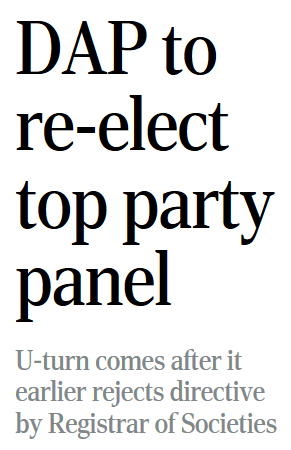
DAP 1Partyforumseasia: The GE 13 election results have been a big shot in the arm for the DAP. But ignoring the Registry of Societies’ verdict on the internal party elections could not be a viable policy, as different as the internal perception may have been. The danger of being deregistered seems to have changed the minds of the leadership.
As in most similar cases the complaint to the RoS came from disgruntled members of the party. Internal party elections regularly highlight and reveal the ambitions of members and candidates which, more often than not, do not overlap with their image and popularity. Standing for elections is a highly emotional risk and affects the sensitive egos of party activists.

DAP 2


Source / Link: Straits Times 16.08.2013

Vietnam’s Marxism-Leninism: RIP…?


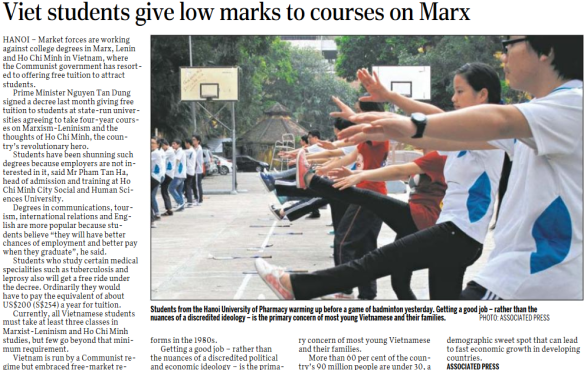
Partyforumseasia: On a visit to Xinhua News Agency’s training centre in Beijing in the late 1990s, the editor of Partyforumsea asked the somewhat naughty question how many Marxists they had in their faculty. The answer came quickly: Only one, the American guest lecturer…
Has Marxism-Leninism become a luxury ideology in rich countries? At least a number of European countries still have Marxist splinter parties surviving alongside the more successful social-democrats.
For Vietnam in its ongoing economic crisis, the traditional ML-ideology seems to attract few followers among the young. State jobs which require membership in the Communist Party obviously don’t attract many any more. See the Associated Press article in the
Straits Times (16 August 2013)
Vietnam ML

Scholarly Papers on Thai Politics: New Publication by Michael H. Nelson


Link: Nelson, Thailand’s election system Partyforumseasia:  Recommended reading:

The Attempt to Adopt a Mixed-Member Proportional Election System in Thailand: The Near Miss of the Constitution Drafting Committee and Constitution Drafting Assembly in 2007, by

Available at: Academia.edu
and Contemporary Southeast Asian Dynamics, Working Paper Series No. 11, ISSN 2191-169X, Lehrstuhl für Südostasienkunde, University of Passau, Germany


Malaysia: Compromise between BN and PR?


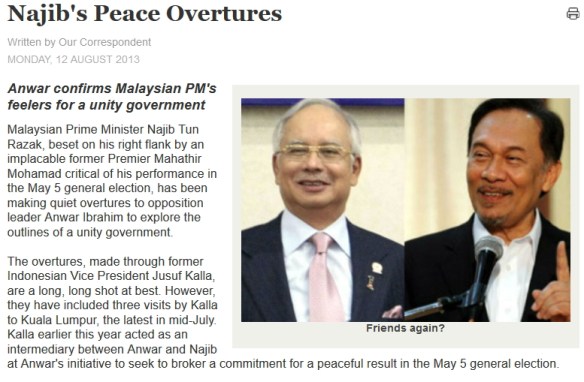
Partyforumseasia:Political contestation is as normal in democratic multi-party systems as eventual compromise. National unity governments have helped to reconcile the competitors after bitter election campaigns. Channels of dialogue should be the very least that voters can expect from politicians who declare themselves as patriots and want to serve the country. This is why many fingers should be crossed when signals of dialogue between PM Najib and opposition leader Anwar ( or PM Hun Sen and opposition leader Sam Rainsy in the Cambodian case) become visible.
See (link) Asia Sentinel 12 August 2013
NajibAnwar

Cambodia: A Surprise in the Pipeline???


Partyforumseasia does not like fortune-telling but the political timeline for the last few weeks looks a bit like indicating a surprise solution:

Mid July
Royal Pardon for Sam Rainsy at the request of PM Hun Senin a spirit of reconciliation

19th July
Triumphant return of Sam Rainsy after four years in exile to avoid imprisonment after a dubious sentence he calls politically motivated

28th July
Election results with heavy losses for the ruling CPP and significant gains for the opposition under Sam Rainsy: 68 seats CPP – 55 seats CNRP

29th July
Press conference of Sam Rainsy: “We are asking for this (investigation into alleged massive irregularities) not to bargain for positions in the government
(Source: Straits times Indochina Bureau Chief Nirmal Gosh, who continues: “He (Sam Rainsy) said it was “premature” to talk about power sharing in the new government.”)

31st July
PM Hun Sen: “The Cambodian People’s Party has an open heart to talk to the CNRP” Background: The CPP has not enough seats to convene parliament and needs the CNRP’s cooperation…

Soon???
– A grand coalition between CPP and CNRP in the national interest of the country?
Sam Rainsy finance minister? or better Foreign Minister?
Partyforumseasia: Probably not a bad solution for Cambodia!

Hun Sam

How Dirty or Clean was the Cambodian Election?


Max3Partyforumseasia: Before the election there was already confusion about the voters lists. Some were too short, many voters were missing, some others were too long, with possible phantom voters. There were many suspicions that the ruling CPP would use the normal tricks to manipulate the outcome of the election which it could not afford to lose. The official observer teams, not all from very democratic countries, were as ineffective as they normally are. But this time a range of civil society initiatives tried to uncover irregularities. In part 2 of his observations, Max Grömping from The Electoral Integrity Project supplies us with a very interesting assessment how civic election observation works and where its limitations are.
Max2
Look up the whole report at the following LINK:

Cambodia Election: Tough Pill for CPP


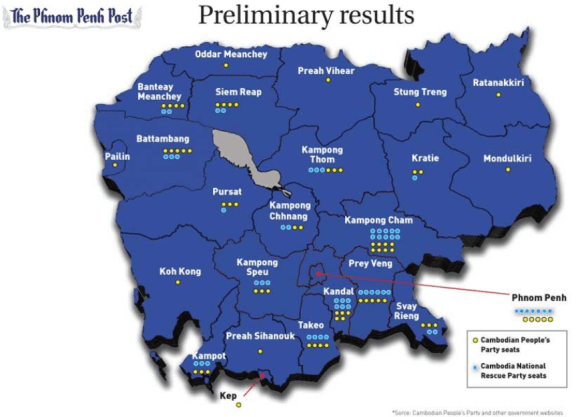
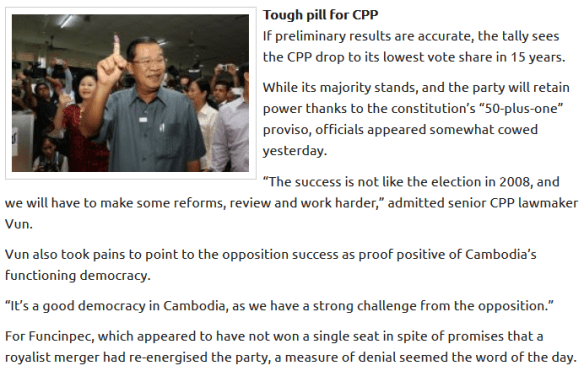
Partyforumseasia: As expected, the CPP has retained majority and power, but the opposition has improved from 29 to 55 out of 123 seats. That is a great victory on the background of much confusion about irregularities with the voter lists and washable indelible ink. More analysis will follow when the dust settles.
Results
Read more in the Phnom Penh Post of 29th July 2013:
Tough Pill

Cambodia at the polls: Erosion of the CPP and More Seats for the Opposition?


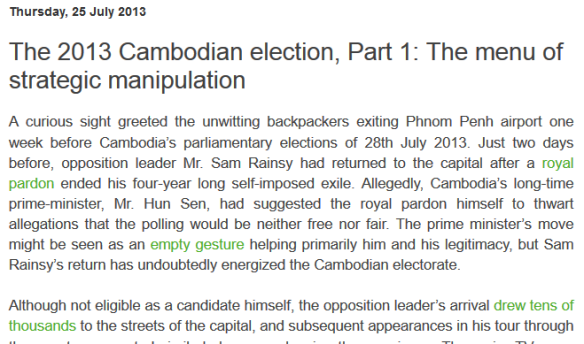
Hun SamPartyforumseasia: The triumphant return from exile of opposition leader Sam Rainsy last week and the increased visibility of young anti-CPP campaigners in Phnom Penh and bigger cities has tempted many foreign journalists to predict a sea change in Cambodia’s politics. Partyforumseasia has been more cautious in view of the overwhelming control of the country by Prime Minister Hun Sen and his CPP. Some gains of the opposition, more united at last, should be possible, though. But recent reports about discrepancies in the voters lists do not augur well for a clean procedure. Under-registration and intimidation of known opposition voters have been common before, over-registration in other constituencies may mean that “ghost voters” can tip the balance decisively. These ghosts have been haunting other countries in the region as well.

For an excellent and balanced overview of the newest developments see Max Grömping’s report under The Electoral Integrity Project:
Link: http://electoralintegrity.blogspot.com.au/2013/07/the-2013-cambodian-election-part-1-menu.html
Max

What is Internet Voting?


Partyforumseasia: Since personal identification techniques are working well with banking services or tax returns, internet voting may be the next step to facilitate a higher voter turnout or make the voting more convenient in remote places.
ballot boxBenjamin Goldsmith, Election Technology Adviser with the International Foundation for Electoral Systems gives an overview on the developments in this field:     

Source/Link:    IFES 17 July 2013
PC

Pardoned Challenger Returns for Cambodia Elections on 19 July


RainsyPartyforumseasia: The Cambodian election campaign is getting a bit more interesting. Two weeks before election day on 28 July, King Norodom Sihamoni has pardoned opposition leader Sam Rainsy King Norodom Sihamoniwho will return from exile in France to Phnom Penh on the 19th. The pardon comes at the request of Prime Minister Hun Sen “in a spirit of reconciliation”. Sam Rainsy is not too optimistic on his Facebook page that his return can really challenge the expected CPP victory: “In the short time that has been made available, I hope to be able to meet my fellow countrymen to discuss their concerns and to hold discussions with leaders of all political parties on the best way foward for Cambodia.” He knows quite well that PM Hun Sen would not take the risk of losing just for the spirit of reconciliation. Nevertheless, some gains for the united opposition which runs as Cambodia National Rescue Party can be expected – an interesting development after the Malaysian GE in May and the Singaporean by-election in March this year.

But there is a high probability that PM Hun Sen Hun Sen neuwill keep smiling after the election.

Cambodia: Sam Rainsy Back Home to Challenge Hun Sen?


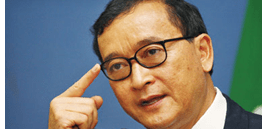
RainsyPartyforumseasia: Yesterday, 7 July 2013, Sam Rainsy has announced his return to Cambodia.  See his Facebook page.

The country will be going to the polls on 28 July and – as usual – Prime Minister Hun Sen’s Cambodian People’s Party (CPP) is expected to win big. The long term ruling party is well prepared with a total penetration of the administration and its control of media and economy. Could opposition leader Sam Rainsy be Hun Sen’s nemesis this time? Rainsy lives in exile since 2009 to avoid imprisonment up to eleven years after a dubious conviction, but the internet allows him constant contact with his party. And this time the opposition has managed to unite in the Cambodian National Rescue Party (CNRP).
Sam Rainsy is the only Cambodian politician with the format and popularity to challenge PM Hun Sen, whose official title is as impressive as his long term grip on power: “The Noble, Supreme, Great, and All Powerful Commander-in-Chief, Prime Minister Hun Sen”. But many Cambodians resent the cronyism and corruption of the CPP regime and the evident nepotism in the Prime Minister’s family.

Hun Sen

Indonesia’s PKS: No Party of Angels…


Engel
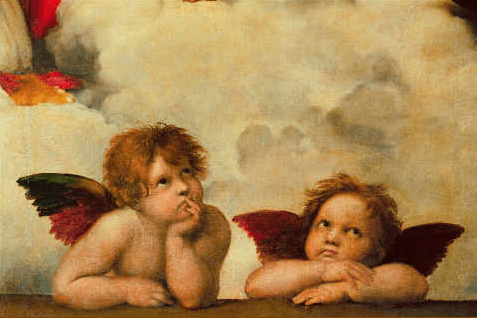
Partyforumseasia: Busyro Muqoddas, chairman of the Anti-Corruption Commission (KPK) of Indonesia, has called the Prosperous Justice Party PKS “not a party of angels”. The latest series of scandals has been highlighted by John Mcbeth in the Straits Times of July 2d 2013. Here is a part of his report:PKS
Apart from doubts about the complete innocence of angels – even these famous ones by Raffael have some mischevious twinkle in the corner of their eyes – Partyforumseasia does not know any party of angels in this world. The question is whether Indonesians are so used to corrupt politics and politicians that they don’t expect angel parties or somewhat cleaner than the others-parties any more.
Another interesting observation of Mcbeth is the split between more religious and ideological PKS members and the more secular pragmatists who adapt to a more affluent lifestyle and don’t mind to make some bucks in the shadow. Only the next elections will show whether voters seriously mind corruption in a major Islamist party or take political corruption for granted.

Respect: UMNO’s Internal Election Reform


VitalsratistixPartyforumseasia: UMNO is getting serious in renewing the less than perfect internal election procedures. After 26 years of pre-democratically choosing the party president and his deputy without voting and by acclamation, this method described and  ridiculed in Asterix’s old Gaul, comes to an end. In the upcoming party elections, probably between mid July and mid August, UMNO will come back to a proper election of the two top leaders. It will remain to be seen whether the election will be competitive or not, and if yes, who will have the courage to openly challenge Prime Minister Najib.
Whether he will like it or not, the voting might show his support level in the party, at least by abstentions, spoiled or no votes.

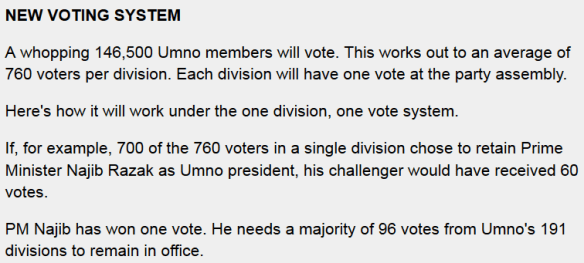
The other part of the reform will expand the number of delegates with voting rights from 2,500 to 146,500, probably enough to make vote buying too expensive even for the richest UMNO members with ambitions for local leadership posts.
See also the short overview on the reform compiled by Singapore’s Straits Times of 29 June:
UMNO new voting system

Virtual Politics in Southeast Asia: Leaders Must Blog


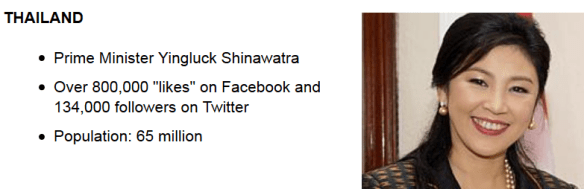
Partyforumseasia: Obviously many voters like to feel close to their leaders, and subscribing to their blogs seems to provide this feeling. This, in turn, obliges the leaders to set up their own websites. Singapore’s Straits Times, 24 June, provides an overview, here is a selection for Southeast Asia, that is the rulers. The opposition figures may be interesting as well and a comparison of the number of followers…

Indo

Malay
Myan

Phil & Sing

Thai

Malaysia: Competition for UMNO’s Top Job?


VitalstatistixPartyforumseasia: This is “Vitalstatistix”, chief of Asterix’s and Obelix’s village in old Gaul. He is waiting on his shield to be uplifted and reconfirmed as chief…

The extended UMNO leadership seems to be divided over how party chairman Prime Minister Najib Razak should be confirmed this time: uncontested like all UMNO top leaders in the last 26 years…or elected. Competitive party elections can be divisive, sure, and each contender has his or her own enemies and supporters. But such is party politics and competition is normal.

For the next party election later this year, PM Najib seems to have already a potential challenger, UMNO senior statesman Tengku Razaleigh Hamzah, once called ” the best Prime Minister Malaysia never had”. Because (or despite his age, born in 1937) he might be the right leader to reconcile the UMNO factions and maybe even UMNO and PAS…
RazaleighNajib


Another interesting result of the new competitiveness in Malaysia’s politics are the attempts of UMNO to reduce its internal money politics by enlarging the voter base for the party elections. Increasing the number of members with voting right from 2,500 to 140,000 may indeed make vote buying too expensive and unaffordable even for the richest leaders. But the patronage and pork barrel system will be difficult to eradicate.

Vietnam: First “Lack of Confidence Vote”?


DungPartyforumseasia: Prime Minister Nguyen Tan Dung and his government risked a confidence vote last Monday, 10 May, for the first time in their regime’s history. Given the 90% majority of the Communist Party in Vietnam’s Parliament and the remaining 10% not really antagonistic opposition, the risk was not life threatening.
But more than 30% “low confidence”votes may
be signaling Dung’s fading popularity for a lackluster performance widely blamed for the slow economy on one side. On the other hand they will give hope to the population that their unhappiness with party and government will not go unnoticed by them any more. The keen interest in specially televised parliamentary debates since a couple of years shows that citizens are not indefinitely prepared to suffer in silence. But will the party be capable of opening up? Will rivalries inside the ‘nomenclatura’ allow for genuine party reform? See more details in today’s (link:) New York Times article.

Myanmar: President Aung San Suu Kyi?


Aung 3Partyforumseasia: The long way from prison and house arrest to the presidential palace seems to open up for democracy icon Aung San Suu Kyi, “The Lady”. At the same time, her leadership of the National League for Democracy (NLD) comes under criticism by former supporters. “Foreign Policy” in its May/June edition (pp 32-34) publishes an article by Min Zin with the telling title “You Can’t Go Home Again”. The author, a former student activist in Burma, is now a journalist based in California. His feelings are nostalgic and disappointed at the same time when he comes back to a changed country: “And the more I spoke with Burma’s intellectuals, with the dissidents who had struggled alongside me so many years ago, what I heard was not simply joy about a country finally opening up to the world (…) but also the striking disappointment, in particular with our beloved Aung San Suu Kyi. (…) Today (…) even among those who love and respect Aung San Suu Kyi, her sainthood appears tarnished by an increasing aloofness and distance from the rest of the political opposition. Her leadership style makes her unapproachable. In the party congress of her National League for Democracy, held in March – the first in more than 20 years – she alone handpicked her central executive committee. But even worse than this worrying authoritarian streak, she seems willing, even eager, to please the former generals at the expense of moral and political principles. One of the most striking examples is her silence on the racist discrimination and violence against the Rohingya Muslim minority…”.
Exile, that shows history everywhere, makes it hard to leave the difficult past behind and see the new reality with open eyes. Many exiles remain bitter and may (often secretly) expect a compensation for their sufferings, one that Aung San Suu Kyi seems to be getting now.
But Min Zin’s question remains valid: What type of party will the NLD be in the next few years and how will The Lady and her handpicked executive committee lead it? The transition from decades as suppressed opposition to ruling a difficult country will not be easy.

UMNO is a Democratic Party, UMNO is a Democratic Party, UMNO is…


AsterixPartyforumseasia …would never say it isn’t. The debate is inside the party about the two top leadership posts. It is an old habit since the times of Asterix about 2000 years ago to lift “born” leaders on a shield without wasting time for elections. Acclamation is sometimes acceptable if clear majorities are evident. But the normal way of determining party leaders is a contested election because it shows the margin of support for the winning leader. Obviously some leaders in UMNO want to do it the Asterix way, without the shield of course. Some others seem to prefer a proper election. But both are sure that UMNO is a democratic party:
Pahang’s chief minister Adnan Yaakob told reporters that he is against the uncontested top job solution: “UMNO is a democratic party. It is better if we do not do this because it will show that we are autocratic”. Deputy Prime Minister and UMNO deputy leader Muhyiddin Yassin who would profit from an uncontested re-election did not want to comment.
Actually the last contested election for the UMNO leadership was in 1987, 26 years ago, when Dr. Mahathir Mohamad narrowly won against Tengku Razaleigh Hamzah, which led to a party split. Najib 1

Beginning of the End of Indonesian Money Politics?


WidodoPartyforumseasia: Will this man change the endemic political corruption in Indonesia? Joko Widodo, the governor of Jakarta, seems to meet the expectations of a growing number of Indonesians fed up ad nauseam with big style money politics in their country. President SBY turning out more and more as a lame duck at the end of his term, popular darling “Jokowi”, as the former mayor of Solo is affectionately known, may be the early front runner in the presidential race for next year.
In a recent poll by think tank CSIS Widodo leads with 28.6% in front of former general Prabowo from the Gerindra Party with 15.6 %. Golkar chairman and business tycoon Abdurizal Bakrie, in strong headwind after scandals, comes third with 7%, and PDI-P long term leader Megawati Sukarnoputri is nearly written off at 5.4%.

The humble style of Widodo, e.g. using the office driver but in his private car, obviously meets the dreams of many voters of an approachable politician who is not showing the usual priority of lining his own and his party’s pockets. One of the leading experts on Indonesian money politics, Marcus Mietzner from the Australian National University, estimates the campaign cost for the governorship of an average Indonesian province at a staggering 10 million US$. The popular dream of cleaner politics may pick up with Jokowi. So more parties than his own PDI-P are eying him as their own presidential candidate…

Backlash for Malaysia’s Partisan Media?


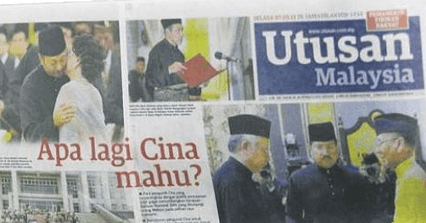
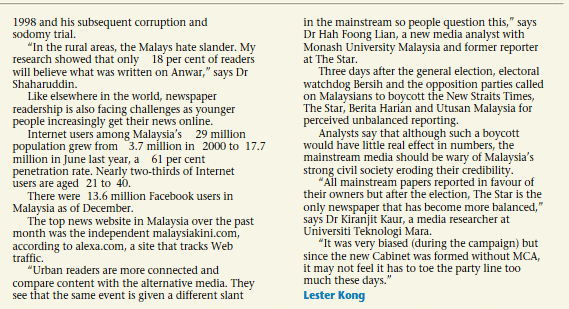
Apa lagi Cina mahuPartyforumseasia: Taking up PM Najib’s unfortunate formula of a Chinese tsunami with the infamous headline “Apa lagi Cina mahu?” (What else do the Chinese want?), the UMNO owned Utusan Malaysia newspaper has exposed its own partisanship to a degree that undermines its credibility even more. The domination, if not control, of the media by government and ruling coalition, blamed among other shortcomings for the uneven political playing field, starts to create a backlash in the era of internet reporting and social media. With the credibility of the partisan media, their economic success is also threatened. An article in the (link:) 2 June Straits Times (Singapore) gives a number of interesting details. And nota bene at the same time the saying goes that the best coverage of domestic developments in Malaysia is supposed to be published in Singapore (and vice versa).
By the way, the first political riddle in the childhood of the author of these lines was: “What lies at your doorstep in the morning and lies? Answer: The newspaper…
See also the following link: Malaysia’s Dilemma
Malaysia papers 1
Malaysia papers 2

Malaysia: Reform of the Election Commission – Najib as ‘pontifex’ (bridge-builder)?


bridgePartyforumseasia:The narrow election victory of the Barisan Nasional coalition under PM Najib comes at a price which the PM has increased himself with the incautious (to say it mildly) remark about the “Chinese tsunami“. The campaign has cruelly exposed the political cleavages in Malaysia’s complex mix of ethnicity, religion, geography, and social stratification, some of them the result of long term government policies.
In this situation, the PM calls for unity and reconciliation which may sound a bit desperate for many critics of the ruling party. But inviting the opposition to participate in a reform of the controversial Election Commission is certainly a good move. It may only come a bit too early since the backlog of fraud complaints for the 5th May election has not even started to be cleared. Including the expected law suits it may take a year. And critics are not optimistic about the results of a mixed committee, the most prominent of them the leader of the election watchdog Bersih, Datuk Ambiga Sreenevasan.

Political Party Funding Regulations in Southeast Asia


Best congress 001

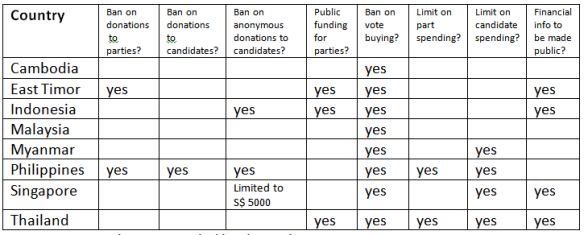
Partyforumseasia: The International Institute for Democratic and Electoral Assistance (IDEA) in Stockholm has published a very detailed database on legal regulations encompassing practically all aspects of party and campaign funding, see
(http://www.idea.int/political-finance/).
To reduce the complexity of the provided data, here’s a selection of the most basic information for Southeast Asia:

IDEA

The table shows “only” the legal situation and certainly not the whole reality of party and campaign related financial activities in Southeast Asia. Looking at the ‘ban on vote buying’ column alone reminds more of the “perfect” theoretical human rights protection in the constitution of the late USSR –  both a far cry from what happened on the ground…

Malaysia After the Election: No Smooth Sailing for the Winner


UMNOPartyforumseasia: Prime Minister Najib Razak is still more popular than his victorious National Front (BN) coalition. But the opposition, harping on their popular vote advantage of 51% (which is not decisive in a first-past-the-vote system), seems to touch the nerve of hundreds of thousands of citizens who understand the unfairness of the electoral system. And they feel outraged by Najib’s and the Election Commission’s calls for  reconciliation and calm acceptance of the results. The protest rallies may go on, now that the official and final results are out, which is the start for formal complaints about election fraud and legal battles to come. The opposition is planning to challenge in court the election outcome for 41 seats won by BN at a narrow margin. Fraud is not easy to prove and rarely leads to reversed seat allocations. But the legal procedures may take many months and keep the hostile climate at the level of a war of accusations and counter accusations. This, in turn, will not help PM Najib to renew his party mandate as chairman later this year. Serious challengers are not yet visible but party politics sometimes has few choices except “support or topple”. Malaysia’s political climate remains volatile.

Indonesia: Democrat Party in continuing decline


Partyforumseasia: Personalized “presidential” parties tend to deteriorate with their leader-founder, see the “Three Kims” in Korea for example. With president Yudhoyono (SBY) having to go soon, his Democrat Party seems to disintegrate already with a string of scandals speeding it up.

See the following article in (link:) Asia Sentinel
PD Indonesia

Partyforumseasia: At the same time the losses of PD seem to translate into gains for the PDI-P. Sunday’s gubernatorial election in Central Java preliminary results see PDI-P candidate Ganjar Pranowo with a huge lead close to 50%, obviously with tailwind by support from popular Jakarta governor Jokowo and grand dame of the party, Megawati Sukarnoputri. Pranowo’s campaign slogan “no corruption, no lying” seems to have struck a chord with the voters.

Political Party Funding in Southeast Asia


Corruption 4

Partyforumseasia is preparing an overview on party funding in Southeast Asia, a region where public funding for political parties is widely unknown, though Indonesia and Thailand are experimenting with it. The party laws prescribe certain minimum infrastructures like the number of branches in so many provinces, etc. And election campaigns cost in the billions, not only in the US but also in Southeast Asia. So, where do the political parties get their funding from? Donations, sure, but why give businessmen and corporations money to the parties?
At the same time, the general perception of corruption, except Singapore, is comparatively high. See here an excerpt of Transparency International’s 2012 Corruption Perception Index (CPI):
TI 2012

Partyforumseasia: What can be expected in the practice of political party funding in this environment?
Contributions, examples, comments will be most welcome for our study. Please send them to:

webmaster@political-party-forum-southeast-asia.org
Corruption 1

Timor Leste: The Most Democratic Country in Southeast Asia?


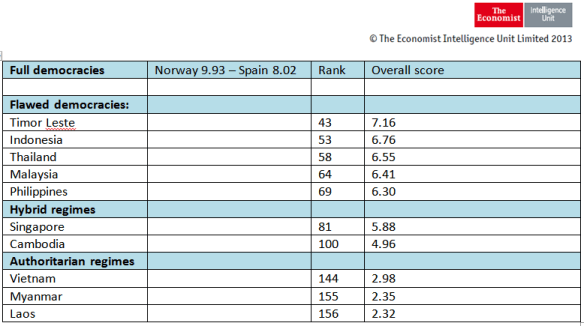
Partyforumseasia: In the Economist’s Intelligence Unit’s Democracy Index 2012 (an excerpt for Southeast Asia attached) Timor Leste tops the regional neighbors’ ranking as no.43 with Indonesia following as no.53 and Laos at the low end as no.156. As all these rankings are debatable, Partyforumseasia would lift Singapore to the flawed and downgrade Cambodia to the authoritarian category.
Anyway, the good ranking of Timor Leste deserves attention and applause.
Economist SEA DEmocracy Index

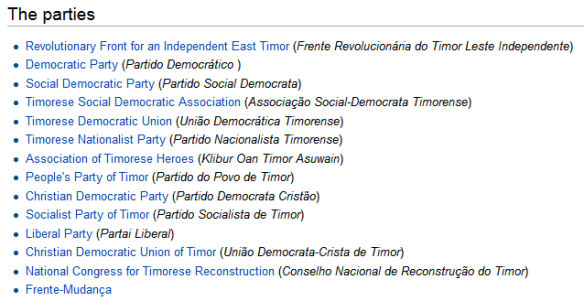
But the splintered party scene in Timor Leste may deserve more attention and research. Contributions from scholars outside and political analysts from inside Timor Leste would be most welcome on Partyforumseasia!
Timor Leste parties (Wikipedia)Source: Wikipedia

Election Results 2012:

Timor Leste Election Results 2012 (Wikimedia)

Source: Wikimedia

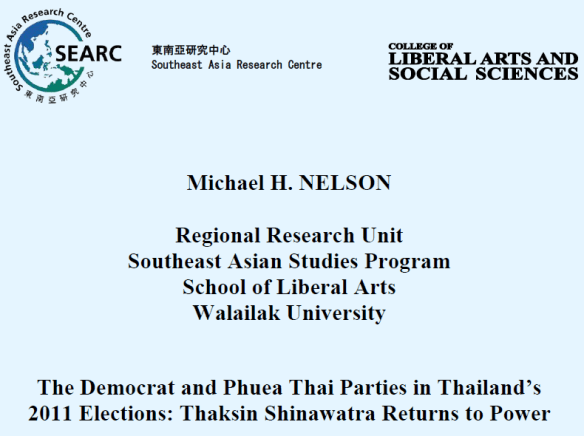
Political Science Papers Thailand: New Paper on Democrat and Phuea Thai Party by Michael H. Nelson


Nelson, Democrat and Phuea Thai

Partyforumseasia: Is Thaksin Shinawatra indirectly back in the driver’s seat, just using his sister Yingluck as facade? An in-depth study by Michael H.Nelson from Walailak University.

A “GE13-Autopsy” with Four Preliminary Conclusions


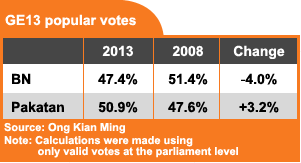
Popular vote

Source: http://malaysiasdilemma.wordpress.com 10 May 2013

Partyforumseasia:

  1. Majority of mandates and minority of the popular vote
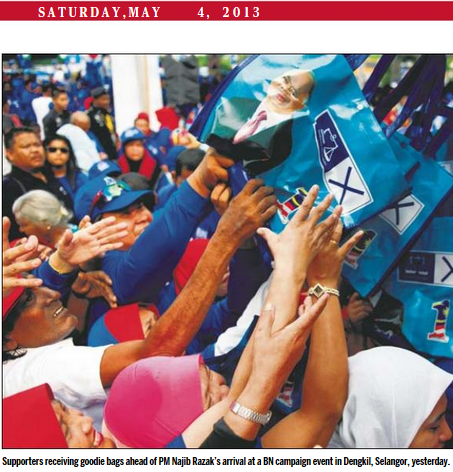
    Barisan Nasional had to win this election at any cost and it did so, never mind the further eroding simple majority. It had to win it in order to keep its grip on the political power, its control of the administration, and the connected business networks which have oiled its machinery for decades. A victorious opposition with a probably cleaner and more transparent government style and consequently cutting the cronies off the pork barrels would have meant much too radical losses for the beneficiaries of the established system. And a losing Pakatan Rakyat opposition coalition will certainly face problems to keep its ranks closed.Eventually, PM Najib’s strategy of an all-out campaign with a mix of threats and goodies, neglecting the short and long term costs for the taxpayer, was successful against the groundswell of opposition sentiment in the population. The much discussed popular vote majority for the opposition (50.9 against 47.4 % for BN) is rather irrelevant in terms of power politics as long as Malaysia does not change the British-heritage first-past-the-post system, though it affects the legitimacy and credibility of the continued BN-rule. So, for the next five years don’t expect changes to the electoral system. As Lee Kuan Yew from neighbouring Singapore once said, a ruling party cannot be expected to make it easier for the opposition.
  2. A stolen victory?
    If an incumbent ruling party or coalition has to win at any cost, at least some preparations for manipulation must be expected. And many Malaysians did expect it. What came up during election night and triggered the complaints of the opposition is probably haunting the BN as well and will continue to do so for a while. The congratulations from president Obama and the EU were urging PM Najib to carefully address the alleged fraud cases. That is a quite unusual diplomatic formulation which affects the international image of Malaysia. But in the face of a critical Bersih (Malay for clean) movement monitoring the elections with tens of thousands of local observers specially trained to detect attempts of fraud, the BN strategists and campaigners may have been prepared for very cautious procedures and for mudding the water after the end of the vote counting as well. More than a week after the election now, the EC chairman urges the opposition to accept being defeated. Opposition and Bersih, on the other hand, seem to be slow with presenting proof of fraud, saying they are still compiling evidence. But the EC by-laws give them ample time for that. Much material published online has disappeared from the internet, but as of 13 May the PKR Election Fraud Investigative Team is looking into 237 complaints, especially in cases with a winning margin under 5%. Future investigation by Election Commission (EC) and courts may bring up more evidence than we have so far. Nevertheless, the anger of hundreds of thousands of outraged protesters clad in black show the public sentiment and the lack of trust in government and EC.  That is a difficult and dangerous situation showing quite brutally the cleavages in Malaysia’s society.
  3. Reconciliation despite bitterness and mistrust?
    Fortunately, Malaysia has enjoyed many years of peaceful development without open conflicts. But unfortunately, political interference, like preferential treatment for Malays, housing and settlement policies, the crony-networks, and the religious undertones in the UMNO-PAS competition about who has the better Muslim credentials, have created and intensified resentment and critical opposition to the decades of BN-rule in growing sectors of the population, nota bene including urban Malays. This is why PM Najib’s first reaction in disappointment and anger, holding a “Chinese tsunami” responsible for his lacklustre victory was a serious mistake. All his calls for reconciliation and unity sound hollow after this, and may cost him the leadership of UMNO eventually.
    On the other hand, the world political history of the last few years is full of narrow and dubious election outcomes with opposition protests fizzling out sooner or later. In the Malaysian case, the final price for the May 5th narrow victory may turn out to be costly for UMNO. Much depends on Anwar’s and Bersih’s perseverance in questioning the results. But even if their protest dies down sooner or later, the BN administration will have to continue to pamper its supporters with material goodies or risk being let down even further. This type of indirect and thus not illegal vote buying will turn out to be more and more costly, after the outrageously costly campaign we have seen already.

4.    Toward a two-party system?
During the last few weeks many commentators were talking about an upcoming two-party system. We can safely assume that the heavy losses of BN’s component parties are gradually pushing UMNO into admitting that it is more or less alone in charge. MCA and Gerakan have been kept alive with the financial and logistic support of UMNO and both have relied too much on this relationship. This political miscalculation has been punished on May 5th and may lead to their dissolution sooner or later.
On the opposition side it is rather difficult to see any tendency toward a merger. As long as Anwar Ibrahim does not retire from politics and joins academia, as he had announced (or threatened?) for the case of losing the election, PKR will remain a strong player. Whether PKR or DAP is the more stable and stronger party is not clear despite the better results of DAP. Merger tendencies or even merger talks between the two have not been published so far, and a merger of any of them with PAS is even more improbable. Racial issues, the urban-rural divide and its gerrymandering advantages, as well as religious preferences will continue to create high barriers against the formation of a united opposition party. But in the longer perspective it may be possible with a new leader even more charismatic than Anwar and who can galvanise the resistance against the prolonged BN rule even more successfully. With the popular vote already on the side of the opposition, the BN strategists cannot lean back and rule as usual. They will try to divide the PR parties as much as possible, but this may backfire with the growing number of voters who suspect UMNO of working more for their own survival than for the progress of the country.

Malaysia’s GE13: Party Results


Partyforumseasia:
Complaints about irregularities in a number of constituencies are still under investigation. Here are the results for the competing parties, by Straits Times (Singapore) 8 May 2013:

Results GE13

Philippines: Mid-term Elections on 13 May


Partyforumseasia:Obviously not as exciting as Malaysia’s GE13 last Sunday, but certainly an important political milestone for the political and economic consolidation of the Philippines: Aquino

May 2013 Elections: A glimpse of the next President of the Philippines
By Jules Maaten, FNF, Manila

The May 13th, 2013 mid-term elections in the Philippines will not only decide whether the current liberal administration strengthens its mandate for the next three years. What is more, it is a preview of the 2016 presidential contest, and of whether the good governance reforms of the administration will last beyond the current administration. The Liberal Party put all their eggs in one basket: that these elections are an endorsement of liberal President Aquino’s administration.

In 2010 the Philippines elected liberal President Benigno “Noynoy” Aquino III with a historically large landslide, on an anti-corruption, anti-poverty platform. His administration has been credited with real successes in the fight against corruption, such as the impeachment of former Chief Justice Renato Corona and the court case against Aquino’s predecessor Gloria Arroyo. At the same time the economy has picked up in a spectacular way.

This is reflected in Aquino’s satisfaction ratings, which in March were a net +59 (up 4 points from December 2012), and his cabinet has a good net satisfaction rating of +26. But Aquino is seeking to strengthen his mandate with a stronger majority in the Senate (where half of the 24 seats are up for grabs), and maintaining his strong position of the House of Representatives (where all seats are at stake). The mid-term election also includes local elections in the 80 provinces, 143 cities and 1,491 municipalities in the country.

Confidence in this administration is high, but many in business wonder whether the anti-corruption and liberalisation drive continues after 2016, when a new President will be elected (Aquino is only allowed one six-year term). Current front runner is vice-president Jejomar Binay, former mayor of Makati City, who is not precisely famous for his good governance record. A candidate who is more in line with Aquino’s policies would be Liberal Party (LP) leader Manuel “Mar” Roxas. President Aquino has been very vocal in recommending Roxas, his 2010 running mate. Roxas has not yet declared his plans for 2016.

Corruption is slowly fading, on the national level at least, but has not yet received a knock-out blow. The economy has picked up, but the benefits take time to trickle down to the poorest Filipinos, and structural liberal reforms have so far been piecemeal. A competition law and a freedom of information law, seen as ‘signature legislation’ for LP as well as for Aquino himself, are yet to be adopted. Following the success of the adoption of the Reproductive Health bill, despite massive opposition of the Catholic Church hierarchy, the public is looking for more reforms, and Aquino needs all the help he can get.

Binay and Roxas already had a close fight for the vice-presidency in 2010, with Binay narrowly winning. Binay now entered the mid-term elections with his own slate of Senatorial candidates: the UNA coalition of parties, formed together with former President Joseph “Erap” Estrada, who was ousted on plunder charges in 2001, and Senate President Juan Ponce Enrile, who was already a minister under Marcos and who has donned more political colours in his career than a fireworks display. Nominally UNA is “not in opposition” against the President, but a victory of the UNA coalition would be seen as a defeat for Aquino.

The President’s men responded with their own coalition, “Team PNoy” (PNoy being another fond nickname for the President), thereby raising the stakes. The message is clear: if you want the “straight path” of the President to continue you have to vote for Team PNoy. And a defeat for UNA would take much gloss off Binay, who so far enjoyed high approval ratings, using his cushy job mainly for public relations purposes.

In this election the interests of the Liberal Party itself took a back seat. The Team PNoy slate of twelve candidates contains only three from LP, only one of whom (the President’s cousin Bam Aquino) stands a good chance of being elected. Some of the other Team PNoy candidates are even erstwhile opponents of LP, but they pledged to support the President’s policies. Amongst some of the rank and file of LP the make-up of the Team PNoy coalition understandably raised eyebrows, to say the least. Yet a victory of Team PNoy together with LP holding on to crucial seats in Congress and amongst governors and mayors, would give LP a head-start in the final half of Aquino’s term and for the 2016 Presidential elections. The victory might also get liberal Senator and campaign leader Franklin Drilon elected as Senate President, which would be a great boon to the administration, replacing the wily Juan Ponce Enrile.

Binay however is an excellent strategist, and in the initial election surveys after the forming of UNA their candidates occupied most of the twelve Senate seats that are up for election. But the picture changed, particularly when President Aquino personally joined the fray, and in the latest polls nine out of twelve are for Team PNoy with several liberal Team PNoy candidates on the verge of breaking into the ‘magic twelve’. The personal ratings for Binay and Ponce Enrile are down. And in the most eye-catching local race between UNA and Team PNoy, for mayor of old Manila, former President Estrada’s challenge to incumbent liberal mayor Alfred Lim may not be as easy a success as was earlier predicted.

Another issue is whether the elections will be plagued by corruption and violence, as they have often been in the past. So far the some violence has come from the communist insurgency NPA, more than amongst rival candidates. The pro-active stance of the Commission for Elections (COMELEC) appears to have some effect. FNF joined the campaign of one of the election commissioners, Grace Padaca, against vote buying, and one of the advocacies in the FNF Freedom Runs in Quezon Province, Leyte Province and on Mindanao was “My Vote Is Not For Sale”, which galvanized more than 3000 local activists. FNF were also active in training 5,600 poll watchers across the country in Cebu, Cagayan de Oro, Capiz, Cubao and Zamboanga.

There is everything to play for on May 13th, and much is at stake.

Leadership, Charisma, and Narcissism


HitStalinPol Pot

  1. Charisma
    The German sociologist Max Weber (1864-1920) applied the centuries-old religious connotations of charisma to politics with the following classic definition: “Charisma is a certain quality of an individual personality by virtue of which he is set apart from ordinary men and treated as endowed with supernatural, superhuman, or at least specifically exceptional powers or qualities. These are such as are not accessible to the ordinary person, but are regarded as of divine origin or as exemplary, and on the basis of them the individual concerned is treated as a leader.” But he also added a second criterion: “the recognition on the part of those subject to authority” is decisive for the validity of charisma.”(See Wikipedia: Charisma)
    In the 21st century, “supernatural” and “superhuman” are outdated notions, but exceptional powers or qualities are easily attributed to political leaders and dignitaries. From the simple village mayor or MP in the constituency up to ministers, prime ministers, and presidents, leaders are always surrounded by beaming and smiling faces, happy slaves when they are blessed with attention or a handshake. The aura of power produces already a semblance of charisma – not necessarily in need of outstanding personal qualities. And in the era of omnipresence and ubiquity of TV coverage, telegenic qualities and good looks may easily supersede the natural authority of personality. Personal charisma and media charisma may be very different, but the latter can be influenced and has created a whole new industry of coaching and political consultancy.
  2. Dangers of Charisma?
    Elections are highly emotional for the candidates because they are a test for attractiveness and potential of charisma and often end up in rejection. The crux is that among a number of candidates with personal charisma there may be some with more ambition than charisma and less desirable narcissistic potential in their quest to be elected.Oxford don Kevin Dutton has published a provocative book on psychopaths and success in 2012: “The Wisdom of Psychopaths: What Saints, Spies, and Serial Killers Can Teach Us About Success.” An article in the Huffington Post http://www.huffingtonpost.com/kevin-dutton/boss-psychopath_b_2083799.html referring to this book, lists tell-tale signs of “ps-I-chopathy” in your boss. Honi soit qui mal y pense, but some features sound somewhat familiar in the political sphere…

    3.
    Signs of Psychopathy According to Kevin Dutton (excerpts) 

    a) Emotional powerplay
    Psychopaths are social chameleons and can change their psychological spots in the blink of an eye if they think they can benefit from doing so. Playing on sympathy is a favourite weapon of choice.

    b) Control freak
    Psychopaths are emotional chess players and a psychopathic boss sees his employees merely as pieces on an invisible psychological chessboard: disposable, dispensable, superfluous.c) Charming
    Psychopaths are past masters at making scintillating first impressions and possess an innate gift for making you feel as if you’re the only person in the room.

    d) Parasitical
    Irrespective of whether they play the charm, manipulation or sympathy cards, psychopaths are corporate vampires and are second to none in their ability to take you into their confidence and suck out valuable new ideas that may have been months in the planning.

    e) Deceitful
    Psychopaths simply do not live by the same moral code as the rest of us, and experience little guilt or anxiety over telling lies – either to big themselves up, or to dump on others, or both.

    f) Narcissistic
    Psychopaths are completely driven by their own hard-nosed self-interest. Though they may feign concern for others, appearing warm, considerate and even helpful, such interest is shallow and superficial and merely serves as the foreplay for future exploitation. For psychopath, read “ps-I-chopath.”

    g) Non-stick
    Psychopaths make expert defence attorneys and are supremely skilled at getting themselves off the hook should accusations of incompetence be levelled at them.

    h) Non risk-averse
    The neural power-cut in the fear zip code of psychopaths’ brains means that things that would scare the hell out of the rest of us just don’t have the same impact on these ice-cool emotional androids.

    i) Power-hungry
    Psychopaths are attracted to positions of influence in which they can satisfy their need to control and manipulate others.

    k) X-Factor
    Psychopaths often do give out a certain ‘aura’ and folk sometimes report experiencing unnerving physical sensations in their presence such as “he sends a chill up my spine” and “he makes my skin crawl.”

Partyforumseasia:
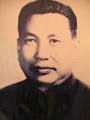
The good news: This type of psychopaths is very rare among contemporary politicians and only applies to monsters like Hitler, Stalin, Pol Pot and the like. See photographs…

The bad news: According to a 2008 survey on psychopathic personalities among American college students, the incidence is growing steadily (Journal of Personality, 76:4, August 2008). Nota bene: students, not politicians!

Are Voters Stupid and Greedy or Smart and Wise?


Voters...Partyforumseasia: Tonight, 5 May, we will know more about the mindsets and the intentions of Malaysia’s 13.3 million voters. Are goodie bags and promises enough to convince them and produce a clear majority? Are the leading politicians and strategists reading the ground correctly? Are the pollsters more and more wrong like in most European countries? Will the first-past-the-post election system generate an outcome which does not reflect the majority of intentions and voter sentiments?

How the voters are being seen by candidates and partisans will depend on the outcome. Opposition voters are stupid if you are on the ruling party’s side and vice versa.
Churchill‘s famous quote that the best argument against democracy is a five-minute discussion with an average voter sounds more than arrogant today. Having a choice after more than five decades without a real choice is already a victory for the Malaysian voter.

Malaysiakini is suggesting the following websites which will carry the live results tonight:
http://www.malaysiakini.com
https://www.malaysiakini.com
http://m.malaysiakini.com
http://www.mkini.co

https://www.facebook.com/MalaysiaKini
https://twitter.com/malaysiakini
https://twitter.com/Yahoo_MY

http://www.kinitv.com
http://www.youtube.com/kinitv
https://www.facebook.com/kinitv
http://www.youtube.com/malaysiakini

http://live.undi.info
https://ge13.s3.amazonaws.com
http://bit.ly/ge13result

Malaysia’s UMNO: Leadership, Warlords, Members, and what keeps them together


Malaysia votesPartyforumseasia: Intense reporting about the election on 5 May brings up a rare glimpse into the structure and internal workings of the ruling party. Here is some information about a membership of more than three million, 20.000 branches etc., but also about the power of grassroot leaders, often called warlords in UMNO. See the revealing article of assistant foreign editor Reme Ahmad in the Straits Times of 3 May 2013.
Here are some key assessments:

“These warlords are a kind of pseudo-godfather…(…) The chiefs get financial allocations from the party and government. (…) In return, they deliver votes for Umno and its Barisan Nasional coalition…These warlords have to be kept happy (…) as they can otherwise sabotage candidates who are parachuted in.
In this election, the wrath of the warlords was on full display when Prime Minister Najib Razak shoehorned his own “winnable” candidates into many constituencies…(…)
In Umno, each of the 191 divisions has hundreds of branches, with total party membership at 3.2 million people. Keeping the branches loyal includes dishing out small projects, and this is where allegations of corruption and the overpricing of projects arise. (…) During the general election and by-elections, disaffected warlords have at times sabotaged their own party (…). Other warlords are known to have told supporters to vote for the other side. To reduce internal mischief, troublesome local leaders are often “given goodies”…
But UMNO is also reforming itself. Obviously in order to reduce money politics and vote buying in the internal elections, 100,000 members instead of the former 2,500 division delegates will elect the party chief later this year. Reme Ahmad comments: “The thinking is that it would be impossible to buy the loyalty of so many people.”
Partyforumseasia:

Party loyalty, of course, hardly comes without any material incentives, be it just power or all sorts of other perks. But the Southeast Asian practice of pork barrel politics has reached quite spectacular levels.
Umno structure 2013

Malaysia’s GE13: Any Economic Risk if the Opposition Wins?


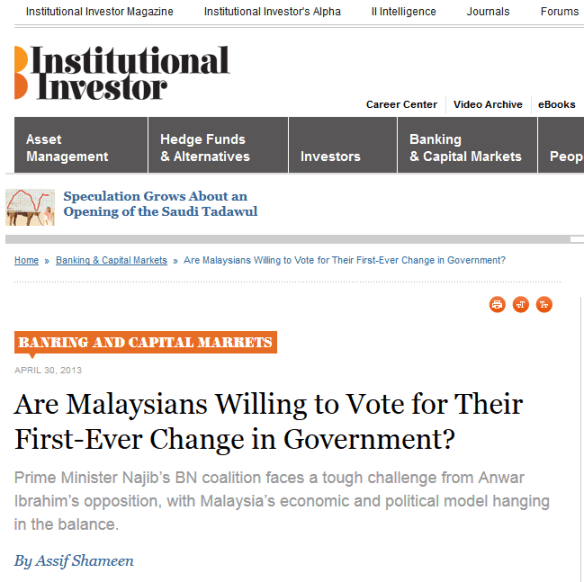
Partyforumseasia: A recommended background article from an economic and investor’s viewpoint. Not surprisingly, the BN campaign predicts economic decline and chaos if the opposition should win. That is a routine threat of incumbent governments world-wide if they feel that defeat is possible. The four opposition state governments since 2008 have not messed up the economy so far and the BN strategists know that the voters know that. But campaign strategists and party leaders always hope that threats can be as powerful as promises… And few Malaysians remember that nearly half of the federal budget comes from oil revenues and not from taxation.
Investor

Source / Link: Institutional Investor Magazine

Malaysia’s GE13: Cleaner Election With Indelible Ink?


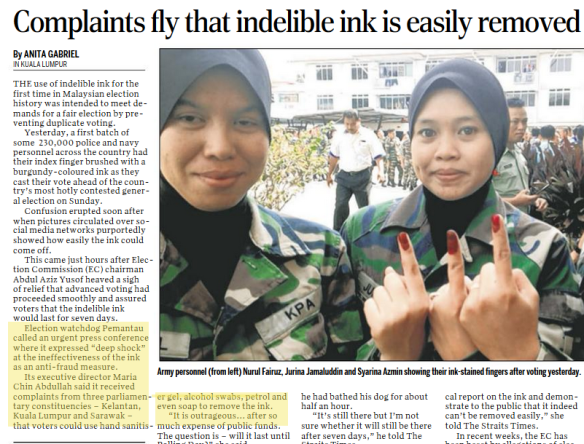
Partyforumseasia: After decades of extremely predictable election results with more than two-thirds majorities for the ruling Barisan Nasional (BN) coalition, 2008 has changed the game. In the 5 May election BN is fighting for survival and continuing access to the huge spoils of power, the opposition Pakatan Rakyat (PR) coalition feels that victory is possible. Election campaigns in Malaysia have always been intense and costly with visible party propaganda like flags and posters all over the country. But this time the population is more divided and politicized than ever before. To calm down widespread suspicions after a long history of election anomalies, the Election Commission (EC) is introducing indelible ink for the first time. And the very first test run when 230.000 Army and Navy personnel came for advance voting on 30 April, immediately produced doubts about the durability of the ink – seven days according to the EC.
GE13ink

Source / Link: Straits Times 1 May 2013

Malaysia’s GE13: Of Frogs and Princes


Partyforumseasia: The ugly frog turned out to be a handsome prince, at least in the fairy tale. In a country where party switching has a long tradition (see national cartoonist Lat’s 1992 cartoon), turncoat politicians are not unknown, even welcome by other parties if they seem to be winnable candidates. But this universal feature, often accompanied by cash handouts, seems to be less acceptable with the Malaysian voters this time. The turncoats are now called katak = frog…

Lat 1
Partyforumseasia: One of the frogs has been nominated by PM Najib to the surprise of many. This rather controversial politician was with PAS first, then with PKR, and is now running as religious and Malay supremacy wild card for BN against a moderate from PAS… This pairing could hardly be more ironical.

Zulkifli

Source / Link: Straits Times 24.4.13

Indonesian Parties Struggle for Electability


Partyforumseasia: Here’s a new contribution to our (young) collection of scholarly contributions to the topic of how political parties in Southeast Asia work. Ulla Fionna is a visiting fellow in Singapore’s Institute of Southeast Asian Studies, which has published this paper in its series ISEAS Perspective available at the homepage http://www.iseas.edu.sg

Link: Read the paper
Ulla Fionna